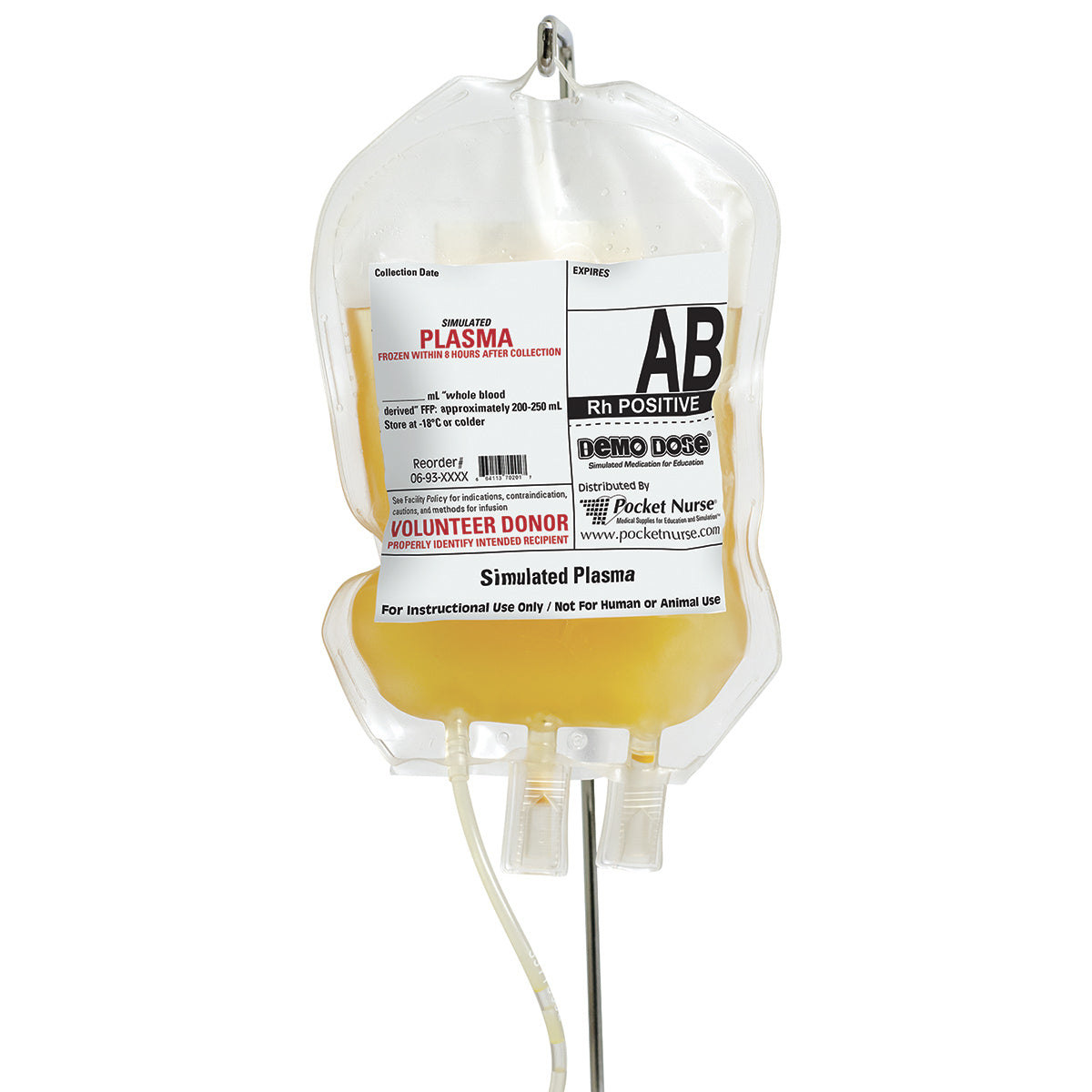
Fresh frozen plasma
35
MENTIONS
9
EPISODES
8
PODCASTS
Search complete. 35 mentions across 9 episodes found for "Fresh frozen plasma".
Nov 3, 2026

speaker_1HOST
Historically, that was the instinct.
speaker_1HOST
Practitioners would reach for fresh frozen plasma or FFP.
speaker_1HOST
But relying on FFP alone to reverse severe warfarin bleeding is a major clinical mistake.
speaker_0HOST
Wait, why? The factors are in there.
speaker_0HOST
Why doesn't it work?
speaker_1HOST
The issue is concentration and logistics.
speaker_1HOST
FFP does contain coagulation factors, but they are very, very dilute.
speaker_1HOST
Oh,

speaker_0HOST
These patients need two large-bore IVs and continuous monitoring.
speaker_0HOST
These patients often need blood transfusion, and we have a whole... series of episodes on blood transfusion and cryo and FFP and all that so check that out if you're interested but some of these patients need massive transfusion protocol as well so you need good vascular access you quite literally that's one of the smallest things you can do that can have the biggest impact and good vascular access is in the eye of the beholder a little bit most people would say at least to 18 gauge IVs.
speaker_0HOST
Some would say, let's try to get even bigger ones, 16 gauge.
speaker_0HOST
Other folks would say, you know, let's put in something like a cortis or a trauma line or a sheath.
speaker_0HOST
And often any type of kind of balanced blood product resuscitation is important.
speaker_0HOST
What that means is a much larger discussion.
speaker_0HOST
But if you're given a couple units of blood, you should be thinking about if the patient should get FFP and platelets as well, you know, some degree of balanced transfusion.
speaker_0HOST
And never forget the calcium.

speaker_0HOST
Let's tackle the blood first.
speaker_0HOST
The team orders transfusions of platelets to get his count up and fresh frozen plasma, or FFP, to provide immediate circulating clotting factors.
speaker_1HOST
Both crucial.
speaker_0HOST
But they also order intravenous vitamin K.
speaker_1HOST
By administering vitamin K intravenously, we bypass the blocked gut entirely and deliver the raw materials directly to the liver.
speaker_0HOST
Hoping that surviving hepatocytes can use it to build clotting factors.
speaker_0HOST
While the FFP provides a bridge of pre-made factors.
speaker_1HOST
Exactly.

Trauma BayHOST
This is the time from initiation of clotting at the point of separation of the resistance curves to a resistance level of 20 mm.
Trauma BayHOST
For prolonged kinetics, cryopercipitate and fibrinogen concentrate, and to a lesser degree FFP, can maintain or increase the circulating fibrinogen to increase the rate of polymerization.
Trauma BayHOST
And there is a trial that has compared fibrinogen concentrate versus cryopercipitate for this purpose.
Trauma BayHOST
Okay, next is MA or maximum amplitude for TEG and MCF or maximum clot firmness for Rotem.
7 MINS LATER
Trauma BayHOST
Transfusion of packed red blood cells, transfusion of fresh frozen plasma, transfusion of platelets, cryoprecipitate, fibrinogen, and prothrombin complex concentrates.
Trauma BayHOST
need for additional interventions for hemostasis, whether interventional, endoscopic, or surgical, time to bleeding control, and mortality.
Trauma BayHOST
Transfusion of red blood cells, FFP, platelets, cryofibrinogen, and PCC was reported as the number of units and volume of the transfused product and the number of patients being transfused.
Trauma BayHOST
To simplify the reporting of the results.

speaker_4HOST
Its factors two, seven, nine, and 10.
speaker_4HOST
An alternative is fresh frozen plasma, which contains all of the clotting factors.
speaker_4HOST
And these are usually combined with vitamin K.
speaker_4HOST
All right, so that's Warfarin.
Trauma BayHOST
Protein C, with the help of protein S, breaks down factors 5 and 7.
Trauma BayHOST
What factors are in plasma or FFP? All of them.
Trauma BayHOST
What factors are in cryo or cryoprecipitate? Remember, cryo is most often given for low fibrinogen, so it contains 1, or fibrinogen, von Willebrand factor, 8, and 13.
Trauma BayHOST
Antithrombin 3 is another natural anticoagulant produced by the liver that inactivates thrombin or factor 2 and factors 9, 10, 11, and 12.
8 MINS LATER
Trauma BayHOST
So the percentage of decrease in amplitude at 30 minutes after maximum amplitude.
Trauma BayHOST
So this is all fibrinolysis or clot breakdown.
Trauma BayHOST
In general, if you have a prolonged R time, you're going to transfuse FFP or plasma.
Trauma BayHOST
For a decreased alpha angle, you'd want to transfuse cryoprecipitate.

Rhea TemmermandHOST
Because heparin depends on antithrombin, a patient with low antithrombin levels are not going to respond to heparin, and we call this heparin resistance.
Rhea TemmermandHOST
So if you picture a cardiac surgery patient who's receiving that full heparin dose, but the ACT won't come up, one classic cause is antithrombin deficiency, and the treatment is usually to replace that antithrombin with antithrombin concentrate or FFP, which contains that antithrombin.
Rhea TemmermandHOST
For a typical heparin infusion, you monitor the aPTT, usually aiming for about one and a half to two and a half times normal or an anti-Xa level.
Rhea TemmermandHOST
For high doses like cardiac surgery, you're gonna use the ACT, 'cause the PTT is not going to be accurate for these high levels.
8 MINS LATER
Rhea TemmermandHOST
It works within minutes, and it's a small volume.
Rhea TemmermandHOST
Always give vitamin K along with it because the PCC is gonna wear off, and then the vitamin K is gonna provide that sustained reversal.
Rhea TemmermandHOST
Well, what about FFP? We've heard of this before, giving FFP.
Rhea TemmermandHOST
It does work, but it requires a really large volume, so it's gonna take time to thaw.

speaker_1HOST
You are lowering the interleukin-6, lowering the ammonia, and stripping out the excess von Willebrand factor that causes those microthrombi.
speaker_2HOST
And at the same time, if you use donor fresh frozen plasma or FFP as your replacement fluid, you are immediately replenishing the patient's depleted coagulation cascade.
speaker_1HOST
You're giving back all the good stuff.
speaker_1HOST
Factor two, factor seven, factor nine and ten.
5 MINS LATER
speaker_1HOST
Yeah,
speaker_2HOST
that's a recipe for disaster.
speaker_1HOST
So by using two thirds FFP, they are actively replacing the coagulation cascade.
speaker_1HOST
But they didn't use 100 percent FFP because massive FFP exposure brings its own severe toxicities, which I definitely want to talk about later.

ChapaHOST
Now, let me explain.
ChapaHOST
Well, if you're like, "What are we talking about here? Don't we do component therapy?" Yes, we do packed red blood cells and then platelets, and then we do, uh, FFP.
ChapaHOST
But the reason that during resuscitation or massive obstetrical hemorrhage we do a one-to-one-to-one ratio of those three is 'cause we're kind, trying to constitute what? Whole blood.
ChapaHOST
That was the original Parkland and UT Southwestern trauma and maternal resuscitation.
ChapaHOST
That leaves 15% of the population that's Rh-negative, and then you gotta get some donors.
ChapaHOST
There's the plug there for giving blood.
ChapaHOST
You've got to get some donors to actually donate their Rh-negative blood, so there's just not a lot, okay? The whole idea of component therapy, breaking up red blood cells, breaking up the platelets, and breaking up the FFP, is you try to get more bang for your buck per donor.
ChapaHOST
That, that, that's the main reason, okay? However, it is logistically easier to take donated whole blood and transfuse that into a patient, because what they are missing is all three components at one, plus you get the extra volume.