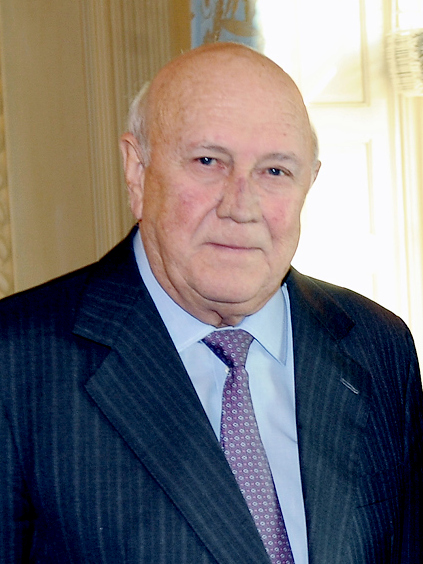
Frederik Willem de Klerk
Former State President of South AfricaWikipedia
45
MENTIONS
13
EPISODES
12
PODCASTS
Search complete. 45 mentions across 13 episodes found for "Frederik Willem de Klerk".
Oct 1, 2026

Tucker CarlsonHOST
So fast-forward from 1994 to May of last year and the White House.
Tucker CarlsonHOST
This was a part of the Trump term where the president was still trying to make good on his campaign promises before giving up entirely in favor of prosecuting an Iran war.
Tucker CarlsonHOST
But at the time, last May of 2025, President Trump was doing something he suggested he would do on the campaign trail, and that's say something publicly about anti-white racism, which is widespread, in some cases codified, including in the United States, and in a lot of ways, the only institutional racism that's still allowed in the Western world.
Tucker CarlsonHOST
And Trump had suggested as he was running for president that he would be the one person brave enough to say something about that on the grounds that all racism is wrong, not because it's bad to hurt one group, but because it's bad to hurt any group.
Tucker CarlsonHOST
It's a universal principle.
Tucker CarlsonHOST
It applies to everybody.
Julius MalemaSOUNDBITE_SPEAKER
There's nothing this parliament can do.
Julius MalemaSOUNDBITE_SPEAKER
With or without you, people are going to occupy land.

Des BernardoGUEST
And our job was to be dressed up in our fancy tunics, and, um, which is the best military garb, and stand at the tables of people present at a dinner after Margaret Thatcher was handed the Order of the Cape of Good Hope.
Des BernardoGUEST
So she was handed that award, uh, by F.W. de Klerk.
Des BernardoGUEST
Uh, this was just after basically P.W. Botha was incapacitated.
Des BernardoGUEST
And F.W. de Klerk shocked me because when I saw him the first time at that dinner, which was afterwards, so they have this huge room, uh, full with massive round tables with people sitting at the tables, and I was assigned to the head table.
Des BernardoGUEST
So I was at the table where F.W. de Klerk sat and where Margaret Thatcher sat.
Des BernardoGUEST
And there I saw the power dynamics in the country.
Des BernardoGUEST
So no one must come and tell me that when I was a 19-year-old boy, that my eyes deceived me.
Des BernardoGUEST
She had this large hairdo.

Michael WhelanHOST
Gerhardt claims it was the weather changing that got it caught by the Vela satellites.
Michael WhelanHOST
A year before Dieter Gerhardt spoke, on March 24th, 1993, South Africa's president, F.W. de Klerk, told Parliament that the country had built six nuclear weapons with a seventh under construction and had dismantled all of them.
Michael WhelanHOST
South Africa remains the only country known to have built its own nuclear weapons and then voluntarily dismantled all of them.
Michael WhelanHOST
De Klerk said nothing about the Vela incident and nothing about Israel.
Michael WhelanHOST
According to a technical retrospective of the South African program by Robert Kelley, a former IAEA inspector, inspections by the International Atomic Energy Agency concluded that South Africa could not have built a bomb until November of 1979, two months after the flash, because it did not yet have enough highly enriched uranium.
Michael WhelanHOST
The IAEA also reported that all of South Africa's possible bombs were accounted for.

speaker_6GUEST
They spoke to the managers futhu na yoo Ferwuth.
speaker_6GUEST
And uh do you know that ooh uh FW de Klerk, o babake was the minister of mines.
speaker_6GUEST
FW de Klerk.
speaker_6GUEST
Eh
Don DadaHOST
O babaka FW de Klerk?
speaker_6GUEST
Nje.
speaker_6GUEST
He was there.
speaker_6GUEST
Ooh d- FW de Klerk was there on a Sunday after the mine collapsed

Aubrey MasangoHOST
doesn't surprise me.
Bronwyn SaaymanGUEST
And FW De Klerk are all out of Katoa.
Bronwyn SaaymanGUEST
Yeah.
Aubrey MasangoHOST
I wasn't aware of the FW De Klerk connection, but I know that... that Paul Kruger is believed to have had some indigenous connection to it.
Aubrey MasangoHOST
So did a guy by the name of Trianift, by the way.
Aubrey MasangoHOST
He was the leader of the conservative party at some point.

Alec HoggGUEST
South Africa was changing.
Alec HoggGUEST
FW De Klerk had come in.
Alec HoggGUEST
He, he, promised us that we were moving back into the world i think the cricketers were starting to play in the in the first world cup where john t did that incredible dive people forgotten about but that pulled the the nation together and it was a eye-opener when i worked there because i realized the power of broadcasting the absolute power that uh the the the visual media has over people who write.
Alec HoggGUEST
And it's something that stayed with me.

Ernst RoetsGUEST
Of course, he was in prison for treason and a bunch of stuff, but he would be released, and the ANC, the legislation that declared communist-aligned organizations as illegal organizations would be repealed, and so they could come back, and we're gonna start negotiating for a new democratic South Africa.
Ernst RoetsGUEST
And President de Klerk, who made that decision, said at the time that his decision was largely shaped by the fact that the Cold War was over and that communism had lost and that capitalism had won or liberalism had won.
Ernst RoetsGUEST
And, you know, sort of the end of history thing.
Ernst RoetsGUEST
But what's remarkable, something that is not as well known, is between the fall of the wall, the Berlin Wall in November 1989, and the announcement that we're going to start negotiating for a new South Africa on the 2nd of February 1990, within those basically two months, two and a half months, the Secretary General of the Communist Party in South Africa published a paper.
9 MINS LATER
Ernst RoetsGUEST
And this banker, Mr.
Ernst RoetsGUEST
Butcher, I believe from New York City, had a very big impact economically.
Ernst RoetsGUEST
I think those in power at the time knew President de Klerk and his cabinet.
Ernst RoetsGUEST
They were very concerned about the sort of economic prospects.

Witney SchneidmanGUEST
It's about people coming together.
Witney SchneidmanGUEST
You know, F.W. de Klerk was the head of the National Party at the time.
Witney SchneidmanGUEST
And, you know, it took him to have this vision that we need to change.
Witney SchneidmanGUEST
What we have here is not sustainable.
Witney SchneidmanGUEST
People just stay d-focused on one singular outcome or their ego or feeling that just their way is the right way.
Witney SchneidmanGUEST
And so you don't get to a peaceful resolution like the South Africans were to, able to achieve.
Jamey BowersHOST
You know, it's interesting that you mention F.W. de Klerk because he is often left out of that story.
Jamey BowersHOST
But he, he had to make a change of heart in order to have that peaceful transition.
Macfarlane MoleliHOST
If those people can be removed there, and then, uh, there's no trouble.
speaker_7SOUNDBITE_SPEAKER
Following President de Klerk's pledge that those guilty of what he called mindless killings would be brought to justice, police reinforcements arrived at the hostel.
speaker_7SOUNDBITE_SPEAKER
The orders were to prevent the Zulus from leaving, to interrogate, and if necessary, to arrest suspects.
speaker_7SOUNDBITE_SPEAKER
[crowd chanting] Inside, the Zulus chanted and resisted defiantly.
speaker_7SOUNDBITE_SPEAKER
Lawyers were called in to mediate.
speaker_7SOUNDBITE_SPEAKER
This operation is taking place two days after the massacre in the township.
speaker_7SOUNDBITE_SPEAKER
The assumption here is that President de Klerk thought yesterday's police response, the confiscation of a handful of traditional weapons, too weak.
speaker_7SOUNDBITE_SPEAKER
[crowd chanting]

James MyburghPANELIST
And Besson is going in and out of Libya all the time, ostensibly for the purpose of these commercial business transactions.
James MyburghPANELIST
So South Africa, de Klerk, just shortly before he hands over, you know, loses the April elections, gets demarched by the British and Americans because he's not keeping – they're worried that there's going to be leakage from the South African side into Europe.
James MyburghPANELIST
to the Libyans.
James MyburghPANELIST
And then that Dimash is repeated again in early 1995 to the government of national unity, but obviously the Mandela-dominated government of national unity.
3 more episodes mention Frederik Willem de Klerk.
Create an account to see the whole feed, search across every transcript, and follow the entities you care about.