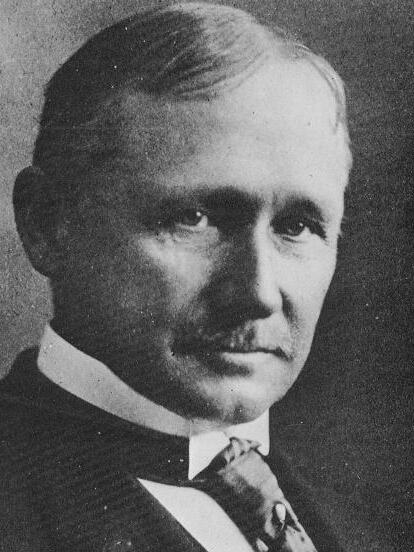
Frederick Winslow Taylor
American mechanical engineerWikipedia
43
MENTIONS
29
EPISODES
29
PODCASTS
Search complete. 43 mentions across 29 episodes found for "Frederick Winslow Taylor".
Sep 12, 2026

speaker_5GUEST
You have to rely on foundational management theories.
speaker_4HOST
And the textbook leans heavily on two pioneers here, F.W. Taylor and Henry Fayol.
speaker_4HOST
And they approach management from like completely opposite ends of the telescope.
speaker_5GUEST
Oh, completely.
speaker_5GUEST
Taylor is all about scientific management.
speaker_5GUEST
His philosophy was born in the dirt and the noise of the factory floor.
speaker_4HOST
From the bottom up.
speaker_5GUEST
He wanted to replace rule of thumb guesswork with rigorous science.

Anil MahabirGUEST
It was written by Sarah O'Connor.
Anil MahabirGUEST
And it's an article where she described that somewhere in the early 20th century, there was a guy called Frederick Taylor.
Anil MahabirGUEST
I don't know if that rings a bell, but Frederick Taylor.
Anil MahabirGUEST
He was tasked by extracting knowledge from inside the heads of workers on American factory floors.
Anil MahabirGUEST
And what he did at the time is that he put a team together and he gave them stopwatches and notebooks.

Autumn KraussGUEST
I think one of the things that we have gone back to, like fundamentals, is what work serves for humans.
Autumn KraussGUEST
And I think if we go back to like Adam Smith and Frederick Taylor and the Wayback Machine, 20s of 1920s, we know that it was much more a transactional exchange for remuneration.
Autumn KraussGUEST
It was like this very much like I give my effort, you give me compensation, I'm on my way.
Autumn KraussGUEST
But over the course of at least only the past hundred years, we've expanded what it means to work.

MarshallHOST
Hi, welcome to Notions of Progress, the show that traces ideas of progress from antiquity to the age of AI.
MarshallHOST
In part two, Professor Gavin Mueller traced a through line from Marx's own ambivalence about machinery through the split between orthodox and heterodox strands of Marxism, to Frederick Taylor's theory of workplace control, the technocracy movement's apocalyptic vision of automation, And Norbert Wiener's attempt as one of cybernetics founding figures to warn what automation would mean for their power.
MarshallHOST
In this final part, Professor Mueller brings that history into the present.
MarshallHOST
The conversation then moves from Shoshana Zuboff's early research of computerized factory floors to her later work on surveillance capitalism, and from there into Professor Mueller's own reading of artificial intelligence, training data, cognitive offloading, and what he sees as Luddism's real legacy.

Eric RiesGUEST
Right.
Eric RiesGUEST
So for those who know Frederick Winslow Taylor, he's a little more famous.
Eric RiesGUEST
Yeah, you've heard of him.
Eric RiesGUEST
She was a contemporary of Taylor.

Jan GriffithsHOST
It's going to take leadership.
Jan GriffithsHOST
It's going to take acknowledgement of the fact that we have to lead with conviction and trust people and not lead to compliance to a legacy system that was created in 1911 by Frederick Taylor.
Jan GriffithsHOST
We cannot any longer work with the silo system and stay with that process.
Jan GriffithsHOST
We just can't do it.

speaker_3HOST
Yeah.
speaker_3HOST
Frederick Taylor's theories of scientific management in the early 20th century.
speaker_3HOST
They were all about maximizing industrial efficiency by treating workers as cogs in a machine, you know, removing their autonomy.
speaker_3HOST
Oh, wow.

Emily M. BenderHOST
So then he's basically, you know, talking about this as the history of the world, but tracing through Prussia and then American railroads.
Emily M. BenderHOST
And then we get to Frederick Taylor.
Emily M. BenderHOST
Would you like to do this one?
Alex HannaHOST
Yeah, Frederick Taylor, everybody's favorite quantitative scientist.
Alex HannaHOST
So he says, Frederick Taylor, or they say Frederick Taylor, often called the father of scientific management, optimized what happened within that hierarchy.
Alex HannaHOST
Taylor broke work into specialized tasks, assigned them to trained experts and managed through measurement rather than intuition.
Alex HannaHOST
Okay.
19 more episodes mention Frederick Winslow Taylor.
Create an account to see the whole feed, search across every transcript, and follow the entities you care about.