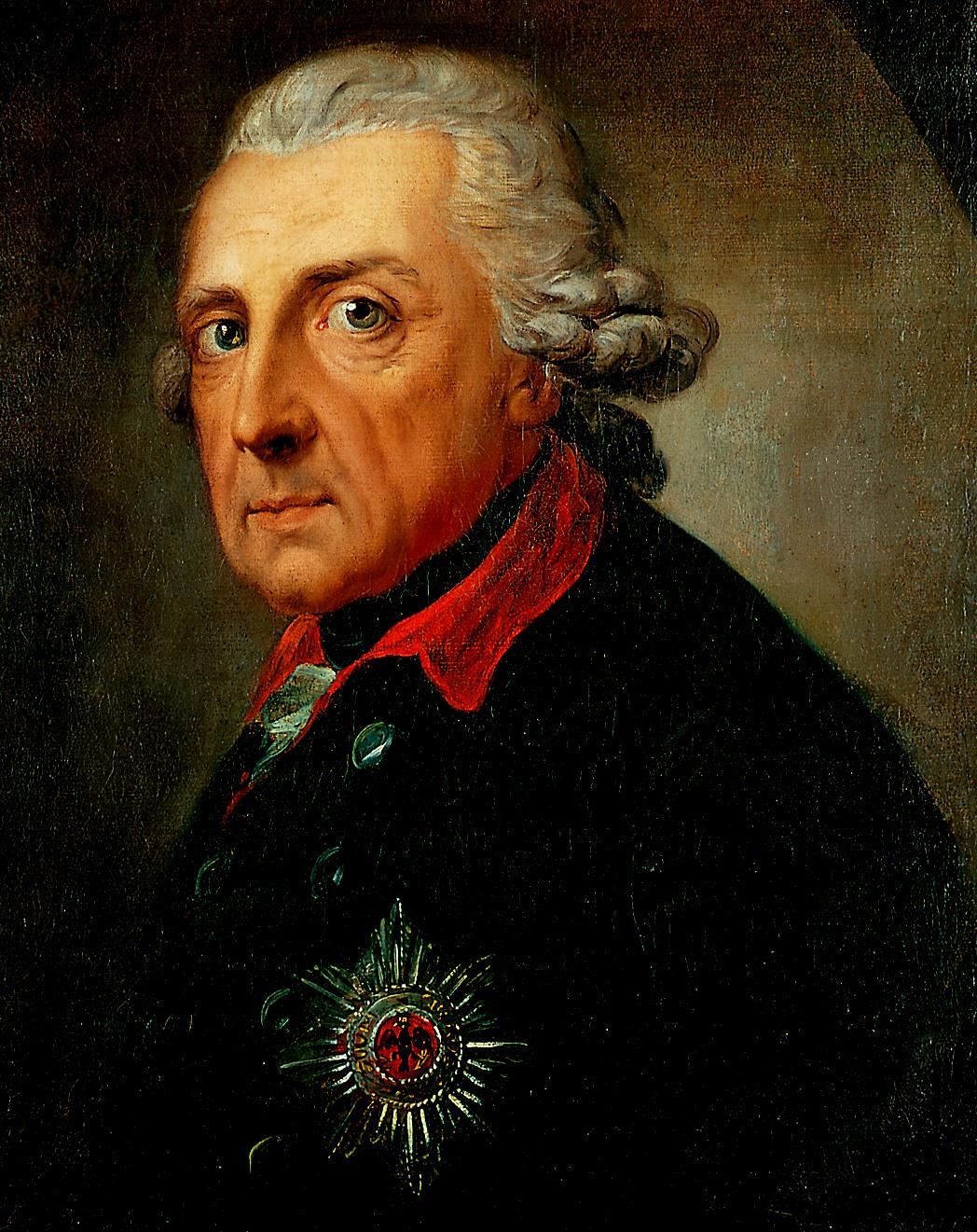
Frederick the Great
Former King of PrussiaWikipedia
455
MENTIONS
130
EPISODES
104
PODCASTS
Search complete. 455 mentions across 130 episodes found for "Frederick the Great".
Oct 31, 2026

David WalesNARRATOR
It was for this event that he wrote a grandiose Ratswahlkantata, whose music exhibits the influence of Buxtehude, heightened by his own incomparable genius.
David WalesNARRATOR
in a burst of generosity the city fathers voted to publish the work it was the only one of bach's cantatas printed in his lifetime otherwise there is no record that aside from the cantata god is my king a single such work of his was given in the mulhausen churches though from the creative standpoint he can scarcely have been idle despite the high esteem bach enjoyed in mühlhausen he remained there only a year the municipal heads and the authorities of the church of st blasius regretted his going but were unable to prevent it he conceded frankly that he wanted to improve his material position yet a deeper reason lay at the back of his departure it was at the bottom the by-product of a religious question for some time a reaction had been developing against certain dogmatic formularies in the lutheran body the dissidents known as pietists gradually came to swords points with the orthodox sect and mullhausen especially became a hotbed of pietism whose adherents strongly opposed the use of music in public worship this of course flew violently in the face of bach's ideal which was the betterment of music in the church and its heightened employment to sacred ends it became solely a question of time when such a situation would render his position at st blasius untenable the consistory was so well disposed to bach that it promptly agreed to a variety of modifications in the organ which he had recommended before these were carried out he had given notice of his departure and his employers realized they could do nothing about it he promised however to come over to mulhausen from near by weimar in order to see how the alterations were being executed weimar weimar to which he now removed became bach's home for the next ten years and here were created some of his mightiest works particularly those for organ the town was even at that period a cultural centre its duke wilhelm ernst of sachsenweimar a pious serious-minded ruler engaged bach not only as organist but also as kammermusikus i e as a member of his household orchestra a close friendship also developed between bach and the young but short-lived johann ernst son of bach's earlier weimar patron exceedingly musical the youth was a talented violinist took lessons from the kammermusikers and composed several works of conspicuous merit three of which bach later transcribed for clavier and which for a long time passed for violin concertos by vivaldi the acquaintances and close friendships bach formed at the weimar court were numerous and valuable with musicians writers and educators prominent among them the ducal capelle varied in size and constitution according to circumstances sometimes when opera was performed it included singers the instrumentalists proper seem to have numbered eleven the conductor was one johann samuel dres the concert master from seventeen fourteen on one of the concertmaster's duties was to provide cantatas for a variety of occasions and beginning in seventeen fourteen he wrote a number of them his choir consisted of twelve singers wilhelm ernst had from the first been impressed by bach's powers as an organist the musician's diverse labors were gratifyingly recompensed and in nine years he had doubled his income at its smallest it was twice as large as any at mühlhausen it is claimed that never in his life did bach have at his disposal an organ truly worthy of his powers and even at weimar the instrument was inferior to that at mühlhausen nevertheless the organ works he composed at weimar exceeded anything he had ever done before in sumptuousness of inspiration imaginative grandeur and technical exaction one hears comparatively little of maria barbara bach's wife appears however to have been a fitting helpmeet to her busy husband handling his household and his numerous pupils with tact and discretion and bearing him children with regularity some of these died early others lived till a ripe age in seventeen ten was born his oldest son wilhelm friedemann a genius in his own right and ever his father's favorite but all his life wayward and something of a black sheep at this stage one might as well mention two other musically outstanding sons of bach among the twenty children he was to beget the more prominent of these was karl philip emanuel who served frederick the great and whose reputation as a pianist and composer was such that whenever at the latter part of the eighteenth century it was a question of bach people usually meant philip emanuel another johann christian bach's son by a second wife lived and died in london composed operas and became an intimate of the youthful mozart During the years of his Weimar residence, Bach made three journeys which are conspicuous among the brief ones that punctuated his life.
David WalesNARRATOR
One was to Kassel toward the end of 1714, presumably to examine a new organ.
David WalesNARRATOR
Possibly, too, he accompanied his ducal master on a ceremonial visit.
27 MINS LATER
David WalesNARRATOR
things went from bad to worse bach accused the rector of usurping his functions he wrote long circumstantial letters setting forth his case to their magnificences the burgomaster the civic council and other outstanding authorities their magnificences replied with legalistic hair-splittings and things grew so violent that bach in one case undertook to drive krauss from the choir law the lengthy series of undignified squabbles was finally brought to an end by augustus the strong king of poland saxony etc etc etc to use bach's own designation we are not certain that the composer obtained the satisfaction he demanded but every one seems to have tired of the interminable quarrel and was relieved to see it peter out meanwhile bach had other worries and vexations one of his sons gottfried bernhard proved as unstable as did wilhelm friedemann in a later day but died before his financial misdeeds had ended in his open disgrace then the composer was made the target of attacks by a certain minor musician one scheib who criticized his works for what he called their complexity and over elaboration bach immortalized the fellow by satirizing him in the secular cantata phoebus and pan where scheib appears as the ignoramus midas adorned with a pair of asses ears in seventeen thirty six augustus the strong conferred upon bach the title of court composer the patent of bach's dignity was committed to the russian envoy in dresden karl freiherr von kaiserling he was a sufferer from chronic insomnia and it is to this circumstance that we owe one of bach's supreme works for the clavier the so-called goldberg variations to ease the torment of sleepless nights the count had in his service a gifted clavecinist johann gottlieb goldberg a pupil of bach's while bach was in the midst of his troubles with ernesti kaiserling commissioned him to write goldberg something soothing to divert his wakefulness bach took a sarabande melody he had copied into his wife's notebook and used it as the basis of thirty variations so delighted was kaiserling that he never wearied of listening to goldberg play them and actually referred to them as my variations The Count, paradoxically enough, now had every reason to remain awake and enjoy the never-ending ingenuity and luxuriant fancy of these variations and the lively quodlibet toward the close, which recalls those boisterous melodies the Bach family of old used to improvise at its reunions.
David WalesNARRATOR
It is pleasant to record that Kaiserling paid Bach liberally for his variations.
David WalesNARRATOR
st matthew passion and b minor mass on good friday seventeen twenty nine came the turn of st thomas's church to produce the music appropriate to the day the result of this official duty was the passion according to st matthew for which christian friedrich henry who wrote under the name of picander and provided bach with innumerable librettos for all purposes compiled the text the composer himself chose and distributed the chorales which punctuate the score bach was still at work on it when his former patron prince leopold of goten died rather than prepare a special memorial piece he asked picander to adapt appropriate words to parts of the music in the st matthew and he performed them at curtain at his friend's obsequies it is hard for us to believe that the st matthew passion did not receive on that far-off april fifteenth seventeen twenty nine the tribute of wondering amazement which in the fulness of our hearts we bring it to-day yet we are told that the leipsic worshippers considered its overwhelming dramatic pages theatrical god help us exclaimed a scandalized old dame tis surely an opera comedy we know that judged by our standards the first performance of the work must have been inefficient whether it was much better done at its repetition in seventeen thirty six may be doubted be this as it may the st matthew passion passed into oblivion for nearly a hundred years the glory of its rediscovery and its reawakening an exact century after its birth belongs to felix mendelssohn who with its resuscitation at the singh academy in berlin performed a service that would have shed immortal lustre upon his name had he never done anything else the st matthew passion which is bach at his most tender intimate lacerating and compassionate stands like the b minor mass beethoven's ninth symphony and wagner's tristan as one of the epical feats of music a lonely and incomparable achievement of the human spirit bach is believed to have written a passion according to st mark but not a trace of it survives another according to st luke is extant but most certainly spurious it is hard to believe he could ever have surpassed the lyric glory of the st matthew for generations after its re-emergence musicians paid it everything from lip service to ecstatic tribute a complete full-length performance of it was however a rarity and not even mendelssohn had the courage to attempt it in our own time we have finally come to the ways of wisdom recognizing that the st matthew passion can produce its proper effect only when heard in its entirety with never a bar or a phrase omitted those who have heard it thus are unlikely ever again to listen willingly to a cut version if anything can be said to rival the grandeur of the st matthew passion it is the mass in b minor the triumphal hymn of the church militant this utterance of subduing and inscrutable majesty which transcends the world to bestride the universe was completed in seventeen thirty three and offered to augustus the strong as an insignificant example of my skill in musique augustus the strong being occupied at the moment with problems of state did not deign to notice bach's insignificant gesture the composer never heard a performance of this gigantic creation which soars to heights beyond human gaze and in its proportions and technical details is too vast to serve ordinary liturgical purposes yet here as so often elsewhere bach followed the example of his age and employed several numbers from this mass with greater or lesser alteration elsewhere even the triumphant osanna which expert criticism has pronounced a polonaise apparently a subtle compliment paid to augustus as king of poland and the ineffably touching agnus dei may be encountered again in several of bach's cantatas visit to frederick the great and later works Early in 1741, Bach's son Philipp Emanuel had become clavecinist to the new sovereign of Prussia, Frederick the Great.
David WalesNARRATOR
Moved, it appears, by a paternal wish to see the young man comfortably settled, the father made a trip to Berlin in the summer of that year.

Steve FullerGUEST
They were anti-university people, and they were always talking about coming up with alternative institutions, right? right? They were always talking about it, right? And in fact, you know, there was a lot of talk.
Steve FullerGUEST
I mean, you may know that people like Voltaire and Rousseau, right, and Diderot, they traveled all over Europe trying to convince various kind of ascendant princes, you know, these ambitious guys like Frederick the Great and Peter the Great and people like that, right, that they should establish these new institutions, right, of knowledge and learning and break away from the old universities, right? Right.
Steve FullerGUEST
That was kind of their thing.
Steve FullerGUEST
And Napoleon, when he when he came to power after the French Revolution.

Emily MantheiGUEST
I'm ready.
Emily MantheiGUEST
Well, I think speaking of 18th century history, the king of Prussia had a palace in Berlin, Friedrich the Great, and his hunting grounds were just outside of the palace.
Emily MantheiGUEST
And that's today called Tiergarten, which is...
Emily MantheiGUEST
the central park of Berlin.
7 MINS LATER
Emily MantheiGUEST
think it's it's because there's such a rich music culture in history particularly 18th century music there are the four majors of the opera there's Mozart, Beethoven, Haydn, and Schubert.
Emily MantheiGUEST
And their music was so important in this, the German cultural Renaissance of the 1800 or the 18th century, that I think that is the inspiration for opera all over Germany.
Emily MantheiGUEST
Well, particularly in the first opera house, the Staatsoper was built in the early 1700s when Friedrich the Great was the King of Prussia.
Emily MantheiGUEST
And so it was built like right by the Prussian palace.

JohannaHOST
Hoping to calm her, I turned the car radio to the classical station, which was playing a lovely late Baroque era flute concerto.
JohannaHOST
As we drove, the peace ended and the announcer came on the radio saying, That was music by King Frederick the Great of Prussia.
JohannaHOST
He was a fine flute player and a keen music lover.
JohannaHOST
But he wasn't just a music lover, he also loved animals and he is buried next to his eleven greyhounds who died before him.

Paul DarlingGUEST
And just instilling that.
Paul DarlingGUEST
And so there's an inherent understanding, Napoleon, Frederick the Great.
Paul DarlingGUEST
And then as technology changed, you have the American Civil War, and then the Boer War, the Franco-Prussian War, and then, of course, World War I.
Paul DarlingGUEST
Where while you want to be aggressive to close with the enemy, you have to respect the inherent...

DaveHOST
Um, he said in their periods of success, good fortune and power, the Germans have always been ruled by men who held them as a people in profound contempt.
DaveHOST
That's the norm, isn't it? Um, Well, Frederick the Great called them a nation of slaves.
DaveHOST
Bismarck said he could not stand Germans unless he had drunk at least one bottle of champagne.
Justin PodurHOST
these are their leaders it's true wow

speaker_0NARRATOR
He regarded the criticism as confirmation that he was doing something no one else could.
speaker_0NARRATOR
In May 1747, Bach made one of the most famous journeys of his life, to the court of Frederick the Great in Potsdam, where his son Carl Philip Emanuel was employed as a court musician.
speaker_0NARRATOR
Frederick, who was himself an accomplished flautist, had been waiting for this visit with evident anticipation.
speaker_0NARRATOR
When Bach arrived, the king handed him a long, deliberately chromatic and awkward theme on his new fort piano, and demanded that Bach improvise a fugue on it immediately.

John SmallHOST
Fun fact for you, Heidi.
John SmallHOST
What's that, John? Prussia's Frederick the Great liked his coffee made with champagne and mustard.
John SmallHOST
What? Ew.
John SmallHOST
How would you even discover that's good?

Pete QuiñonesHOST
A cursory glance would make it appear that in no direction could the Jews, the stateless people, have had less influence than in the establishment of modern states.
Pete QuiñonesHOST
Not one of the statesmen of whom we think is in this connection was a Jew, neither Charles V nor Louis XI nor Richelieu, Mazarin, Colbert, Cromwell, Frederick William of Prussia nor Frederick the Great.
Pete QuiñonesHOST
However, when speaking of these modern statesmen and rulers, we can hardly do so without perforce thinking of the Jews.
Pete QuiñonesHOST
It would be like Faust without Mephistopheles.

Pete QuiñonesHOST
A cursory glance would make it appear that in no direction could the Jews, the stateless people, have had less influence than in the establishment of modern states.
Pete QuiñonesHOST
Not one of the statesmen of whom we think is in this connection was a Jew, neither Charles V nor Louis XI nor Richelieu, Mazarin, Colbert, Cromwell, Frederick William of Prussia nor Frederick the Great.
Pete QuiñonesHOST
However, when speaking of these modern statesmen and rulers, we can hardly do so without perforce thinking of the Jews.
Pete QuiñonesHOST
It would be like Faust without Mephistopheles.
120 more episodes mention Frederick the Great.
Create an account to see the whole feed, search across every transcript, and follow the entities you care about.