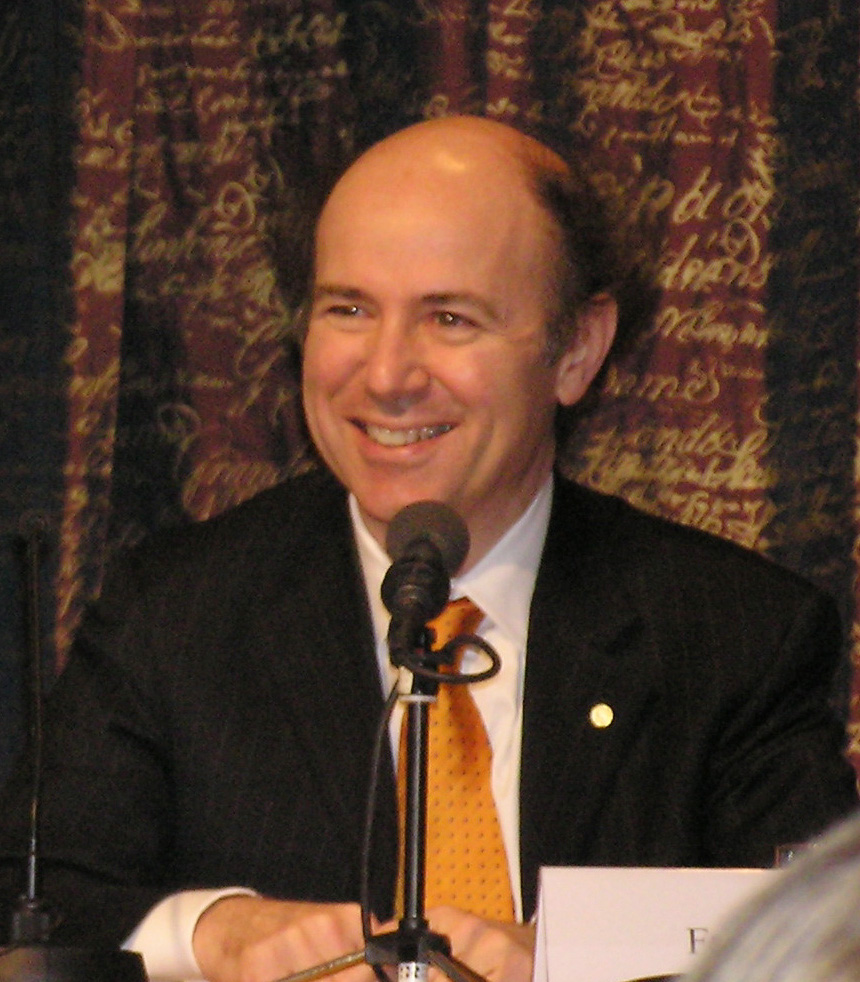
Frank Wilczek
American theoretical physicistWikipedia
7
MENTIONS
7
EPISODES
5
PODCASTS
Search complete. 7 mentions across 7 episodes found for "Frank Wilczek".
Nov 1, 2026

Brian KeatingGUEST
So time is really the differentiator.
Brian KeatingGUEST
So some people, I've talked to Nobel Prize winner Bill Phillips and Frank Wilczek, who both of them won the Nobel Prize.
Brian KeatingGUEST
They say, oh, time is just what a clock measures.
Brian KeatingGUEST
Well, it's a clock.
Brian KeatingHOST
Yeah, and I think that's the kind of language, the paucity of the economics of language that we have.
Brian KeatingHOST
When I asked Frank Wilczek many years ago on the podcast, what's time? He said, time is what a clock measures.
Brian KeatingHOST
Oh, thank you, Frank.
Brian KeatingHOST
That's really helpful.

Dave FarinaHOST
This is similar to the Higgs spontaneous symmetry breaking we talked about.
Dave FarinaHOST
In 1978, Frank Wilczek and Steven Weinberg both independently came up with the idea of a particle called the axion that would emerge as the goldstone boson of this symmetry breaking.
Dave FarinaHOST
It was named the axion after the soap since it cleaned up the strong CP problem.
Dave FarinaHOST
Then, physicists realized that these light axion particles could be an explanation for dark matter as well.

Arvin AshHOST
Who designed the designer's universe? How did the designer arise? It kicks the can down the road without really answering the question.
Arvin AshHOST
Frank Wilczek, a Nobel-winning physicist, put it this way, The beauty of physical laws is too impressive.
Arvin AshHOST
It has led people to believe that a tasteful, higher being created us.
Arvin AshHOST
But this hypothesis goes far beyond the evidence.

Don HoffmanGUEST
And this has been well understood and known for a long time.
Don HoffmanGUEST
Frank Wilczek, a very famous physicist, won the Nobel Prize, is saying, you know, In physics, we need a theory of the observer.
Don HoffmanGUEST
He's looking for it himself in quantum theory, but more generally, we just need a theory of the observer.
Don HoffmanGUEST
And this is not the first.

Brian KeatingGUEST
So time is really the differentiator.
Brian KeatingGUEST
So some people, I've talked to Nobel Prize winner Bill Phillips, who, um, and Frank Wilczek, who, both, both of them won the Nobel Prize.
Brian KeatingGUEST
They say, "Oh, a time is just what a clock measures." Well, it's a clock.
Brian KeatingGUEST
Clock is something you measure time, so it's teleological, which means that we don't really have a great definition.
Brian KeatingHOST
No, I, I, I think that rings true.
Brian KeatingHOST
And actually, we have had on past guest, uh, Frank Wilczek, uh, many times, and he, he cites that the discovery of jets at least, not, not by, you know, IceCube or anything personally, but he cites that as, as the kind of signature achievement of, of his career and of work that, that, uh-
Francis HalzenGUEST
Yeah, yeah
Brian KeatingHOST
... particle physics as a community has led to.