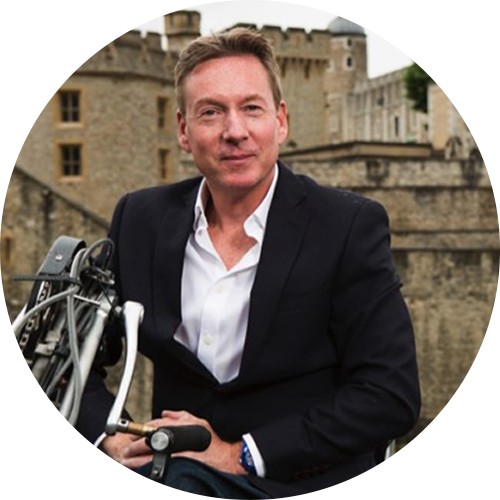
Frank Gardner
British journalist and author
18
APPEARANCES
8
PODCASTS
Sep 11, 2026


Frank GardnerGUEST
Subsequently, catastrophic mistakes were made in the occupation, really stupid, avoidable mistakes like disbanding the Iraqi Army.
Frank GardnerGUEST
Most people in the Iraqi Army would've been happy to serve under a puppet president appointed by the United States.
Frank GardnerGUEST
But no, they went and took away their uniforms, took away their pride, and so immediately forming the core of an insurgency straight away.
Frank GardnerGUEST
In the immediate aftermath of the March 2003 US-led invasion of Iraq, Osama bin Laden issued a kind of call to arms, a dawah, an invitation to Muslims all over the world to come and join what he called the righteous jihad to reverse that invasion.
Frank GardnerGUEST
And he said, "It doesn't matter if you support," as he called it, "the usurper, the apostate in Baghdad," referring to Iraq's president, Saddam Hussein.
Frank GardnerGUEST
"It's not about that." He said, "You've got a religious duty to come to Iraq." And they did.
7 MINS LATER

Asma KhalidHOST
What do you see as the consequences of the United States' almost laser focus on the Middle East over the past twenty-five years?


Ingrid HipkissHOST
So what can you tell us about retaliation then and how much further or quickly this could all escalate again?
Frank GardnerGUEST
So what happened is the reason the U.S. has given for this uptick in fighting and kinetic action is that they believe that Iran was preparing to launch some missiles.
Frank GardnerGUEST
Iran has been trying to steer all maritime traffic towards its own coast and basically force all shipping to abide by its rules.
Frank GardnerGUEST
Namely, you've got to come and be checked over, passed by our own security people, and possibly pay a fine.
Frank GardnerGUEST
And the US is trying to stop that and is trying to escort ships the southern route along close to the Omani coast.
Frank GardnerGUEST
... they're gonna go for our infrastructure, our desalination plants, our, our critical national infrastructure, our electricity plants, and we d-- we don't think we've got enough missiles to be able to shoot all of those down.
Frank GardnerGUEST
So we'd really rather you didn't do this, this big attack." So where does that leave all of this? Um, as I say, I think the, the only viable show in town right now are the Iran-Oman talks, um, about coming up with some kind of a viable waterway route.
Frank GardnerGUEST
I mean, look, there was nothing wrong with the existing route, the so-called tr-- um, transit separation, traffic separation scheme, the TSS.
Frank GardnerGUEST
Incoming traffic goes one way, you have a two-mile separation to make sure tankers don't smash into each other, and outgoing goes the other way.


Frank GardnerGUEST
Um, I eventually got a two-week unpaid work experience at BBC World, which is the sort of, um, international channel of the BBC, uh, of TV.
Frank GardnerGUEST
And they said, "Look, do understand, you're welcome to come and look around, see what we do, but please understand there is not a job at the end of this for you.
Frank GardnerGUEST
So, you know, make the most of your time here and then clear off, basically." Um, and so I, I knew I had just two weeks to make connections and to try to make an impression.
Frank GardnerGUEST
And it w- it was, it was, it was good because I had already done quite a lot of time in the Middle East and spoke Arabic, so that was, I had something to offer.
7 MINS LATER


Andy CoulsonHOST
A comfort, and that can be, I don't know, a piece of music, a particular film, a book, something that you just sort of lean back into.
Frank GardnerGUEST
When you've got the everyday effort of having to move yourself with your arms instead of your legs, and the arms, and of course, you've only gotta look at the size of them, they are not the same size as our legs, ergo, they're not as, therefore they're, they're just not as strong.
Frank GardnerGUEST
And the effort that it takes me to cross a carpeted room, I have to mobilize my whole sort of muscle group from roughly the sternum down to the knees just to push myself across a carpeted room.
Frank GardnerGUEST
Whenever I stay in hotels that have got a disabled access room, there's always some great big thick carpet, 'cause somebody thinks that would be nice for you.
Andy CoulsonHOST
Finally, a piece of advice, either one you wanna pass on, that you've kinda taken on board, or from you, yourself.

Frank GardnerGUEST
The Saudis have-- They've been slightly hot and cold on, on America because they didn't like the Biden administration.
Frank GardnerGUEST
Before he became president, he said, "We're going to make Saudi Arabia the pariah that it is." And MBS, who is the de facto ruler of Saudi Arabia, that's Crown Prince Mohammed bin Salman, he never forgave Biden for that.
Frank GardnerGUEST
So despite all of that, these conversations have been going on, been taking place.
17 MINS LATER

John CampbellHOST
At what stage does this become a form of war crime? This is civilian infrastructure, right?
Frank GardnerGUEST
I mean, it-- I think the get-out clause for the US that they will almost certainly...
Frank GardnerGUEST
Well, first of all, I should point out that I don't think Donald Trump is particularly concerned about the accusation of a war crime.
Frank GardnerGUEST
Um, and in the case of Iran, he is thrashing around trying to find a way out of this war that he's blundered into.
Frank GardnerGUEST
-CENTCOM, US Central Command, have failed to shift the Iranians one millimeter on the dial.
Frank GardnerGUEST
And every night of airstrikes that they survive, they appear stronger, as it were.
Frank GardnerGUEST
You know, they are being decimated militarily, but they only need a small handful of drones and missiles to be able to make the Strait of Hormuz and the Gulf unnavigable, too dangerous for shipping.
Frank GardnerGUEST
Um, so I won't say that Iran holds all the cards here, but they, they are in a strategically strong position, and it's taken the US a long time to realize that.
Andy CoulsonHOST
It's bravery and courage and grit of a different nature, I know, but it's, but it's, it's all part of the same piece.
Frank GardnerGUEST
I had a very inspirational teacher at school called John Osborne, who was passionate about Iran, and he taught what was called a minor subject, which was all about the art and the architecture, the, the culture of the Islamic world, but primarily of Iran, which he knows really well.
Frank GardnerGUEST
It's a bit tricky to do that now because Iran keeps nabbing people and using them as hostages.
Frank GardnerGUEST
It was really inspirational and I thought, "Wow, I really want to go and explore the Middle East." And my mum introduced me to somebody she knew called Wilfred Thesiger, who was this kind of post-Victorian explorer who'd done these incredible epic journeys across the giant sand dunes in the late '40s and '50s, crossing from Salalah in Mus- in Oman, all the way up to the Liwa Oasis in Abu Dhabi.
15 MINS LATER
Andy CoulsonHOST
When you look back on that moment now, are you able completely to avoid the kind of what-ifs?
Frank GardnerGUEST
There is a northern route, which is where the Iranians want everybody to go so that they can stop the ship, swarm the people over it, inspect it, charge a toll and send it on its way.
Frank GardnerGUEST
And then there's the southern route, which is where U.S. warships will escort it, hugging the Omani coast.
Frank GardnerGUEST
But that's where a container ship was hit this morning, which prompted further strikes by the U.S., So this is a situation where both sides are stuck in this ever-escalatory loop.
Frank GardnerGUEST
So what is not in the deal is the timing and specifics about what Iran exactly is going to get in return.
Frank GardnerGUEST
This is a country that has been under heavy international sanction from the West for many years, and they want that lifted.
Frank GardnerGUEST
They want funds, billions of dollars of funds unfrozen, They are also talking about $300 billion of war reparations that they would like the U.S. to pay.
Frank GardnerGUEST
But the details of all this are not so far in the deal, the memorandum of understanding.

Frank GardnerGUEST
They have known from the start they can't possibly compete with the combined power of the US Air Force, the US Navy, and the Israeli Air Force.
Frank GardnerGUEST
But what they've done is to play geography to their advantage, and you can't change the fact that Iran owns the longest bit of coastline in the Gulf, past the Strait of Hormuz.
Frank GardnerGUEST
So they consider this to be very much their backyard, their territory, and they've spotted that by carrying out the threat that they've often threatened to carry out in the past of choking off that strait, that that can put enormous economic pressure on whoever is fighting them, in this case, the United States.

John SimpsonHOST
Do you see any signs of what some people are saying are divisions within the, the Iranian system?


Frank GardnerGUEST
I mean, this is my third Gulf War, um, the first one being 1991, Desert Storm, second one being 2003, the, uh, US-led invasion of Iraq, and now this one.
Frank GardnerGUEST
And I think that there are gonna be some really big long-term, um, changes, some kind of seismic shifts, um, because for most of these countries, there is no substitute to the United States as their big strategic partner and ally and provider of arms.
Frank GardnerGUEST
But the problem for people in this region is that the United States has a very close relationship with Israel, a strategic partnership, and they see that, many people here see that as a liability.
Frank GardnerGUEST
Um, governments in this part of the world are often closer to Israel in some cases than they are to their own people.
Frank GardnerGUEST
So for example, under the Abraham Accords, you've got Bahrain and the UAE have-- they've got full diplomatic and trade relations with Israel.
Frank GardnerGUEST
It warned that it was going to hit the US coalition air operations center at Al Udeid Air Base in Qatar, and they gave plenty of warning.
Frank GardnerGUEST
They got the Patriots up, fired up, and shot down the missiles, and it was pretty harmless.
10 MINS LATER
Helena MerrimanADVERTISER
What are your contacts in the region telling you about this?
Frank GardnerGUEST
I mean, it, it, it was ratified, uh, by the UN as far back as November, and I don't think the UN had any idea when they approved it that this was potentially an existential threat to its own existence.
Frank GardnerGUEST
[pensive music] The, the, the UN approved this, but what it approved was the idea that this was yet another mechanism for trying to resolve the Israel-Palestinian conflict, specifically with a view to resolving Gaza, to coming up with a long-term solution, and it was within the framework of Trump's twenty-point peace plan.
Frank GardnerGUEST
And I think probably people thought, "You know, that looks great, but is it really gonna achieve anything?" And to Trump's credit, and the people who worked on it, the Qataris, the Egyptians, uh, the Americans, as well as, of course, the Palestinians and the Israelis......
Frank GardnerGUEST
The Gaza War stopped, hasn't completely stopped some of the deaths, but it stopped the conflict, and it released all those Israeli hostages, it released hundreds of Palestinian prisoners.
17 MINS LATER


Frank GardnerGUEST
Look, every time a terrorist attack gets through, such as 2017, which was a particularly bad year because we had the Manchester bombing, questions are rightly asked about what was MI5 doing, the security service? Why didn't they spot this? Why didn't they make this a top priority? And very often there are signs that are logged but perhaps don't get right to the top of the list.

Catherine BrownGUEST
We can say actually British values, the rule of law mean that we can bring children back with their mothers and provide proper care for the children and bring where appropriate the women to justice, should that be.
speaker_13HOST
Mm.
Frank GardnerGUEST
And there is absolutely no tolerance of any kind of political dissent, or not even just dissent, any questioning.
Frank GardnerGUEST
Anybody who even suggests that it would be nice to have a bit more transparency in government, that is not tolerated.
Frank GardnerGUEST
But Jamal Khashoggi is m- much more popular in Washington media circles than he was in Saudi Arabia.
Frank GardnerGUEST
And Saudis, I think, were pretty shocked and horrified, and many, I think, probably would have preferred not to believe that their de facto ruler was involved, and they've been relieved to move on.
Frank GardnerGUEST
They've got other things to worry about, getting jobs, getting their, their sons and daughters into schools and universities, getting that new car.
Frank GardnerGUEST
All of these things of daily life are more important to them, and Saudis don't really understand the Western media's obsession with going on and on about Khashoggi, somebody who many Saudis considered to be, frankly, a, a traitor, who didn't represent their views.
6 MINS LATER


Ian DaleHOST
And, and, and sort of the papers are always quite interested in doing this, and I wonder have you, have you got evidence that when you have done this, where you've named and shamed, that it has resulted in change?
Frank GardnerGUEST
Um, so, um, Kenya Airways, way back in 2013, um, they didn't wanna let me on the plane becau- well, 'cause they said that my, (sighs) my, my Zimmer frame was too wide or something like that.
Frank GardnerGUEST
I, I can't remember what the excuse was, but my fellow passengers sort of rebelled and said, "Well, we're not getting on the plane unless you let him on." Um, I then went on Radio 4 You and Yours, and it then became a thing and it sort of, it got a lot of publicity.
Frank GardnerGUEST
Kenya Airways, um, had a brilliant guy back in Nairobi at their head office who reached out to me and said, "We're so sorry about this.
Frank GardnerGUEST
Um, come down to Nairobi and come and meet our chief exec, and we're gonna make this a case study in how not to do things and how we can improve." And they did improve.