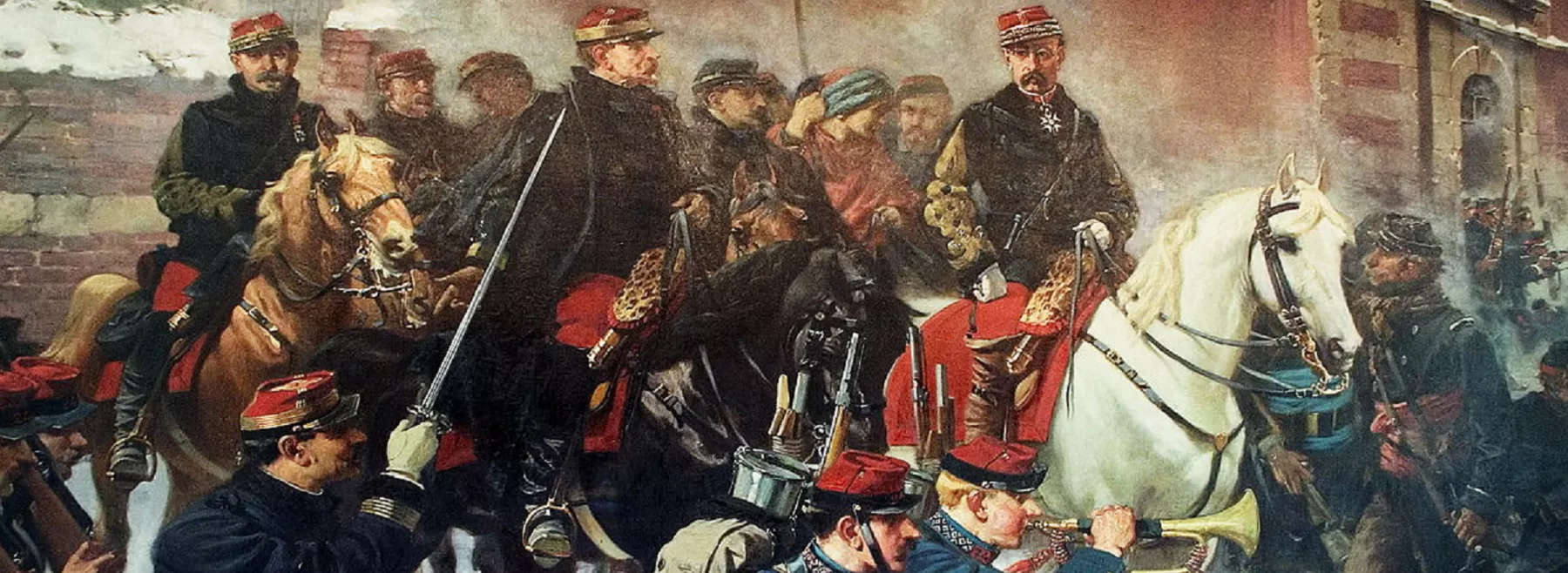
Franco-Prussian War
WarWikipedia
199
MENTIONS
124
EPISODES
109
PODCASTS
Search complete. 199 mentions across 124 episodes found for "Franco-Prussian War".
Oct 27, 2026

Haviv Rettig GurGUEST
And inside the École Militaire is Dreyfus' humiliation ceremony where his sword is broken and he's walking around a square of officers and they tell him shame and shame and he stands up and he says, I have done nothing wrong and that whole big, right? Now he's accused of being a German spy.
Haviv Rettig GurGUEST
at a time when the worst thing you could possibly be in France is a German spy, right? We're 20 years after the Franco-Prussian War, 1870 to 73, there's a military, German military occupation of Paris, and Victor Hugo says, right, never speak of it, but never forget it, revenge, right, revenge.
Haviv Rettig GurGUEST
And 20 years later, Dreyfus.
Haviv Rettig GurGUEST
20 years after that, World War I, where they will kill millions of each other.

Carlton HobbsVOICE_ACTOR
There was a parallel instance in Aberdeen some years back.
Carlton HobbsVOICE_ACTOR
And there was something on very much the same line that Munich, the year after the Franco-Prussian War...
Carlton HobbsVOICE_ACTOR
It's one of these cases.
Carlton HobbsVOICE_ACTOR
Oh, but hello, here is Lestrade.

Rebecca RosenbergGUEST
And she had an entirely different set of circumstances.
Rebecca RosenbergGUEST
And she was fighting the Franco-Prussian War, which I didn't know a lot about.
Rebecca RosenbergGUEST
So that was interesting.
Rebecca RosenbergGUEST
And here we have Lily Bollinger fighting World War II.

Dan SnowHOST
So are they growing up...
Dan SnowHOST
Is the father encouraging that? Are the boys steeped, for example, in the narrative of lost provinces after the Franco-Prussian War of the 19th century? Are they proud, patriotic Frenchmen who want to see Alsace-Lorraine back in the motherland?
Richard VinenGUEST
Yeah, absolutely.
Richard VinenGUEST
So...
Richard VinenGUEST
De Gaulle was born 1890.
Richard VinenGUEST
He very much grows up in the shadow of the defeat in the Franco-Prussian War, the loss of Alsace-Lorraine.
Richard VinenGUEST
He's more or less kind of born to fight Germany.
Richard VinenGUEST
And thinking about Germany as the center of his life.

Tim O'CallaghanHOST
So if that sounds like something you'd enjoy, then please subscribe and turn on your push notifications for wherever you get your BBC podcasts so you never miss an episode.
Tim O'CallaghanHOST
We're going all the way back more than 150 years to a major event in the Franco-Prussian War.
Tim O'CallaghanHOST
We're going to enter the siege of a city through an amazing recording in the BBC archives from 1946 of one woman's memories.
Sydney SnellSOUNDBITE_SPEAKER
I can remember the siege of Paris in 1870 quite clearly.
Tim O'CallaghanHOST
That's the voice of Mrs Sydney Snell, then 86 years old, meaning she would have been 10 at the time of the siege.
Tim O'CallaghanHOST
It's unclear why she was living in Paris at the time.
Tim O'CallaghanHOST
The Franco-Prussian War was a short-lived conflict from July 1870 until January 1871.
Tim O'CallaghanHOST
Prussia was a powerful state in what is now known as modern-day Germany.

Scott Dominic CarpenterGUEST
Yeah, in 1869...
Scott Dominic CarpenterGUEST
We have the beginning of the Franco-Prussian War, and this is a time where the French government is put under a certain amount of strain.
Scott Dominic CarpenterGUEST
The French basically lose that war, and there is a sort of composite government that's formed that is conciliatory toward the Germans.
Oliver GeeHOST
You're using a lot of big words for a moron audience.

Dan SnowHOST
So are they growing up...
Dan SnowHOST
Is the father encouraging that? Are the boys steeped, for example, in the narrative of lost provinces after the Franco-Prussian War of the 19th century? Are they proud, patriotic Frenchmen who want to see Alsace-Lorraine back in the motherland?
Richard VinenGUEST
Yeah, absolutely.
Richard VinenGUEST
De Gaulle was born 1890.
Richard VinenGUEST
He very much grows up in the shadow of the defeat in the Franco-Prussian War, the loss of Alsace-Lorraine.
Richard VinenGUEST
He's more or less kind of born to fight Germany.
Richard VinenGUEST
And thinking about Germany as the center of his life.

Katherine GrantHOST
I, the start of World War I is the end of the Belle Epoque.
Melinda CoppGUEST
And that kind of corresponds with a time in Paris, in France, history that there was the war between France, the Franco-Prussian War in 1871.
Melinda CoppGUEST
You know, so a very similar time period as Gilded Age.
Melinda CoppGUEST
And I, you know, the setting really came to me.

Clémentine Fauré-BellaïcheGUEST
He attended all the Protestant spaces connected with the Haute Société Protestante.
Clémentine Fauré-BellaïcheGUEST
So, for instance, the École Alsacienne in France, which still exists and which was founded by Protestants who had left Alsace after Alsace was, I mean, when Germany took Alsace from France after the Franco-Prussian War.
Clémentine Fauré-BellaïcheGUEST
and which is going to become a pedagogical model, very important in the foundation of the Third Republic, with the emphasis on the autonomy of thought, etc., as opposed to the Catholic formation from above.
Clémentine Fauré-BellaïcheGUEST
So he was part of all this milieu.
12 MINS LATER
Clémentine Fauré-BellaïcheGUEST
So it's something that he tells in his autobiography, in the words.
Clémentine Fauré-BellaïcheGUEST
So the words is all about that, all about being brought up both by a mother and grandmother who give him a Catholic education.
Clémentine Fauré-BellaïcheGUEST
And on the other hand, being formed, super influenced by his Protestant grandfather, who was an alization who chose France after the Franco-Prussian War, who was a pedagogue, who invented a method for learning German, who participated in the pedagogical dictionary.
Clémentine Fauré-BellaïcheGUEST
It was really kind of symbol of this third republic, Protestant, radical socialist group.

Clémentine Fauré-BellaïcheGUEST
Protestant spaces connected with the haute société protestante.
Clémentine Fauré-BellaïcheGUEST
So, for instance, the École Alsacienne in France, which still exists and which was founded by Protestants who had left Alsace after Alsace was, I mean, when Germany took Alsace from France after the Franco-Prussian War.
Clémentine Fauré-BellaïcheGUEST
and which is going to become a pedagogical model, very important in the foundation of the Third Republic, with the emphasis on the autonomy of thought, etc., as opposed to the Catholic formation from above.
Clémentine Fauré-BellaïcheGUEST
So he was part of all this milieu.
12 MINS LATER
Clémentine Fauré-BellaïcheGUEST
So it's something that he tells in his autobiography, in the words.
Clémentine Fauré-BellaïcheGUEST
So the words is all about that, all about being brought up both by a mother and grandmother who give him a Catholic education.
Clémentine Fauré-BellaïcheGUEST
And on the other hand, being formed, super influenced by his Protestant grandfather, who was an alization who chose France after the Franco-Prussian War, who was a pedagogue, who invented a method for learning German, who participated in the pedagogical dictionary.
Clémentine Fauré-BellaïcheGUEST
It was really kind of symbol of this third republic, Protestant, radical socialist group.
114 more episodes mention Franco-Prussian War.
Create an account to see the whole feed, search across every transcript, and follow the entities you care about.