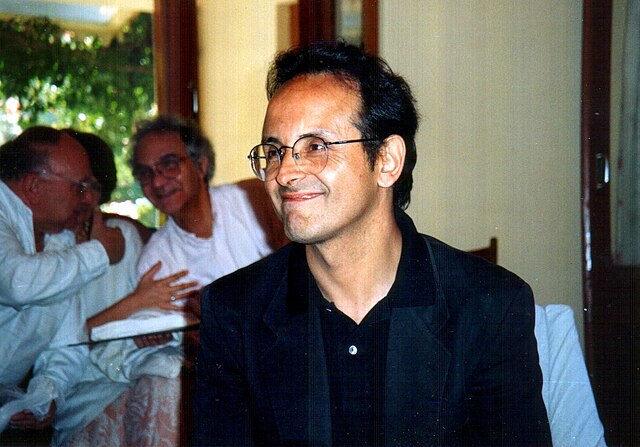
Francisco Varela
Chilean biologist and philosopherWikipedia
15
MENTIONS
5
EPISODES
4
PODCASTS
Search complete. 15 mentions across 5 episodes found for "Francisco Varela".
Oct 11, 2026

Doug SwiftHOST
[gentle music] Dr. Julie is a practicing Buddhist, but she was cautious about integrating it into her professional work.
Julie Brefczynski-LewisGUEST
Then someone told me that there was a scientist named Francisco Varela who had these dialogue between Buddhism and scientists.
Julie Brefczynski-LewisGUEST
I'm like, "Really?" And they're like, "Yeah, and they're, and there's gonna be a class coming up on the whole Buddhist science of mind, Buddhist psychology." I'm like, "Ooh, I, I ...
Julie Brefczynski-LewisGUEST
You know, I, I've been staying away from the Buddhist side.
Maxim RaginskyGUEST
I mean, one, one of the examples from, from the literature and kind of more theoretical biology, um, there's this book by, uh, uh, Moreno and Mossio on biological autonomy.
Maxim RaginskyGUEST
They, they are building on the ideas of, uh, people like Francisco Varela and, uh, you know, Robert Rosen, and they talk about-
Paul MiddlebrooksHOST
Hmm
Maxim RaginskyGUEST
... like networks of constraints that are operating at a higher Let's say layer, right? Because, uh, on-

Francis HeylighenGUEST
Well, autopoiesis is for me the best definition of life.
Francis HeylighenGUEST
It was proposed by the cyberneticians in Chile, Humberto Maturana and Francisco Varela, and it literally means auto-self-poiesis production.
Francis HeylighenGUEST
It's self-production.
Francis HeylighenGUEST
What an organism does is it produces itself, that is because an organism is not an inert object like a stone, it is a network, a metabolic network of processes that are constantly taking in resources, extracting energy, extracting building blocks, producing all kind of molecules, enzymes, fatty acids, cells, organelles, organs, everything is being constantly being produced and reproduced, and that is necessary because an organism is a so-called dissipative system.

Sara McClintockGUEST
And this is where we get to this question of multiple worlds and even the very philosophical term of a world, which is something I'm still trying to kind of come to terms with myself.
Sara McClintockGUEST
But I think what I've really, I'm really starting to see is that for some people, the word world, necessarily indicates all that is real and then there would they would be comfortable saying sure there are different perspectives on that mind independent reality which is the world you know and and you see it your way i see it my way and you know an ant sees it their way and uh you know a hungry ghost sees it their way to use a buddhist idea um And then there's another way of thinking, which is coming to the fore more through the work of those people who are interested in what's called inactivism, E-N, inactivism, which is really coming out of the work of Francisco Varela and his collaborators like Evan Thompson, Eleanor Roche, and then more recent people like Ezequiel de Paolo and... and others like that, that it's not just that there's a mind-independent world and then there's people who have different perspectives on it and then therefore there's multiple truths, but actually in the creation of, as we do actions in the world, and this gets back to the idea that truth is an action, as we create our truths, we are also changing our world.
Miles OsgoodHOST
Mm-hmm.
Sara McClintockGUEST
You know, so it's not just like there's a world out there and then we are going to say at one moment we have this idea about it and another moment we have this idea and we can say, yeah, I was wrong before.

Andrea GambarottoGUEST
So I was working on, in one room, and he was in the PhD student room, and he was working in the, in the permanent people, uh, room.
Andrea GambarottoGUEST
And we met over coffee, and we were discussing, and I was reading Varela already because it, I was interested a little bit.
Andrea GambarottoGUEST
And, and he was working already, he was starting to work on the concept of teleology too, but in this completely different concept.
Andrea GambarottoGUEST
And he had, he ended up writing a paper that was published online in 2014, uh, with Leonardo Bik called, uh, "What Makes Biological Organization Teleological?" Um, and, and it was striking to me the similarity between-
Paul MiddlebrooksHOST
I was trying to do it in a sort of pithy manner.
Andrea GambarottoGUEST
No, it's, it's, uh, very accurate, and you, you named the, the, the, the main people.
Andrea GambarottoGUEST
So, um, principle of biological autonomy is from Varela, nineteen seventy-nine.
Andrea GambarottoGUEST
Just got republished by, um, MIT Press with a new apparatus by, edited by Ezechiele Paolo and Evan Thompson.