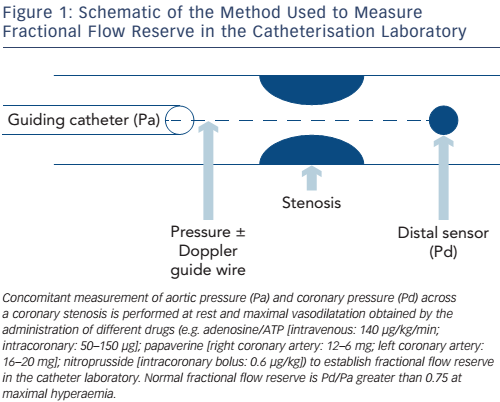
Fractional flow reserve
Diagnostic techniqueWikipedia
23
MENTIONS
5
EPISODES
5
PODCASTS
Search complete. 23 mentions across 5 episodes found for "Fractional flow reserve".
Oct 6, 2026

Christian Tegen MadsenGUEST
Yes, uh, of course.
Christian Tegen MadsenGUEST
So a FFRct is an estimation of the fractional flow, flow reserve calculated using computational fluid dynamics, and it is based on the images that we have obtained from the CTA scan, so it does not require the patient to come to the hospital for any additional tests, and we know that it correlates very well with invasive FFR.
Christian Tegen MadsenGUEST
So why can't we just estimate the stenosis visually during angiography? Um, well, it turns out that is actually really, really hard to do.
Christian Tegen MadsenGUEST
For example, if you have a stenosis in a vessel which supplies a large amount of myocardium, then even a lower grade stenosis may actually induce a large reduction in flow as opposed to, for example, a higher grade stenosis, uh, in a vessel which do not supply a large amount of myocardium.
Christian Tegen MadsenGUEST
That stenosis may not induce a significant reduction in flow.
Christian Tegen MadsenGUEST
So it is really difficult to just visually assess whether or not flow is compromised by just looking at thing.
Christian Tegen MadsenGUEST
And thus, I think we need to have either FFRct or invasive FFR.
Christian Tegen MadsenGUEST
But in the stable coronary artery disease patient population, where almost all of them have a CTA prior to the cath lab, it just makes really good sense to perform the FFRct because then you already know prior to them coming to the cath lab which stenosis should be treated and which should not.

Matthew WattoHOST
So it, it's, it's something that we will revisit over and over again.
Matthew WattoHOST
But I mean, even with the coronary CT angiography, now there's some AI modeling and looking at ulcers and, you know, FFR and all these kind of things, and they still, from that, it's still hard to predict who's gonna have an event, you know? So I think it's just a really tricky thing to know who will and won't have an event, and, you know, just, just hedging it all on a calcium score just seems silly when you think about it that way.
Rahul GanatraGUEST
Yeah.
Rahul GanatraGUEST
And the other thing that I should caveat my, my thinking with is, you know, this is just based on this study, not subject matter expertise in coronary artery calcium scores-

Eman NamatiGUEST
Along the journey, and we can talk a little bit more about this as we kind of chat today, but we also then took that first, I would say, beachhead technology slash application space and looked at how to expand the utility of this product and move towards a platform.
Eman NamatiGUEST
And in that regard, we then developed a non-invasive physiology assessment product that we refer to as X1-FFR, fractional flow reserve.
Eman NamatiGUEST
And this was really a next generation non-invasive assessment of whether or not the restriction that's in a coronary artery is significant enough physiologically and it meets a criteria for revascularization or stenting.
Eman NamatiGUEST
And so that was the second product that we launched and developed and then launched under the Spectrowave banner and now under Philips.

John MandrolaHOST
Now, my comments are short.
John MandrolaHOST
Indeed, FFR-guided complete revascularization is likely better, but for the same reason FFR is almost always better.
John MandrolaHOST
It reduces the amount of stents in the body.
John MandrolaHOST
There were nearly 50% fewer PCI procedures in the FF arm.

speaker_0NARRATOR
Previously brought to you by clinicaltrialresults.com with C. Michael Gibson and TCTMD's Beyond the Data with our senior clinical editor, Mama's Mamas.
C. Michael GibsonHOST
Mike Gibson, Bill Farron, and we're talking about the five-year results comparing angiographic or FFR-guided, rather, PCI versus CABG.
C. Michael GibsonHOST
Talk to us about what you found, Bill.
William FearonGUEST
Thanks, Mike.
William FearonGUEST
You need longer follow-up.
William FearonGUEST
You'll start to see more MIs, more death in the PCI arm.
William FearonGUEST
And so that was the goal of FAME III was to look at five-year outcomes, hard endpoints, death, stroke, or MI between FFR-guided PCI and CABG.
C. Michael GibsonHOST
And what did you see?