Four Freedoms
SpeechWikipedia
14
MENTIONS
8
EPISODES
6
PODCASTS
Search complete. 14 mentions across 8 episodes found for "Four Freedoms".
Oct 16, 2026

Jay DyerHOST
Nothing to do with the poor Russian people starting their own businesses.
Jay DyerHOST
The American business enterprise thus became a model for the world, and thus the Four Freedoms, right? The Four Freedoms that we read about earlier in this book.
Jay DyerHOST
Life magazine in 1944 made the connection between the societal organizing principles and economics, and they called it, quote, "capitalism." By any other name, it is the free market.
Jay DyerHOST
Um, blah, blah, blah.
Jay DyerHOST
But what does this really mean for the world? And this is, this is a quote from...
Jay DyerHOST
Let's see what this is from.
Jay DyerHOST
The second theme of American l- well, this is, this is the Four Freedoms, right? According to Time magazine, Billings and Luce.
Jay DyerHOST
In a strictly confidential m- memorandum to Billings, Henry Luce revealed the inner dynamic of American life and called it, uh, uh, he na- named this theme as liberty and freedom, defined as the ability to make all the money that one can in any damn well way you please.

Kelly McFarlandHOST
FDR and his sort of view of, you know, this is kind of the, it came out of the New Deal, and this idea of security, and then expanding it.
Kelly McFarlandHOST
But, um, that was a good segue because I was gonna get into the Four Freedoms.
William HitchcockGUEST
All right.
Kelly McFarlandHOST
And you get from, you know, Munich and '38, you're starting to see more of a turn here towards internationalism, and h- FDR starting to make these arguments, um, and then we're pushing to get rid of the Neutrality Acts, either through cash and carry and destroyers for bases, and then ultimately Lend-Lease.
Kelly McFarlandHOST
But tie that together for me with the, the, when he introduces the Four Freedoms and how that is tied to, you know, this notion of the New Deal and what they've been doing, and where do you see that and how important is that Four Freedom speech?
William HitchcockGUEST
Well, the Four Freedom speech is hugely important, and it becomes the slogan of, of, of the Second World War for the United States.
Kelly McFarlandHOST
Mm-hmm.
Kelly McFarlandHOST
Mm-hmm

speaker_7NARRATOR
The men in our armed forces want a lasting peace, and equally they want permanent employment for themselves, their families, and their neighbors when they are mustered out at the end of the war.
speaker_7NARRATOR
Two years ago, I spoke in my annual message of four freedoms.
speaker_7NARRATOR
The blessings of two of them, freedom of speech and freedom of religion, are an essential part of the very life of this nation, and we hope that these blessings will be granted to all men everywhere.
speaker_7NARRATOR
The people at home and the people at the front are wondering a little about the third freedom, freedom from want.
Jay DyerGUEST
That didn't really work, and so the- the Fabians put out and created all of these modern institutions that we know about today, explicitly on record.
Jay DyerGUEST
So League of Nations was a Fabian creation, and that was through the machinations of, uh, Colonel Edwin Mandell House working for the Rothschild and the British, uh, the Bank of England and so forth to get Woodrow Wilson into promoting, uh, the notion of the Four Freedoms, the, um, a, a new, uh, uh, uh, global system of governance and...
Jay DyerGUEST
But the League of Nations ended up failing.
Jay DyerGUEST
And so the, uh, Fabians r- came back with a new style of how to do this based on what they call steering committee models.
Jay DyerGUEST
Yeah, correct.
Jay DyerGUEST
I mean, I was just, uh, looking again at, at, um, some of the propaganda from, uh, FDR and, um, the idea of the Four Freedoms and all this, and how America would be the, uh, universal police force to guard the Four Freedoms, Team America type bullshit.
Jefferson LeeHOST
[laughs]
Jay DyerGUEST
And, and, uh, yeah, I mean, and, and, and the irony is that even though at that time it didn't mean, um, you know, turning kids into the opposite gender and, uh, you know, transifying the world, guess what? That's what it means now.

Jade CraigGUEST
Right.
Jade CraigGUEST
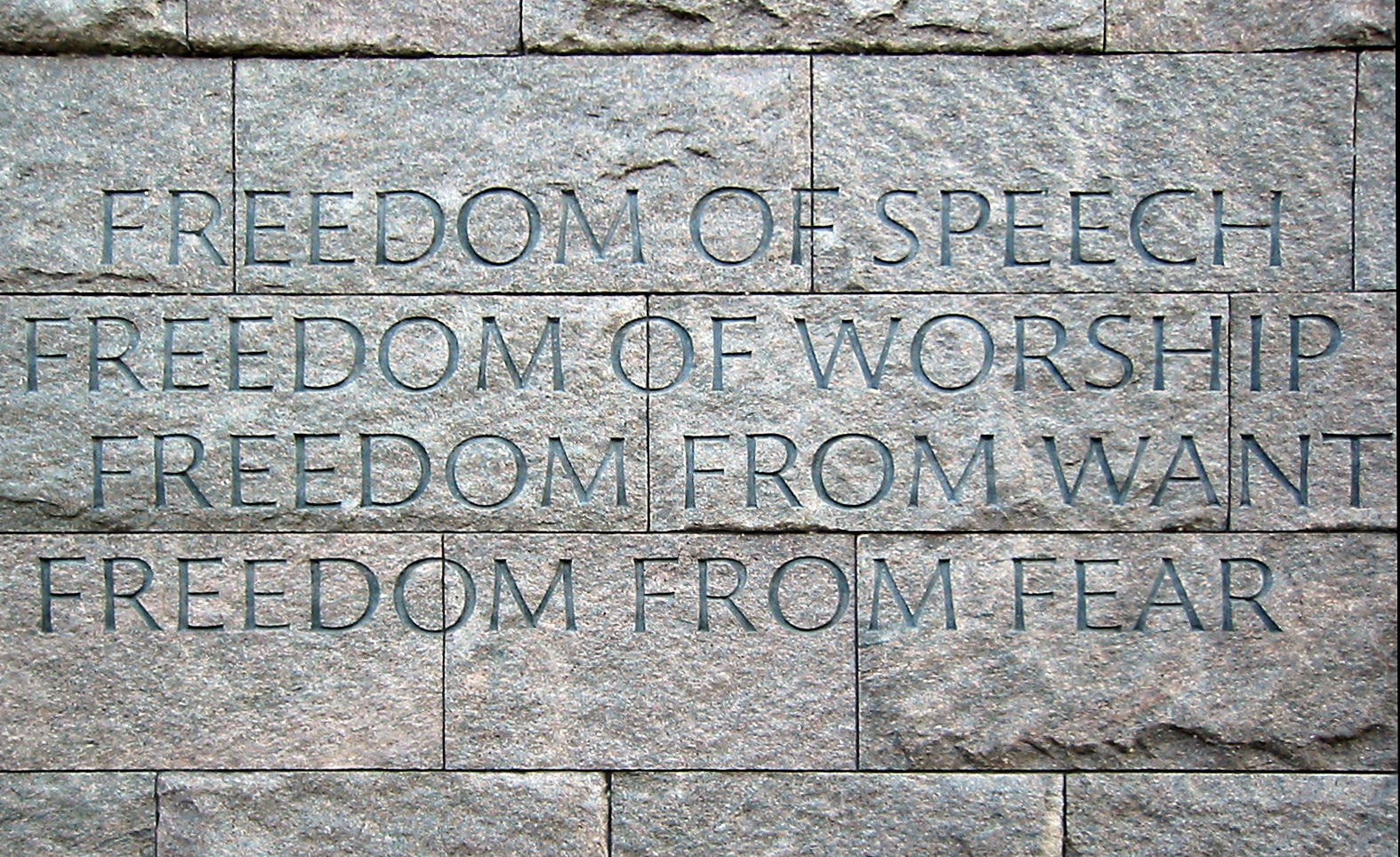
I go back to the four freedoms that Franklin Roosevelt announced during World War II and which Norman Rockwell made the famous paintings of freedom of religion, freedom of speech, freedom from want, and freedom from fear.
Jade CraigGUEST
Now, freedom of religion and freedom of speech are protected to some extent under the First Amendment, but freedom from want isn't its own freestanding right.
Jade CraigGUEST
And freedom from fear is also not its own freestanding right.
Jade CraigGUEST
But those are the rights we hold dear in a modern society, which is part of the reason that the Four Freedoms paintings mean so much to people historically.
Jade CraigGUEST
And so I think that part of what happens is that we have certain constitutional provisions and statutory schemes that limit the ability to deprive people of these rights and that provide a mechanism for living out some of these benefits, and that you can protect what you think of as a right through protecting those statutory mechanisms or enforcing them in different ways.
Wilson StriblingHOST
So the laws that are established maybe can help establish and protect the expectations, maybe is a better word than rights, that you have of our modern society.

Michael ShawHOST
Freedom from want.
Michael ShawHOST
This is one of four paintings he made from 1942 to 43 to illustrate the, quote, four freedoms laid out by Franklin D. Roosevelt on January 6, 1941, when he provided the moral framework for America's involvement in World War II.
Michael ShawHOST
The other three are freedom of speech, freedom of worship, and freedom from fear.
Michael ShawHOST
If you look closely at Freedom From Want, which is on permanent display at the Norman Rockwell Museum in Stockbridge, Massachusetts, you see first how utterly brilliant Rockwell was.

Zohran Kwame MamdaniGUEST
That's not the city we want to have.
Alexander HeffnerHOST
So we're here at Four Freedoms Park.
Alexander HeffnerHOST
Franklin Delano Roosevelt, the most liberal president, progressive president in our history, elected four times.
Alexander HeffnerHOST
A lot of people don't remember a time when a liberal lion like that could be leading this country.
Zohran Kwame MamdaniGUEST
I don't know.
Zohran Kwame MamdaniGUEST
But what I would say is that regardless of how he would describe himself, he would consider what we are fighting for to be in alignment with that same movement.
Zohran Kwame MamdaniGUEST
I mean, we think about the four freedoms, right? We're talking about freedom from want, freedom from fear, freedom of expression and speech, freedom of religion.
Zohran Kwame MamdaniGUEST
These are in many ways still the things that we are fighting for.