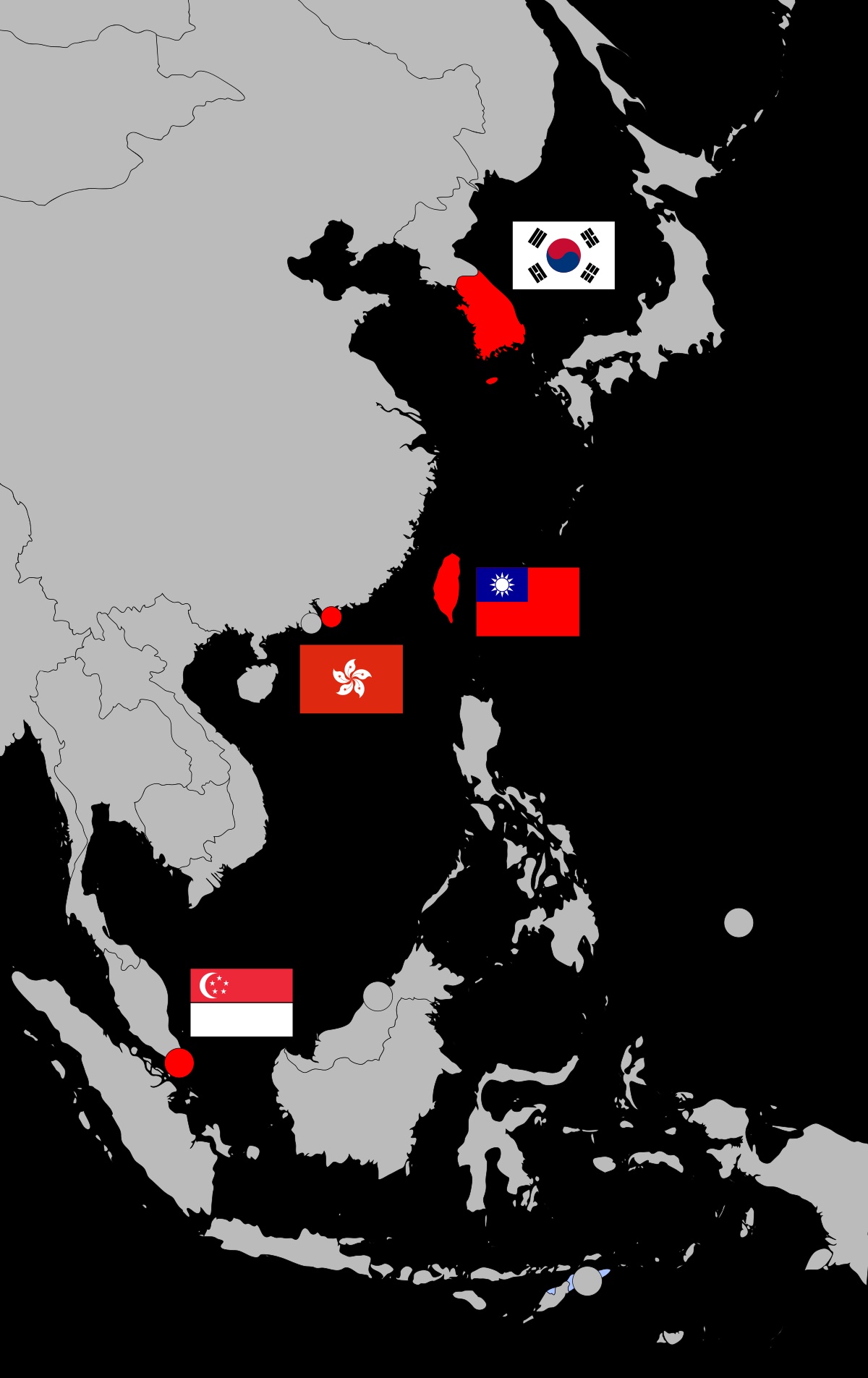
Four Asian Tigers
6
MENTIONS
5
EPISODES
5
PODCASTS
Search complete. 6 mentions across 5 episodes found for "Four Asian Tigers".
Sep 16, 2026

Alizé CarrèreHOST
But at the end of the 1940s, China went through a civil war that led to communist rule, and prompted the US and their allies to provide ample funding to set up strong, capitalist economies to reinforce and maintain a containment zone around Chinese communism.
Alizé CarrèreHOST
Today, Taiwan still acts as a shatterbelt between China and the West, meaning it's strategically located between two large powers, the US's allies and China.
Alizé CarrèreHOST
So by the 1980s, Taiwan was considered one of the Asian Tigers, which was a term used for Asian economies that experienced intense growth and industrialization after World War II.
Alizé CarrèreHOST
That's a lot of land grabbing and economic movement.
Alizé CarrèreHOST
And all that just in this one island.

BhuvanHOST
I don't mean that in a negative sense, but household debt as a share of GDP has inched up, which means that buffer of savings available is shrinking.
BhuvanHOST
So if we have to invest to grow and the likes of China, the East Asian Tigers, they had routinely massive amounts of capital had to go into before they would build up their manufacturing base.
BhuvanHOST
Foreign capital is an obvious source, but that can't be the only source of capital that we'll get to grow ourselves way out of these challenges.
BhuvanHOST
Where will all the money come from?

Philip PilkingtonGUEST
Um, The whole thing about the reason that the system survived 2008 comes down to three simple words, flight to safety.
Philip PilkingtonGUEST
The way that the US dollar system worked, say in the past tense, was basically that if a normal country, let's say like take the Asian tigers, which went into crisis in 1997.
Philip PilkingtonGUEST
They had many of the problems that the United States had in 2008.
Philip PilkingtonGUEST
They'd overborrowed on external markets to run a trade deficit, to prop up living standards artificially.
Philip PilkingtonGUEST
So their currency was too high, basically.
Philip PilkingtonGUEST
And that generated an internal bubble, a property bubble in the Asian Tigers.
Philip PilkingtonGUEST
It was very, very similar to the 2008 crisis.
Philip PilkingtonGUEST
And of course, when that property bubble blew up, their banks blew up in Indonesia and all these places.

Jeffrey SachsGUEST
So not only did the Soviet Union want to just be normal after 1991, but the process of catching up was at least taking place across Asia.
Jeffrey SachsGUEST
It was taking place in China, in India, in the so-called Asian Tigers, which were the smaller economies, Korea, Taiwan, Hong Kong, and Singapore.
Jeffrey SachsGUEST
It was taking place in Southeast Asia, though delayed by the Vietnam War and by the disasters that ensued from that.
Jeffrey SachsGUEST
And to my mind, that was completely natural.

Mathew FrithGUEST
Um, And he took a lot of these protectionist ideas back to Europe, and Germany ended up adopting heavy protectionist policies, arguably through the influence of List.
Mathew FrithGUEST
Then, of course, you had... you know, the Asian tigers and Japan also adopt these, uh, protectionist policies.
Mathew FrithGUEST
Now they're all a bit distinct in the exact system.
Mathew FrithGUEST
America, as we talked about in the internal market was probably a lot freer than those other economies, but you still get the sense of these other nations adopting, um, protectionist policies.