Fort Monroe
Military installationWikipedia
82
MENTIONS
17
EPISODES
13
PODCASTS
Search complete. 82 mentions across 17 episodes found for "Fort Monroe".
Oct 15, 2026

Tone HollywoodHOST
And like I said, they're here today to talk about what they have coming up with 757 Solidarity, Nolan Wells' Life Mattered that's going on this Sunday.
Gabrielle BlairGUEST
Yeah, so we will be having it at Fort Monroe.
Gabrielle BlairGUEST
We just want you guys to come with energy.
Gabrielle BlairGUEST
We want you guys to come with pride.
Japharii JonesGUEST
We've been a peaceful organization for these past 10 years.
Japharii JonesGUEST
Nobody can put us in with the stigmas or anything like that.
Japharii JonesGUEST
And when we had this similar visual at Fort Monroe for George Floyd on June the 5th of 2020, we had about 2,500 people show up.
Japharii JonesGUEST
It was all peaceful.

Josh JohnsonHOST
Now that we have it, and bear all the disadvantages of it, as we do bear in some certain quarters, we must also take some benefit from it, if practicable," end quote.
Josh JohnsonHOST
He's talking to Major General Dix about, uh, they call them contrabands, but it is escaped slaves that are going to Fortress Monroe, and they're showing up, and, and this has been something that's happened, uh, from the very beginning.
Josh JohnsonHOST
Benjamin Butler is at Fortress Monroe at first, and there's these contrabands, they call them contrabands, that come up to the works of Fortress Monroe, and they're like, "Hey, can we do anything?" And it's this weird situation where it's like, do you allow the, the formerly enslaved to come work for you? Do you...
Josh JohnsonHOST
Like, what do you do? There's the political considerations, and I think we've talked about that in the past, but it's, there's also some of these, like, racial undertones.
Josh JohnsonHOST
Some generals just don't want anything to do with them.

Andrew GontzNARRATOR
Hen Morse, he answered me.
Andrew GontzNARRATOR
We expect to change our position before long, are hoping to spend a few of these hot weeks at Fort McHenry in Baltimore, or at Fortress Monroe.
Andrew GontzNARRATOR
I don't know where the idea started from, but it would be fine.
Andrew GontzNARRATOR
I hear from Manchester often.
1 HR 6 MINS LATER
John BrandonNARRATOR
There were good fireplaces and plenty of wood, and though it rained great guns and the gale howled most of the time, we were dry and warm and made ourselves very comfortable there for three days, but became pretty near starving before a boat got down from Washington bringing us something to eat.
John BrandonNARRATOR
The boys gave it a very appropriate name, Camp Starvation.
John BrandonNARRATOR
When we got away, we went straight to Fortress Monroe.
John BrandonNARRATOR
We got there in the morning just as the rebel ironclad Merrimack came out from Norfolk.

Lee HabeebHOST
The artillery position was designed to assault a Union fort just across the James River.
Lee HabeebHOST
The fort was called Fort Monroe.
Lee HabeebHOST
As evening approached, Baker, Mallory, and Townsend decided to abandon the Confederate post and cross the James River to Fort Monroe.
Lee HabeebHOST
And when they traveled that short distance from Sewell's Point to the fort, they became fugitives.
Lee HabeebHOST
You see, according to the laws of Virginia, Frank Baker, Shepherd Mallory, and James Townsend were slaves.
Lee HabeebHOST
Any casual student of American history would likely expect the Union soldiers would take them in.
Lee HabeebHOST
After all, the soldiers' commander-in-chief was Abraham Lincoln, who would eventually earn the nickname The Great Emancipator.
Lee HabeebHOST
But when the three arrived at Fort Monroe, the fort's commander, Major General Benjamin Butler, was faced with a dilemma.

Tim RoeNARRATOR
While his partner read Carlyle, he read Shakespeare.
Tim RoeNARRATOR
In the spring of 1862, the president spent several days at Fortress Monroe, awaiting military operations upon the peninsula.
Tim RoeNARRATOR
As a portion of the cabinet were with him, that was temporarily the seat of government, and he bore with him constantly the burden of public affairs.
Tim RoeNARRATOR
His favorite diversion was reading Shakespeare.

KevinSNARRATOR
It was enlivened by the uniforms of staff officers just now, and as they rode through the trees of the approach and by the tents of the New York Eight, encamped in the grove to the rear, the tableau was brilliantly warlike.
KevinSNARRATOR
here by the way let me pause to ask as a horseman though a foot-soldier why generals and other gorgeous fellows make such guys of their horses with trappings if the horse is a screw cover him thick with saddle-claws girths cruppers breast-bands and as much brass and tinsel as your pay will enable you to buy but if not a screw let his fair proportions be seen as much as may be and don't bother a lover of good horseflesh to eliminate so much uniform before he can see what is beneath from arlington i rode to the other encampments the sixty ninth fifth and twenty eighth all of new york and heard their several stories of alarms and adventures this completed the circuit of the new fortifications of the great camp washington was now a fortress the capital was out of danger and therefore of no further interest to anybody the time had come for myself and my regiment to leave it by different ways i should have been glad to stay and see my comrades through to their departure but there was a massachusetts man down at fortress monroe butler by name has any one heard of him and to this gentleman it chanced that i was to report myself so i packed my knapsack got my furlough shook hands with my fellows said good-bye to camp cameron and was off two days after our month's service was done farewell to the seventh under providence washington owes its safety first to general butler whose genius devised the circumvention of baltimore and its rascal rout and whose utter bravery executed the plan he is the grand yankee of this little period of the war second to the other most worshipful grand yankees of the massachusetts regiment who followed their leader as he knew they would discovered a forgotten colony called annapolis and dashed in there asking no questions third and while i gladly yield the first places to this general and his men i put the seventh in as last but not least in saving the capital character always tells.
KevinSNARRATOR
The Seventh, by good, hard, faithful work at drill, had established its fame as the most thorough militia regiment in existence.
KevinSNARRATOR
Its military and moral character were excellent.
23 MINS LATER
KevinSNARRATOR
The setting sun in a clear April sky shone full up the street.
KevinSNARRATOR
Mother's eyes glistened at the windows upon the glistening bayonets of their boys below.
KevinSNARRATOR
i knew that winthrop and the other dear friends were there but i did not see them i saw only a thousand men marching like one hero the music beat and rang and clashed in the air marching to death or victory or defeat it mattered not they marched for justice and god was their captain from that moment he has told his own story in these pages until he went to fortress monroe and was made acting military secretary and aide by general butler before he went he wrote the most copious and gayest letters from the camp he was thoroughly aroused and all his powers happily at play in a letter to me soon after his arrival in washington he says i see no present end to this business we must conquer the south afterwards we must be prepared to do its police in its own behalf and in behalf of its black population whom this war must without precipitation emancipate we must hold the south as the metropolitan police holds new york all this is inevitable now i wish to enrol myself at once in the police of the nation and for life if the nation will take me i do not see that i can put myself experience and character to any more useful use my experience in this short campaign with the seventh assures me that volunteers are for one purpose and regular soldiers entirely another we want regular soldiers for the cause of order in these anarchical countries and we want men in command who though they may be valuable as temporary satraps or proconsuls to make liberty possible where it is now impossible will never under any circumstances be disloyal to liberty will always oppose any scheme of any one to constitute a military government and will be ready when the time comes to imitate washington we must think of these things and prepare for them love to all the dear friends this trip has been all a lark to an old tramper like myself Later he writes, It is the loveliest day of fullest spring.
KevinSNARRATOR
An aspen under the window whispers to me in a chorus of all its leaves, and when I look out, every leaf turns a sunbeam at me.

Don HollenbeckCORRESPONDENT
President Lincoln will be under increased pressure to accept the Confederate demands for peace.
Don HollenbeckCORRESPONDENT
At this very moment, according to CBS reports from Washington, the vice president of the Confederacy, Mr. Alexander Stephens, is now at Fortress Monroe in Chesapeake Bay under a flag of truce, awaiting to be received by President Lincoln.
Don HollenbeckCORRESPONDENT
If Meade's army is defeated here today on the soil of Pennsylvania, there may be many more who will say that the war is hopeless, that the North had better make peace with the South, and that would mean a nation permanently divided.
Don HollenbeckCORRESPONDENT
It would mean the dissolution of the Union.

DangHOST
Hampton Roads, responsible for beginning that work, fell to Flag Officer Garrett Pendergrast.
DangHOST
He had the protected Union position at Fort Monroe.
DangHOST
He had to watch Norfolk.
DangHOST
He also had to investigate the rivers feeding into the bay with whatever vessels he could gather.
DangHOST
Well, that's a lot to ask for old Pendergast.
BangHOST
Well, the one major advantage he had, it was Fort Monroe.
BangHOST
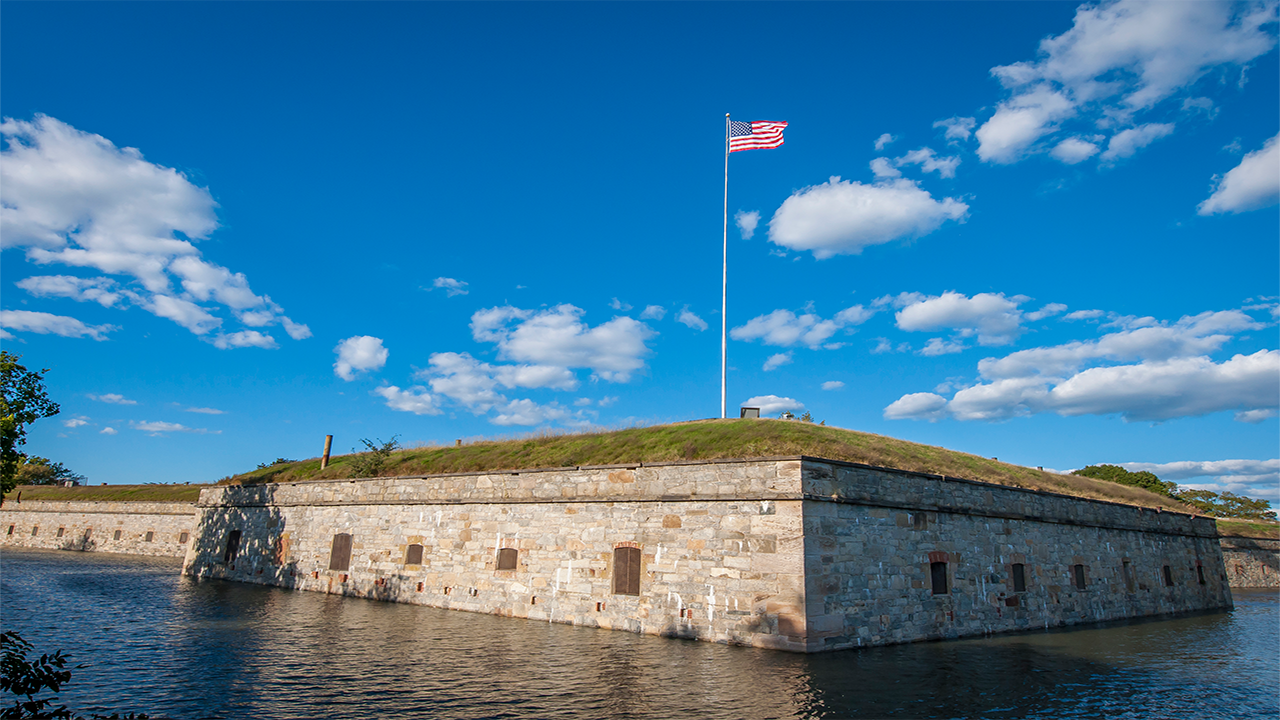
Standing at Old Point Comfort on the northern side of Hampton Roads, the massive stone fort remained under United States control even after Virginia left.
BangHOST
This location allowed the Union to watch the entrance to the James River, the approaches to Norfolk and Portsmouth, and the shipping lanes connected to the lower Chesapeake with the Alanna.
Don HollenbeckNARRATOR
President Lincoln will be under increased pressure to accept the Confederate demands for peace.
Don HollenbeckNARRATOR
At this very moment, according to CBS reports from Washington, the vice president of the Confederacy, Mr. Alexander Stevens, is now at Fortress Monroe in Chesapeake Bay under a flag of truce awaiting to be received by President Lincoln.
Don HollenbeckNARRATOR
If Meade's army is defeated here today on the soil of Pennsylvania...
Don HollenbeckNARRATOR
There may be many more who will say that the war is hopeless, that the North had better make peace with the South.
7 more episodes mention Fort Monroe.
Create an account to see the whole feed, search across every transcript, and follow the entities you care about.