Forest of Argonne
90
MENTIONS
20
EPISODES
15
PODCASTS
Search complete. 90 mentions across 20 episodes found for "Forest of Argonne".
Oct 23, 2026

Bill McClayGUEST
With each new engagement with the Germans, America became more involved.
Bill McClayGUEST
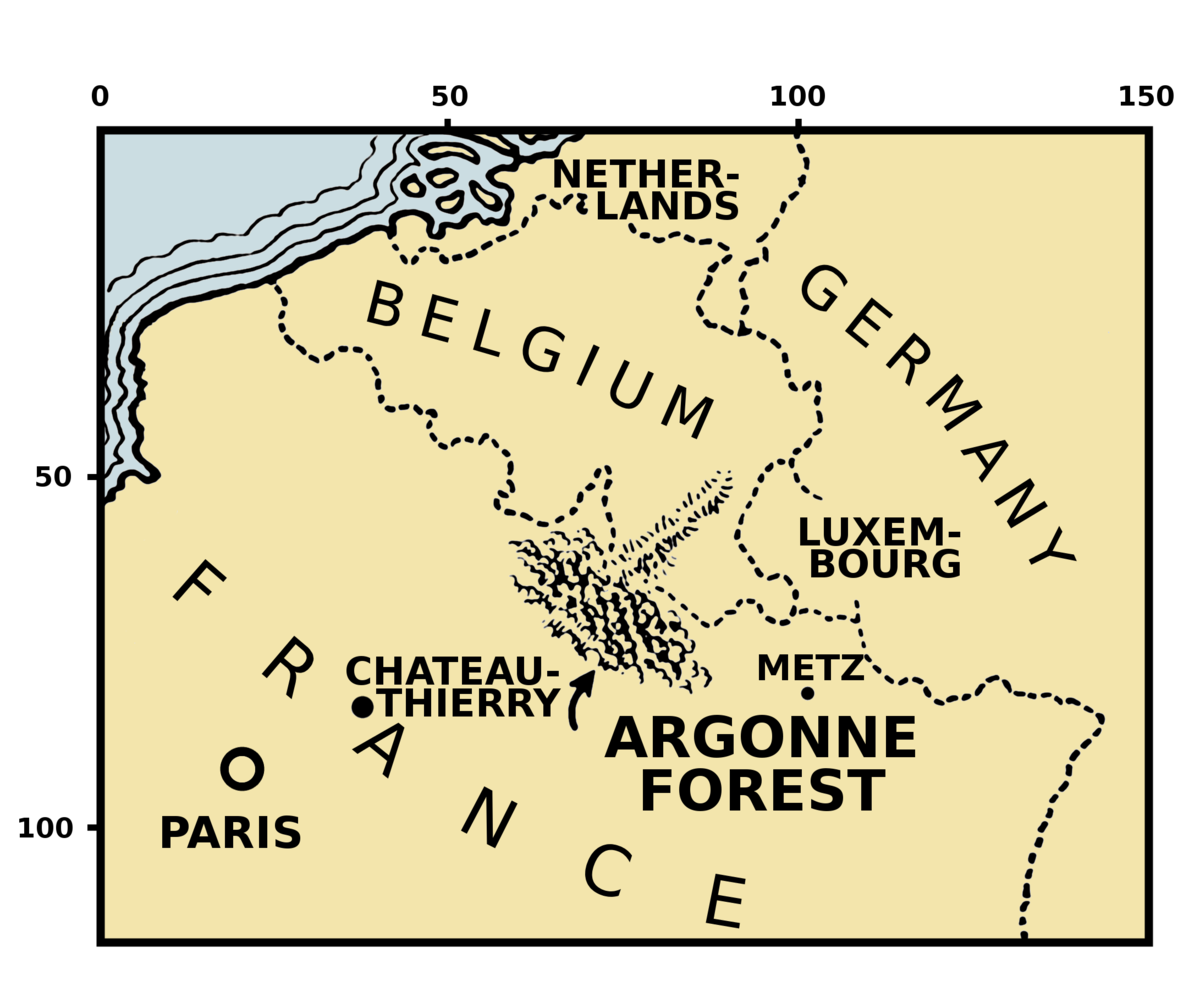
And by late September, more than a million American soldiers drove west from the blood-stained Verdun and through the dreaded Argonne Forest, It was a month of the very worst, awful fighting as Americans, foot by foot and yard by yard, crawled their way, fought their way through the hilly, hardened terrain against Germans who'd spent years fortifying it.
Bill McClayGUEST
And all the while, French and British troops attacked from the west, driving German troops back to their own border.
Bill McClayGUEST
On November 1st, American troops broke through, and the French 4th Army was given the honor of recapturing Sedan, a huge moral and psychological win for the Allies.

Colleen McMahonNARRATOR
And yet when the United States called for soldiers to cross the ocean to fight for the preservation of civilization, the Indian left the land of his ancestors to die on foreign soil, fighting side by side with his white brothers under a flag which he had no right to call my flag and for a nation which had denied him the right to call my country.
Colleen McMahonNARRATOR
The warriors of nearly every tribe on the American continent are today sleeping side by side with the khaki-clad Yanks on every battlefield of northern France, from Vimy Ridge to the Argonne Forest.
Colleen McMahonNARRATOR
There were in the Army and Navy of the United States in round numbers about ten thousand Indians.
Colleen McMahonNARRATOR
Of this number over six thousand enlisted as volunteers.
Colleen McMahonNARRATOR
The majority of the officers and non-commissioned officers of the D Company, 114th Battalion of Canada, were Indians of the Six Nations.
Colleen McMahonNARRATOR
These few facts, gathered from the official reports of the United States and Canada, show a part of the help given by the American Indian to the cause of the Allies.
Colleen McMahonNARRATOR
Does it not seem to be the time, after the injustice of more than a century of dishonor, to grant to this patriotic race a place side by side with the white man and the Negro in the affairs of the nation? They were deemed worthy of a place by the side of their white brothers in the battles of Vimy Ridge, the Marne, Chateau Thierry, and in the Argonne Forest.
Colleen McMahonNARRATOR
They have been deemed worthy to sleep the last long sleep side by side with their comrades in khaki in those hallowed spots in France.

Lee SmalleyNARRATOR
It was a march of some seventy miles to the frontier.
Lee SmalleyNARRATOR
So through the lovely forest of Argonne the boys set out, singing and joking as they strode along.
Lee SmalleyNARRATOR
It was pleasant enough at first, a romantic adventure, but with his heavy rifle, his heavy cartridge belt and bayonet, and his musette full of food slung over his shoulder, it was not long before poor Coco began to get weary.
Lee SmalleyNARRATOR
On his back, with his knapsack and his rolled overcoat and his tin bidon and tin gamelle, with the entrenching tool and his share of the company's baggage, he carried fully sixty pounds.
Lee SmalleyNARRATOR
From one of the villages they passed, the boy wrote a brave little letter to his mother on a postcard.
Lee SmalleyNARRATOR
"If anything should happen, well, one knows one's duty, and God will do the rest.
Lee SmalleyNARRATOR
Lovingly, Coco." On, on through the hilly forests of Argonne they marched, making about twenty-five miles a day.
Lee SmalleyNARRATOR
And on that dusty march, food was scarce.

Johnny SteinerGUEST
Uh, but you know, my grandfather fought World War I.
Johnny SteinerGUEST
He had his eyes shot out in the Argonne Forest, the guy I'm named after, uh, at a place called Verdun.
Johnny SteinerGUEST
Uh, and uh, he never talked about anything, uh, to my father, and he died of his war wounds when my father was eight.
Bill BaileyHOST
Mm-hmm.

Mike CunhaHOST
If the attack was really coming, this would definitely put a wrinkle in the Germans' plans.
Mike CunhaHOST
So the night sky from Reims to the Argonne Forest lit up with the violent bursts of light and the pounding of giants' hooves as the guns belched out an explosive rain of iron on the assembling Germans.
Mike CunhaHOST
The thunder and the lightning of the guns increased in intensity when at 0-10 hours on the 15th of July 1918, the German guns opened up their own artillery on schedule.
Mike CunhaHOST
While French shells rained down on staging points, supply depots, and flesh, the German rain of artillery fell on largely empty trenches.

Scott JenningsHOST
Then came October 8th, 1918.
Scott JenningsHOST
We take you to France, the Argonne Forest, where the man's seventeen-soldier patrol came under devastating German machine gun fire.
Scott JenningsHOST
Six Americans were killed, three were wounded.
Scott JenningsHOST
With the other non-commissioned officers down, this reluctant soldier took command.

Scott JenningsHOST
Then came October 8th, 1918.
Scott JenningsHOST
We take you to France, the Argonne Forest, where the man's 17-soldier patrol came under devastating German machine gun fire.
Scott JenningsHOST
Six Americans were killed, three were wounded.
Scott JenningsHOST
With the other non-commissioned officers down, this reluctant soldier took command.

Ken HudnallHOST
And it was in 1918 that the famous Sergeant Alvin York performed his famous World War I action.
Ken HudnallHOST
This was during the Argonne Forest, don't you know? 1956, Don Larson pitches the only perfect game in World Series history.
Ken HudnallHOST
1967, Che Guevara is captured in Bolivia.
Ken HudnallHOST
1970, Alexander Solzhenitsyn is awarded the Nobel Prize in Literature.
10 more episodes mention Forest of Argonne.
Create an account to see the whole feed, search across every transcript, and follow the entities you care about.