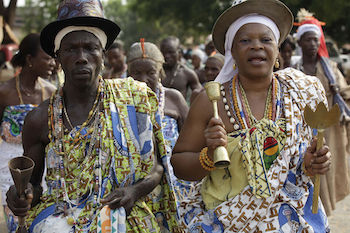
Fon people
PeopleWikipedia
5
MENTIONS
3
EPISODES
3
PODCASTS
Search complete. 5 mentions across 3 episodes found for "Fon people".
Oct 21, 2026

Steve StocktonHOST
Now, the occult nature of this story is often misinterpreted through a strictly Christian, Faustian lens.
Steve StocktonHOST
In the deep south of the 1930s, the man at the crossroads was likely a remnant of Yoruba and Fon spiritual traditions brought to the Americas by the transatlantic slave trade.
Steve StocktonHOST
In these traditions, the deity Ishu, or Papa Legba in Haitian voodoo, is the guardian of the crossroads.
Steve StocktonHOST
Now, he's a trickster god, the messenger between the human and divine realms.

Andrew M. HenryHOST
Throughout this video, I'll be using the term Vodou to refer specifically to Haitian Vodou.
Andrew M. HenryHOST
This word derives from the designation for spirit in the Fon language group of West Africa, which is spoken today in the country of Benin and its surroundings.
Andrew M. HenryHOST
Vodun, with an N, refers to beliefs and practices in West Africa today, which is a topic we'll save for a future video.
Andrew M. HenryHOST
Keep in mind, though, that religions are internally diverse, and while I'll be generalizing throughout this video, there is diversity within Haitian Vodou.
Andrew M. HenryHOST
Haitian Vodou emerged in the 1600s within communities of enslaved Africans who were forced to the island of Hispaniola, which is today two countries, Haiti on the western third and the Dominican Republic on the eastern two thirds.
Andrew M. HenryHOST
People from all over West and West Central Africa were forced to Caribbean plantations.
Andrew M. HenryHOST
Some of the largest populations that ended up on Hispaniola came from the regions roughly around modern-day Benin and western Nigeria, including the Fon and Ewe people, as well as various Yoruba-speaking ethnic groups.
Andrew M. HenryHOST
Congo communities from Central Africa also played a significant role in Haiti's demographic makeup.

Angela PucaHOST
but institutionally distinct traditions.
Angela PucaHOST
In southern Benin, Togo and neighbouring regions, we encounter Vodun or Vodou among Fon, Yu, Aya and related peoples.
Angela PucaHOST
In Haiti, we encounter Vodou, a Creole religion formed in the extraordinarily violent social world of colonial Santo Domingo and post-revolutionary Haiti.
Angela PucaHOST
In 19th century Louisiana, particularly New Orleans, we encounter what historians conventionally call voodoo or voodoo.
9 MINS LATER
Angela PucaHOST
cross the Atlantic again, but do not imagine ideas traveling by themselves.
Angela PucaHOST
People traveled under coercion.
Angela PucaHOST
The Atlantic slave trade displayed Fon, Yu, Aya, Yoruba, Congo, and many other African peoples into colonial societies where previous kinship networks, political institutions and ritual communities were violently disrupted.
Angela PucaHOST
Haitian Vodou emerged from this catastrophe.