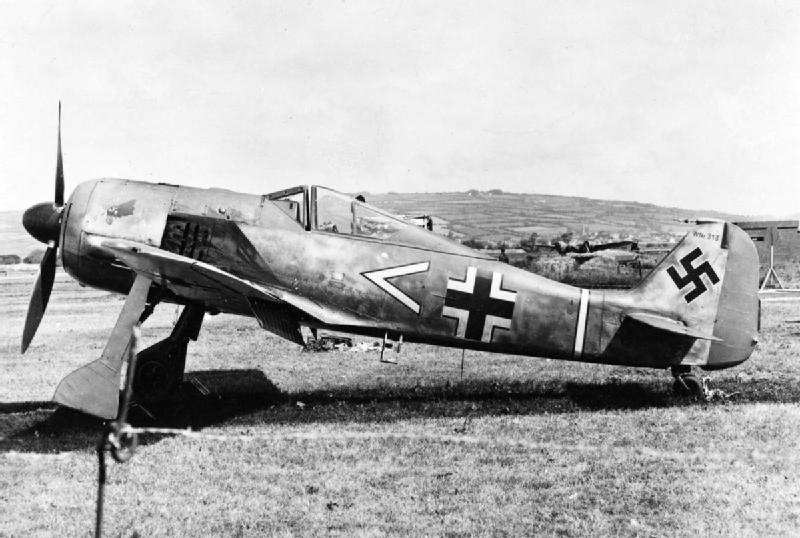
Focke-Wulf Fw 190
Fighter aircraftWikipedia
41
MENTIONS
27
EPISODES
9
PODCASTS
Search complete. 41 mentions across 27 episodes found for "Focke-Wulf Fw 190".
Oct 17, 2026

Tail DraggerHOST
Now, here's where it gets interesting.
Tail DraggerHOST
The Focke-Wulf 190 was, in 1944, one of the finest fighter aircraft in the sky.
Tail DraggerHOST
The Germans had spent years refining it into something exceptional, a radial engine, heavy armament, fast and maneuverable at altitude.
Tail DraggerHOST
The pilot who got behind Hoover was good at his job.
Tail DraggerHOST
The situation was fluid in the way that military situations become fluid when the command structure holding them together starts to come apart.
Tail DraggerHOST
He got to the airfield.
Tail DraggerHOST
On the ramp, unattended, sat a Focke-Wulf 190, the same type of airplane that had shot him down.
Tail DraggerHOST
He climbed in.
Tail DraggerHOST
The Mark V added a two-speed supercharger that restored performance at altitude.
Tail DraggerHOST
The Mark IX, rushed into service in 1942, could finally match the Focke-Wulf 190 that had been running away from earlier Marks at high speed.
Tail DraggerHOST
The photo reconnaissance variants flew stripped of guns and armor, unarmed and unpainted, at 40,000 feet over occupied Europe, trading vulnerability for altitude.
Tail DraggerHOST
The Mark XIV put a Rolls-Royce Griffon engine under that nose making over 2,000 horsepower and a five-bladed propeller that would have been unrecognizable to Mitchell and yet somehow still recognizable, still that wing.
Tail DraggerHOST
At altitude above 30,000 feet, there was effectively nothing in the standard Luftwaffe inventory that could reliably intercept it.
Tail DraggerHOST
The Focke-Wulf 190 and the Bf 109G could match it at lower levels.
Tail DraggerHOST
The late-war Ta 152H was faster still.
Tail DraggerHOST
But for most of the war, most of the time, the Mosquito crew that flew high and fast could simply outrun the problem.
Tail DraggerHOST
There are stories from the war that stretch credibility until you see the photographs.
Tail DraggerHOST
A pilot named Robert Johnson was attacked by a Focke-Wulf 190 in the fall of nineteen forty-three.
Tail DraggerHOST
The German pilot made repeated firing passes and shot Johnson's P-47 to near wreckage.
Tail DraggerHOST
He flew alongside Johnson afterward, looked him over through the canopy, apparently saw the airplane was a ruin, and the pilot was still alive and decided he was out of ammunition and that was that.
Tail DraggerHOST
Then in February of 1944, on a mission near the south of France, the war reached out and grabbed him.
Tail DraggerHOST
A Focke-Wulf 190 got on his tail.
Tail DraggerHOST
The engagement was brief and did not go his way.
Tail DraggerHOST
His P-40 took critical hits, the engine quit, and he went into the water off the French coast near Cannes.
Tail DraggerHOST
Hoover saw his window and went through it.
Tail DraggerHOST
The exact sequence of the escape has never been laid out in complete detail, partly because Hoover was deliberately cagey about the specifics, a habit perhaps developed from military discretion or maybe just from a lifetime of knowing that a good story is better with some mystery in it.
Tail DraggerHOST
What is established is this: He got out of the camp perimeter, made his way to the airfield, and on that airfield sat a Focke-Wulf 190.
Tail DraggerHOST
Think about that for a moment.
Tail DraggerHOST
The reality was that German interceptor pilots were experienced, aggressive, and flying in their own backyard.
Tail DraggerHOST
The Focke-Wulf 190, the Messerschmitt 109, they could slash through a formation, take their shots, and break away before the gunners could track them.
Tail DraggerHOST
And the flak, over the big industrial targets.
Tail DraggerHOST
The Germans had concentrated so much anti-aircraft artillery that crews described it as flying through a solid black cloud.
Tail DraggerHOST
Zemke looked at the Thunderbolt and started thinking tactically rather than complaining about what it wasn't.
Tail DraggerHOST
What you did not do in a P-47 was mix it up in a turning fight at low altitude with a Focke-Wulf 190.
Tail DraggerHOST
That was a losing proposition.
Tail DraggerHOST
The Fw 190 was lighter, more nimble down low, and it would take you apart.
Tail DraggerHOST
And sometimes the situation turned against you hard.
Tail DraggerHOST
Robert Johnson was flying with the 56th that summer.
Tail DraggerHOST
On June 26th, 1943, he was jumped over the Dutch coast by a flight of Focke-Wulf 190s.
Tail DraggerHOST
His aircraft took cannon hits that by any reasonable accounting should have ended the story right there.
Tail DraggerHOST
By 1942, the Luftwaffe was fighting on multiple fronts with a single engine fighter force that was genuinely excellent, but approaching its physical limits.
Tail DraggerHOST
The Messerschmitt Bf 109 and the Focke-Wulf Fw 190 were outstanding machines, fast, agile, combat proven, but squeeze more horsepower out of a single piston engine and you run into a wall of physics, torque, cooling, propeller diameter.
Tail DraggerHOST
There's only so much one power plant can do.
Tail DraggerHOST
The obvious answer is two engines.
Tail DraggerHOST
The Jug owned the high sky.
Tail DraggerHOST
Down low, in a slow-turning dogfight at ten thousand feet, a Focke-Wulf 190 could eat it alive, but that was not how you were supposed to fight it.
Tail DraggerHOST
The unit that defined what the Thunderbolt could do was the 56th Fighter Group, based in England and eventually operating out of Boxted.
Tail DraggerHOST
They called themselves the Wolf Pack.
Tail DraggerHOST
Stay high.
Tail DraggerHOST
Use your diving speed as your weapon, slash through a formation, take your shots, and climb back up where you live.
Tail DraggerHOST
Do not try to circle with a Focke-Wulf 190 at ten thousand feet.
Tail DraggerHOST
You will lose.
Tail DraggerHOST
The theory was sound on paper, heavy bomber formations bristling with .50 caliber machine guns, flying in close defensive boxes, fighting their way through enemy fighters in daylight, and putting precision bombs on industrial targets.
Tail DraggerHOST
What the theory did not fully account for was the Focke-Wulf 190 and the Messerschmitt 109, and the fact that German anti-aircraft gunners were very, very good at their jobs.
Tail DraggerHOST
A combat tour was twenty-five missions.
Tail DraggerHOST
On paper, that was the number you had to reach before they rotated you home.
17 more episodes mention Focke-Wulf Fw 190.
Create an account to see the whole feed, search across every transcript, and follow the entities you care about.