FMOD
6
MENTIONS
5
EPISODES
3
PODCASTS
Search complete. 6 mentions across 5 episodes found for "FMOD".
Sep 8, 2026
P
Unknown podcast
Sound Stock and API Integration: Turning an Audio Library Into Creative Infrastructure
Sep 8 · 1 Mention
S
4:38speaker_1UNKNOWN
That adds another layer of protection while still making the integration painless.
S
4:44speaker_1UNKNOWN
A fascinating use case is real-time game audio middleware like Wwise or FMOD pulling sound banks via API during build time.
S
4:52speaker_1UNKNOWN
The assets can be fetched automatically and stitched into a level's audio set.
S
4:57speaker_1UNKNOWN
For video editors, an IDE plugin could call the search API on the fly, present the user with a scrollable list of preview thumbnails, and let them drag drop directly into their timeline.
P
Unknown podcast
Game Audio Variations Made Simple with Sound Stock’s Massive Sample Library
Sep 8 · 1 Mention
S
11:42speaker_1UNKNOWN
A balanced approach is to have a small buffer for critical actions like footsteps and a larger one for ambient loops to keep stability.
S
11:51speaker_1UNKNOWN
In many indie projects, developers use middleware like Wwise or FMOD.
S
11:56speaker_1UNKNOWN
They both support Soundstock assets via easy import pipelines.
S
12:00speaker_1UNKNOWN
When importing, maintain consistent naming conventions, e.g. "footstep_wood_one" and "footstep_wood_two," to allow automated random selection scripts.
P
Unknown podcast
How Game Audio Uses Massive Sound Libraries to Build Realistic Variation Systems
Sep 7 · 2 Mentions
T
2:00TonyHOST
Those nodes automatically shuffle your samples on playback while giving you knobs for pitch variation and volume fuzziness.
T
2:09TonyHOST
What if you're working in a middleware engine like FMOD or Wwise? They let you build event objects that pull from an array of audio files at runtime.
T
2:19TonyHOST
You can attach parameters to control the random selection algorithm, such as random or sequential with random skip, which can keep the experience fresh without obvious looping.
T
2:30TonyHOST
Both engines also expose DSP chains per event.
S
5:41speaker_0ADVERTISER
Shop now at palmolive.com.
T
5:44TonyHOST
You should also embed metadata tags such as genre or usage notes into the files themselves.
T
5:50TonyHOST
Engines like FMOD can read these tags for in-game sorting.
T
5:55TonyHOST
The more semantic information you attach, the easier it is to pick up a footstep on a stone surface versus a dirt trail purely through the event's parameters.
158: Moonlighting in the Dungeon with Mark Essen (Blood Dungeon)
M
75:52Mark EssenGUEST
And yeah, Tom was amazing.
M
75:53Mark EssenGUEST
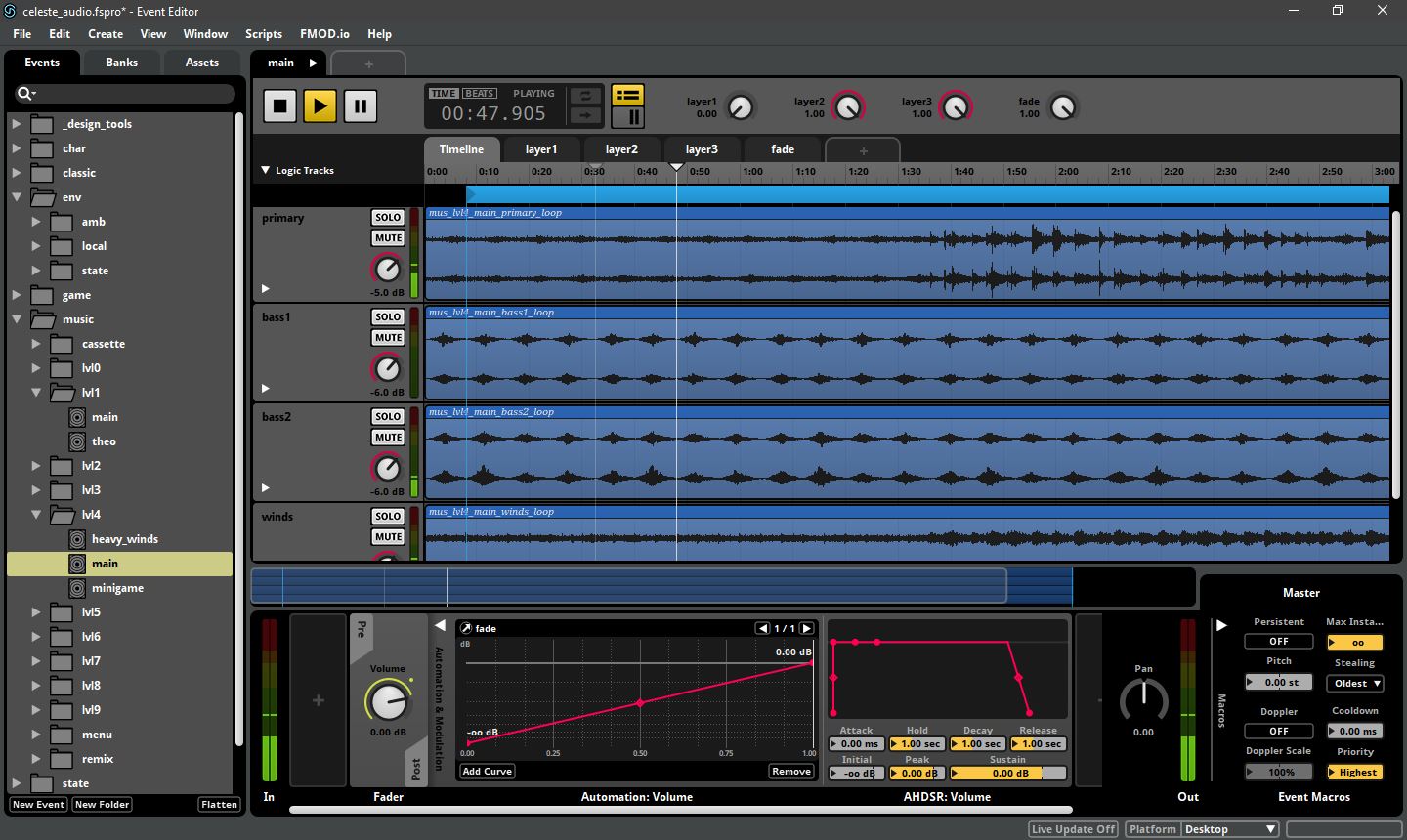
Yeah, it's all in Fmods.
M
75:56Mark EssenGUEST
It's all sort of different stems and different things that have chances of happening.
M
76:01Mark EssenGUEST
And then every wave, it moves on to the next section.
How Would You Start a Composing Career in 2026 (with Anne-Kathrin Dern)?
D
17:06Dave KropfHOST
Now, I know a lot of, uh, a lot of game developers, especially indie game developers, they're gonna lean on their composer to do s- like, s- bring sound design to the table, not just music, also possibly implementation.
D
17:21Dave KropfHOST
H- uh, are, is that anything that you have, you have to do, or are you kind of further along down, and they bring on, you know, their own, uh, own sound design folks, and I- Wwise folks or FMod people?
A
17:33Anne-Kathrin DernGUEST
So far they've had their own, uh, just be- I haven't really worked on indie indie games.
A
17:39Anne-Kathrin DernGUEST
Um, I, I've always worked with companies that are either mid-level or up, so they-