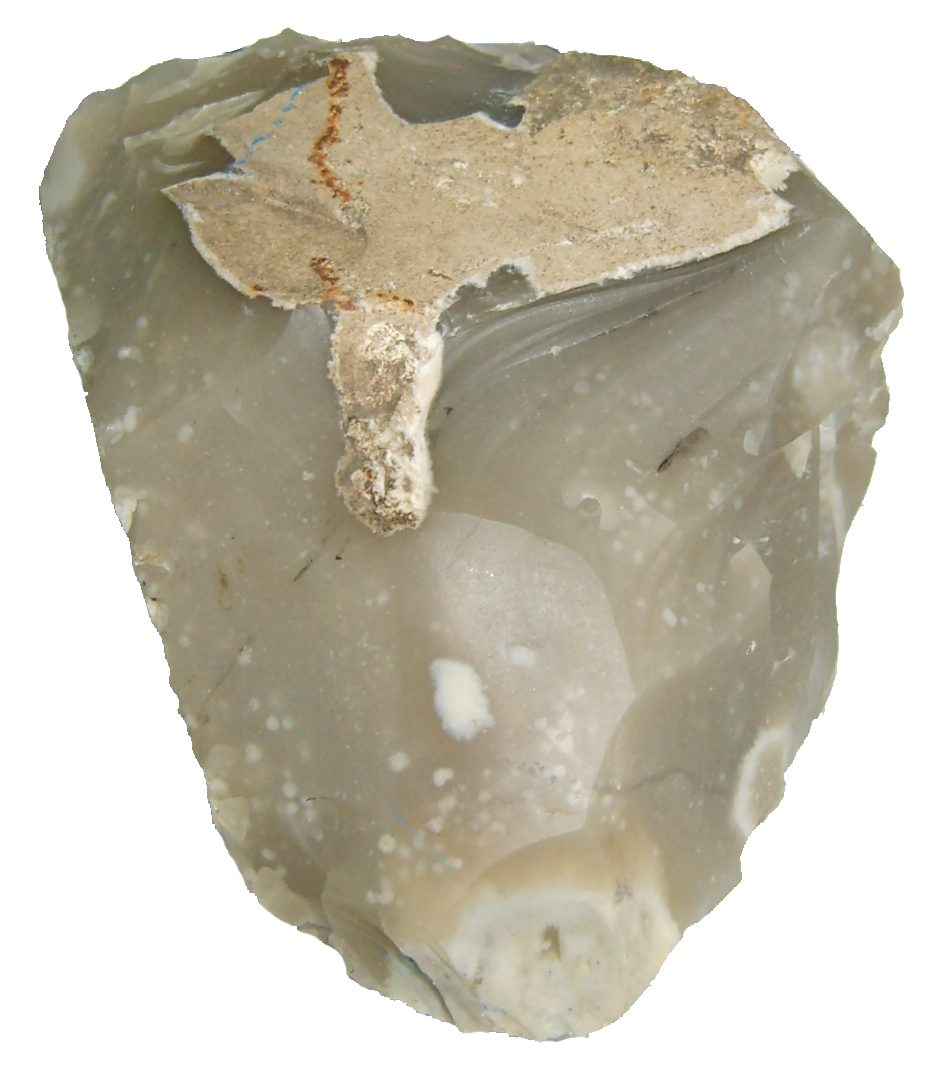
Flint
Form of rockWikipedia
36
MENTIONS
10
EPISODES
10
PODCASTS
Search complete. 36 mentions across 10 episodes found for "Flint".
Sep 15, 2026

Mark RonanHOST
Fighting knives have been around for as long as people have been fighting.
Mark RonanHOST
Flint was first mapped, I suppose.
Mark RonanHOST
Yeah, exactly.
Mark RonanHOST
So before swords, there were knives because you couldn't turn a piece of flint into a sword.

Drowsy HistorianHOST
Your work is not glamorous, although nobody has yet invented the word glamorous, which saves you from having to compare your occupation unfavorably with it.
Drowsy HistorianHOST
You are a flint miner, and your day will be spent beneath the ground where the sunlight cannot reach and where the most important thing you may see for hours is a piece of stone.
Drowsy HistorianHOST
Flint is not especially impressive when you first look at it.
Drowsy HistorianHOST
It does not glow like metal or shine like a polished ornament.
Drowsy HistorianHOST
It lies hidden among layers of chalk and earth, waiting patiently for someone to notice that it can be struck into something sharp and useful.
Drowsy HistorianHOST
Some layers are loose and easy to clear.
Drowsy HistorianHOST
Others resist the pick with a stubbornness that feels almost personal.
Drowsy HistorianHOST
Flint itself appears within the surrounding material in nodules, often concealed until the careful removal of earth reveals its dark surface.

Chris WebsterHOST
You need to use something harder to etch obsidian.
Chris WebsterHOST
And the harder thing in the area would have been Flint.
Chris WebsterHOST
And the Flint is is actually rare for the area.
Rachel RodenHOST
Yeah.
Chris WebsterHOST
So finding something like Flint hard enough to actually do this.
Chris WebsterHOST
Would have been difficult.
Chris WebsterHOST
And so that's why the intentional nature of this seems plausible because somebody did this because they had the material to do it with.
Chris WebsterHOST
Yeah.

Ruth GoldingNARRATOR
It is so hard as to scratch glass, is but little affected by heat or cold or by the gases of the atmosphere, and absorbs so little moisture that even frost cannot greatly injure it.
Ruth GoldingNARRATOR
Footnote: Flint is impure silica.
Ruth GoldingNARRATOR
End of footnote.
Ruth GoldingNARRATOR
Hence, a granite which contains a large proportion of quartz is one of the most durable rocks there is.
3 HRS 38 MINS LATER
Ruth GoldingNARRATOR
But there is one great difference between them.
Ruth GoldingNARRATOR
Chalk, especially that of the English cliffs, consists almost entirely of carbonate of lime, and such small quantities of other minerals as it contains are as equally mixed with it as if the whole had been well stirred.
Ruth GoldingNARRATOR
Flints are very commonly associated with chalk, and sometimes occur in layers or sheets at almost regular intervals, but not a particle of flint is scattered about in the chalk itself.
Ruth GoldingNARRATOR
The Atlantic mud, on the other hand, contains no flints, but does contain a large proportion of silica, twenty to thirty per cent, in the shape of cases, sheaths, and skeletons of minute animals and vegetables, and the bed of the Pacific is to a still larger extent covered with these siliceous remains.

Ruth GoldingNARRATOR
It is so hard as to scratch glass, is but little affected by heat or cold or by the gases of the atmosphere, and absorbs so little moisture that even frost cannot greatly injure it.
Ruth GoldingNARRATOR
Footnote: Flint is impure silica.
Ruth GoldingNARRATOR
End of footnote.
Ruth GoldingNARRATOR
Hence, a granite which contains a large proportion of quartz is one of the most durable rocks there is.
3 HRS 18 MINS LATER
Ruth GoldingNARRATOR
Chapter ten of The World's Lumber Room by Selina Gay.
Ruth GoldingNARRATOR
This LibriVox recording is in the public domain.
Ruth GoldingNARRATOR
Chapter ten, What Becomes of the Dust, Flint, Salt, etc.? We mentioned in the last chapter the strong resemblance existing between the Atlantic ooze and the chalk, which, wherever found, has evidently been formed in a similar way.
Ruth GoldingNARRATOR
But there is one great difference between them.

Neil OliverHOST
And you can just become completely subsumed by, intoxicated by the atmosphere of these places.
speaker_1HOST
Is Flint all the same, or would certain types have been more desirable than others?
Neil OliverHOST
It varies in quality.
Neil OliverHOST
You get grades of purity and perfection.

Ruth GoldingNARRATOR
Chalk especially that of the english cliffs consists almost entirely of carbonate of lime and such small quantities of other minerals as it contains are as equally mixed with it as if the whole had been well stirred.
Ruth GoldingNARRATOR
Flints are very commonly associated with chalk and sometimes occur in layers or sheets at almost regular intervals but not a particle of flint is scattered about in the chalk itself.
Ruth GoldingNARRATOR
The atlantic mud on the other hand contains no flints but does contain a large proportion of silica twenty to thirty per cent in the shape of cases sheaths and skeletons of minute animals and vegetables and the bed of the pacific is to a still larger extent covered with these siliceous remains.
Ruth GoldingNARRATOR
Silica is not enumerated among the minerals contained in seawater because in one thousand grains the quantity is so small as to be little more than a trace.

Gary MannersHOST
University of Saragossa.
Gary MannersHOST
Flint carries a map of Neanderthal movement.
Gary MannersHOST
The newly excavated tools came from superior rock, namely flint from outcrops close to Batorda.
Gary MannersHOST
The source of the material is important because it serves as a map in the sense it reveals places the people knew, selected and collected the stone from before the tools arrived at the cave.

Gill Gordon SmithHOST
Like Sancerre, Sauvignon Blanc is the principal variety, producing dry wines with vibrant acidity and citrus fruit.
Gill Gordon SmithHOST
Flint or Silex is an important soil type here.
Gill Gordon SmithHOST
These flint-rich soils are associated with the smoky gunflint character that distinguishes Pouilly Fumé from neighbouring Sancerre.
Gill Gordon SmithHOST
Examination.
Gill Gordon SmithHOST
Gravel and limestone influence the style of Cabernet Franc in Chinon and Bourgogne.
Gill Gordon SmithHOST
The central vineyards have the most continental climate, producing benchmark Sauvignon Blanc in Sancerre and Pouilly-Fumé.
Gill Gordon SmithHOST
Flint contributes to the distinctive smoky character associated with Pouilly-Fumé.
Gill Gordon SmithHOST
So always link climate, soils, grape variety and winemaking to the resulting wine style.

StephHOST
There's so much going on.
StephHOST
To find out more and to join us, please visit nationalcentreforwriting.org.uk/summer. And now onto the main portion of today's podcast, and that is our conversation with Norfolk-based writer Lawrence Mitchell, who reveals how he brought the spirit of landscape and place onto the page in his award-winning book, Flint Country: A Stone Journey.
StephHOST
Lawrence is a travel writer with several guidebooks and walking guides to his name.
StephHOST
He also writes features for magazines like Geographical, Walk, and Discovering Britain.
StephHOST
His first book for Saraband, Westering, was published in 2021, and his second, Flint Country, was published in 2025.
StephHOST
Flint Country won the general nonfiction category at the East Anglian Book Awards.
StephHOST
Lawrence sat down with NCW program manager Holly Ainley to discuss the spirit of place and how writers can weave culture, folklore, and personal memory into their portrayal of landscape.
StephHOST
Together, they also explore his decision to write about Norfolk flint, how writers can bring their own personality to the narrative, and what it means to think about landscape as character.