Five whys
26
MENTIONS
12
EPISODES
12
PODCASTS
Search complete. 26 mentions across 12 episodes found for "Five whys".
Sep 11, 2026

Angela ShurinaHOST
So this is thing number one that will allow you to drop unnecessary shoots and find better ways or figure out what are your stakes and what is important.
Angela ShurinaHOST
And so with a client, we're going to do five whys exercise.
Angela ShurinaHOST
Five whys.
Angela ShurinaHOST
Basically, you ask yourself, why is it important? Why do I think it's important? And then why? And then why? And then why? Until you truly understand your reasoning.
Angela ShurinaHOST
And your brain gets it.

Christina HeystekHOST
Dean Graziosi popularized a specific process for getting to that why, called the seven levels deep.
Christina HeystekHOST
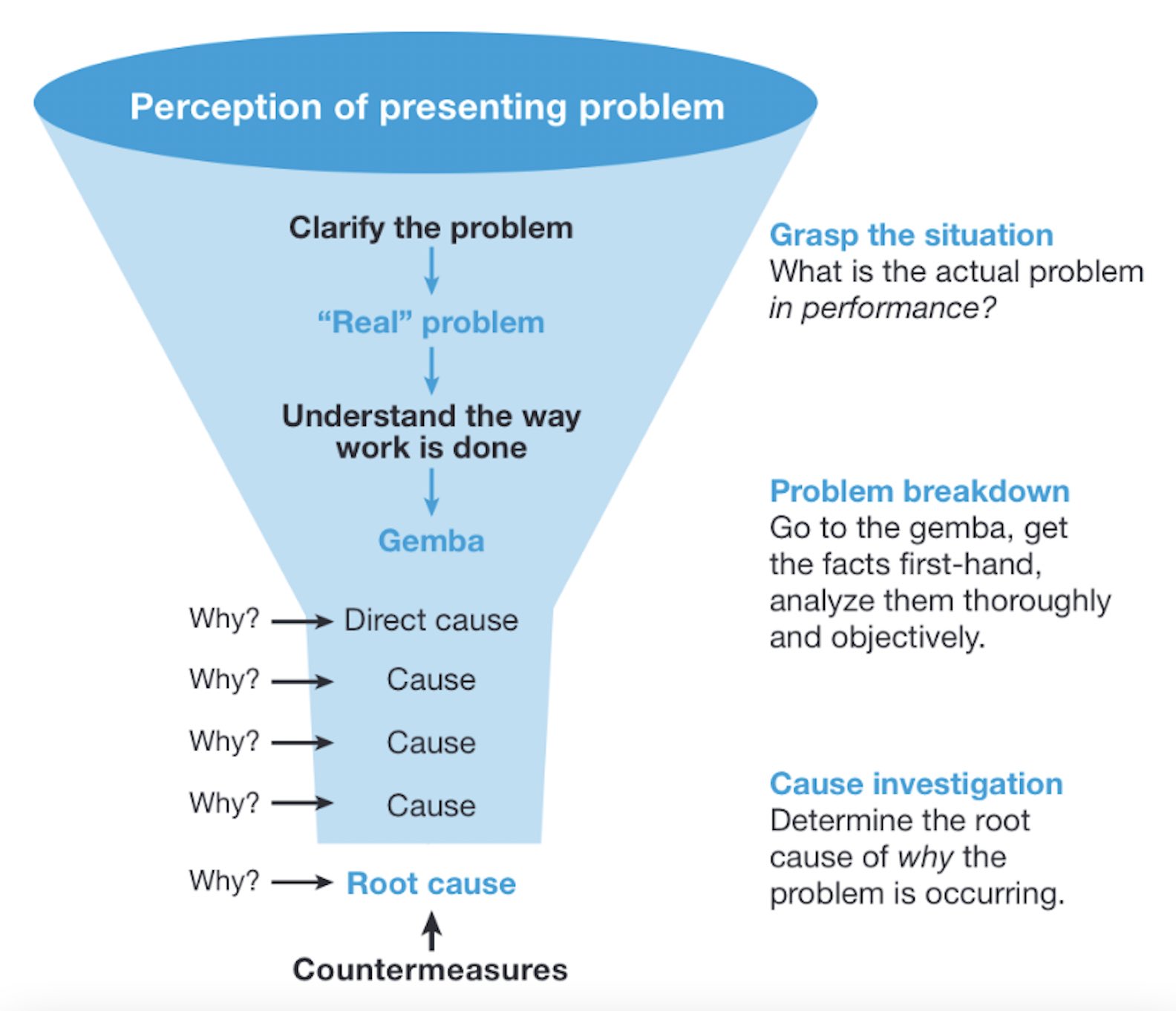
That process itself is rooted in something even older, a technique of Toyota's manufacturing floor called the five whys.
Christina HeystekHOST
Toyota's engineers found that if the machine broke down, asking why just once usually got you a surface explanation.
Christina HeystekHOST
But if you keep on asking why again and again, about five times deep, you'd eventually hit the actual root cause, not the symptom.
Christina HeystekHOST
The real answer is never sitting on the surface.
Christina HeystekHOST
It's buried under layers of logic, ego, and the stories we've gotten used to telling ourselves about why we do what we do.
Christina HeystekHOST
The Yota's five whys wasn't invented by a psychologist either.
Christina HeystekHOST
It came out of a factory floor solving mechanical problems.

Courtney CecilGUEST
And it's the double click and double click and double click.
Courtney CecilGUEST
So in the Toyota production system, like very technical there, or if anybody's familiar with Six Sigma, there is a classic root cause analysis called the five whys.
Courtney CecilGUEST
Maybe it's the seven whys.
Courtney CecilGUEST
Oh my gosh, I've been out of, I've clearly been out of school for a while.

Andrew BustamanteGUEST
wow
Michael FranzeseHOST
so interesting you know within the chapter uh you talk about the five whys and i realized as i read them how important the answer to those five whys are you explain that a little bit
Andrew BustamanteGUEST
yeah the there's this process that we use to identify the the root whether it's a root issue or a root core motivation or the the core kind of personality driver when you're trying to get to the core of something something at work something in a relationship something that you're feeling when you're trying to get to the core of it we have this process that we call the five whys and the five whys is really nothing more than asking yourself five questions or asking your target five questions that all start with the word why and are all based off the previous answer.
Andrew BustamanteGUEST
And what happens with that is essentially if you think of a person like an onion, every time you ask a new why question, you're peeling off another layer of the onion and you're getting closer to the core, closer to the center of the problem.
Andrew BustamanteGUEST
So when you're trying to ask yourself, you know, why am I mad at this person? You start by saying literally like, well, why am I upset at Gus? Oh, because Gus didn't tell me the truth.
Andrew BustamanteGUEST
It's incredible how it works.
Andrew BustamanteGUEST
So if you're smart
Michael FranzeseHOST
and you're honest with yourself, and you ask these five whys and give yourself an honest answer, it can probably save you a lot of unnecessary work in your life or unnecessary mistakes in your life, really.

Mel ShenkerHOST
And today I want to show you how I use two of my coaching tools together.
Mel ShenkerHOST
So one of them is the Vexanova technique and the other one is five whys or five levels of why.
Mel ShenkerHOST
So think of this as a mini coaching session.
Mel ShenkerHOST
So I know that we've had a lot of episodes with guests and amazing information and stuff along the way.
Mel ShenkerHOST
But today I actually want to invite you in to what it would be like being coached by me.
Mel ShenkerHOST
So grab a notebook, choose something that you've been struggling with and work through it with me.
Mel ShenkerHOST
So I want to start by introducing the five whys or five levels of why, which I tend to call it more.
Mel ShenkerHOST
The five whys isn't something that I created.

Tina BlunsdonGUEST
And that really helped them turn around to be able to have those in-depth questions.
Tina BlunsdonGUEST
The other thing I teach people is the five whys.
Tina BlunsdonGUEST
So you don't just ask why or ask a question once.
Tina BlunsdonGUEST
You then ask another question on top of that and then another one just to really get in depth of what someone's talking about.

Avril MillarHOST
So your beliefs that are sitting under all your operating system are running your life.
Avril MillarHOST
And attached to the bottom of this under this video, there is, um, a link to what's called the Five Whys technique because the reason that we do things is rarely the obvious one.
Avril MillarHOST
So you might have, for instance, I work very hard.
Avril MillarHOST
I overwork because I want to make money.
Avril MillarHOST
And why is it to feel valuable? Because I don't think I'm valuable enough.
Avril MillarHOST
So you can actually get to the reason why you do things and find that you, you have behaviors which are a response to something that you've really not wanted often to recognize, that you're running an operating system, uh, which you've inherited or then created on top of an inherited start.
Avril MillarHOST
So I think if you could use the Five Whys technique if you find yourself doing something, and you're aware that the doing, the, the doing of it is not particularly useful for you, and then you try and interrogate the belief and use the Five Whys technique.
Avril MillarHOST
And what I think is going to be really useful is that you can use that technique, but there's actually a really, really quick way to find out what your beliefs are that we're going to do in the next episode, and it's the one that all of us use all the time.

Rosanne RasoHOST
Like leadership practices that are universal outside of even that great example.
Dave MayerHOST
Yeah, I think one that comes to mind, and you didn't state this specifically, but it reminds me of the five whys, is the Toyota management philosophy.
Dave MayerHOST
And essentially, just keep asking why until you find the root cause.
Dave MayerHOST
Or maybe you could ask, why not? Oh, we can't meet this deadline.
28 MINS LATER
Dave MayerHOST
Legend, reward, winner.
Dave MayerHOST
A lot of great stuff here.
Dave MayerHOST
You didn't say it specifically, but really kind of going down through the five whys is really important.
Dave MayerHOST
I think having this robust decision-making process.

Dan GoGUEST
Like, the symptom is me overeating, especially at the end of the day." Let's just call it that.
Dan GoGUEST
Where exactly does this come from? And I like to use this process called, like, the, the five whys, which is, like, you keep on asking yourself why.
Dan GoGUEST
Even though you answer a question, you keep on asking yourself why as if you're trying to peel an onion and get deeper to the core.
Dan GoGUEST
So I asked myself these five whys.
Dan GoGUEST
So I was like, "Why do I eat at night? Oh, I eat at night because I'm stressed." Okay.
Dan GoGUEST
So, uh, why do you, uh, why do you end up eating your stress? Uh, I end up ending my, eating my stress because it just, like, makes me feel good.

Olaolu OgunyemiGUEST
It's if you want to know how your insecurities are really ins- inspiring or influencing your de- decisions today, you have to go back to where that insecurity started, find the root cause of that insecurity, and then work from there.
Olaolu OgunyemiGUEST
And the way I do it is I ask the five whys, and I know this sounds a little bit cliché because many people have heard the five whys, but I've modified it a little bit.
Olaolu OgunyemiGUEST
I say, "Why does this matter to me?" And what I found is that when we ask that simple question, let's say something happens, something as simple as, uh, you get, you get cut off in traffic and you get upset.
Olaolu OgunyemiGUEST
If you start asking, "Why does this matter to me?" Once you ask that five times, you start to realize that you can get to a root cause of something that, that dates back years.
2 more episodes mention Five whys.
Create an account to see the whole feed, search across every transcript, and follow the entities you care about.