Five Civilized Tribes
TribeWikipedia
16
MENTIONS
6
EPISODES
6
PODCASTS
Search complete. 16 mentions across 6 episodes found for "Five Civilized Tribes".
Oct 30, 2026

Brett ChapmanGUEST
such as here in Oklahoma, which is now Oklahoma, the Indian territory, which was usually land that was not as desirable.
Brett ChapmanGUEST
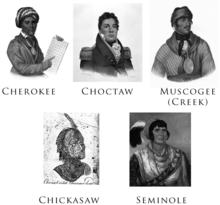
And so in Oklahoma, or I'm sorry, in the 1830s, what was called the Five Tribes, the Muscogee Creek Nation, the Cherokee Nation, the Seminole Nation, the Choctaw Nation and Chickasaw Nation, were basically all of the Southeast.
Brett ChapmanGUEST
And so the US government made treaties with them to remove them to the Indian territory, promising them that they would have complete sovereignty over their own people, regardless of whether a state was ever made there in the future.
Brett ChapmanGUEST
And that sovereignty to enact your own laws, enforce your own laws, and basically just engage in self-government.

Alice ShattuckHOST
Yes.
Alice ShattuckHOST
In addition to the Cherokee, the other four members of the Five Civilized Tribes also practiced African-American chattel slavery.
Alice ShattuckHOST
The Choctaw, Chickasaw, Muskogee, and Seminole Nations...
Alice ShattuckHOST
Muskogee! Together, these five nations adopted European-style agricultural slavery and brought enslaved black people with them to Indian Territory, modern-day Oklahoma, during the forced removals like the Trail of Tears.

Aaron ThomasHOST
Uh, some of the opposition includes the state officials in Oklahoma, and local municipal groups contested the decision, arguing that federal oversight infringes upon state-level jurisdiction and local development permits.
Aaron ThomasHOST
And why it matters to tribes, it provides the Pawnee Nation and the Five Civilized Tribes and other regional nations with an additional layer of federal regulatory defense against state overreach and industrial contamination on or near reservation boundaries.
Aaron ThomasHOST
And why this matters to all tribes and sovereignty, this r- uh, affirms the federal environmental protections can coexist with tribal governance to safeguard homelands through chelt- through true self-determination, which means pushing for tribes to hold primary regulatory control themselves.
Aaron ThomasHOST
And so again, congratulations on the tribes up there, out there in Oklahoma.

Linford D. FisherGUEST
Just to step back a bit, essentially things begin to sort of happen simultaneously in the nineteenth century.
Linford D. FisherGUEST
So eighteen oh one when the first federally funded boarding school begins to emerge and then quickly after that several more, it's happening at the same time, but in different regions, well, in some cases the same region, as other processes that begin to lean towards removal of Native people from the southeast, right? So we call Indian removal, this large scale dispossessing of Native people at gunpoint to move them west of the Mississippi, as something that doesn't just happen initially with the so-called Five Civilized Tribes, but actually happens repeatedly in different parts of the Midwest and the Plains and the West of, of North America.
Linford D. FisherGUEST
So while those removals are taking place, while the US military is becoming the strong arm of American colonialism in the upper Midwest and the Plains and eventually California, while the Civil War is raging where you have the Union army both liberating slaves and, and slave people in the South, but also contributing to the enslavement of Native people in the West, which is very contradictory and confusing, but I try to highlight that in one chapter.
Linford D. FisherGUEST
While all this is happening, these boarding schools slowly begin to rise as sort of a side way of assimilating Natives, sometimes from within sort of states that are well established, sometimes in Indian country, so-called, and then sometimes in the newer territories out west.

Dave StevensNARRATOR
William McKinley, December 6, 1897, Part 4.
Dave StevensNARRATOR
For a number of years past, it has been apparent that the conditions under which the five civilized tribes were established in the Indian territory under treaty provisions with the United States with the right of self-government and the exclusion of all white persons from within their borders have undergone so complete a change as to render the continuance of this system thus inaugurated practically impossible.
Dave StevensNARRATOR
The total number of the five civilized tribes, as shown by the last census, is 45,494, and this number has not materially increased.
Dave StevensNARRATOR
While the white population is estimated at from 200,000 to 250,000, which, by permission of the Indian government, has settled in the territory, the present area of the Indian territory contains 25,694,564 acres, much of which is very fertile land.
Dave StevensNARRATOR
The United States citizens residing in the territory, most of whom have gone there by invitation or with the consent of the tribal authorities, have made permanent homes for themselves.
Dave StevensNARRATOR
It has been found impossible for the United States citizen to keep its citizens out of the territory, and the executory conditions contained in the treaties with these nations have for the most part become impossible of execution.
Dave StevensNARRATOR
Nor has it been possible for the tribal governments to secure to each individual Indian his full enjoyment in common with other Indians of the common property of the nations.
Dave StevensNARRATOR
Friends of the Indians have long believed that the best interests of the Indians of the five civilized tribes would be found in American citizenship, with all the rights and privileges which belong to that condition.

Liz DyeHOST
So I mean, look, it's just a scam to steal the land.
Andrew TorrezHOST
Yeah, and another way in which we know this is that initially, Section 8 of the Dawes Act exempted what were known as the so-called Five Civilized Tribes, the Cherokee, the Creek, the Choctaw, the Chickasaw, and the Seminole, plus, plus a, plus a few others.
Andrew TorrezHOST
And the reason for that Section 8 exemption was that, a- as we have said, those tribes by treaty owned their land in fee simple, by patent, right? Not as a federal trust.
Andrew TorrezHOST
And so at this time, the, the federal go- uh, you know, even Senator Dawes was like, "Look, we, we can't just announce that we're gonna carve up land we don't own." So the first step was 1893, Congress creates the Dawes Commission and sends this commission out to Indian Territory to negotiate with the Five Civilized Tribes to get them to agree to allotment.
Andrew TorrezHOST
And, uh, about a year later, the commission reports back to Congress and says that the Creek, quote, "Would not under any circumstances agree to cede any portion of their lands to the federal government."
Liz DyeHOST
So Congress responded with the Curtis Act of 1898, which says, "Fine, you don't agree.
9 MINS LATER
Andrew TorrezHOST
Uh, show us where Congress used the specific words 'disestablish' or 'go home.'" I mean, Gorsuch's opinion even cites to a Federal Arbitration Act case for the proposition that, a- and, and here's what he cites, "Our charge is usually to ascertain and follow the original meaning of the law before us." And, uh, right? The four liberals signed onto that.
Andrew TorrezHOST
So, you know, Gorsuch gets there by looking at the two most significant laws that were passed by Congress in 1906 and 1907.