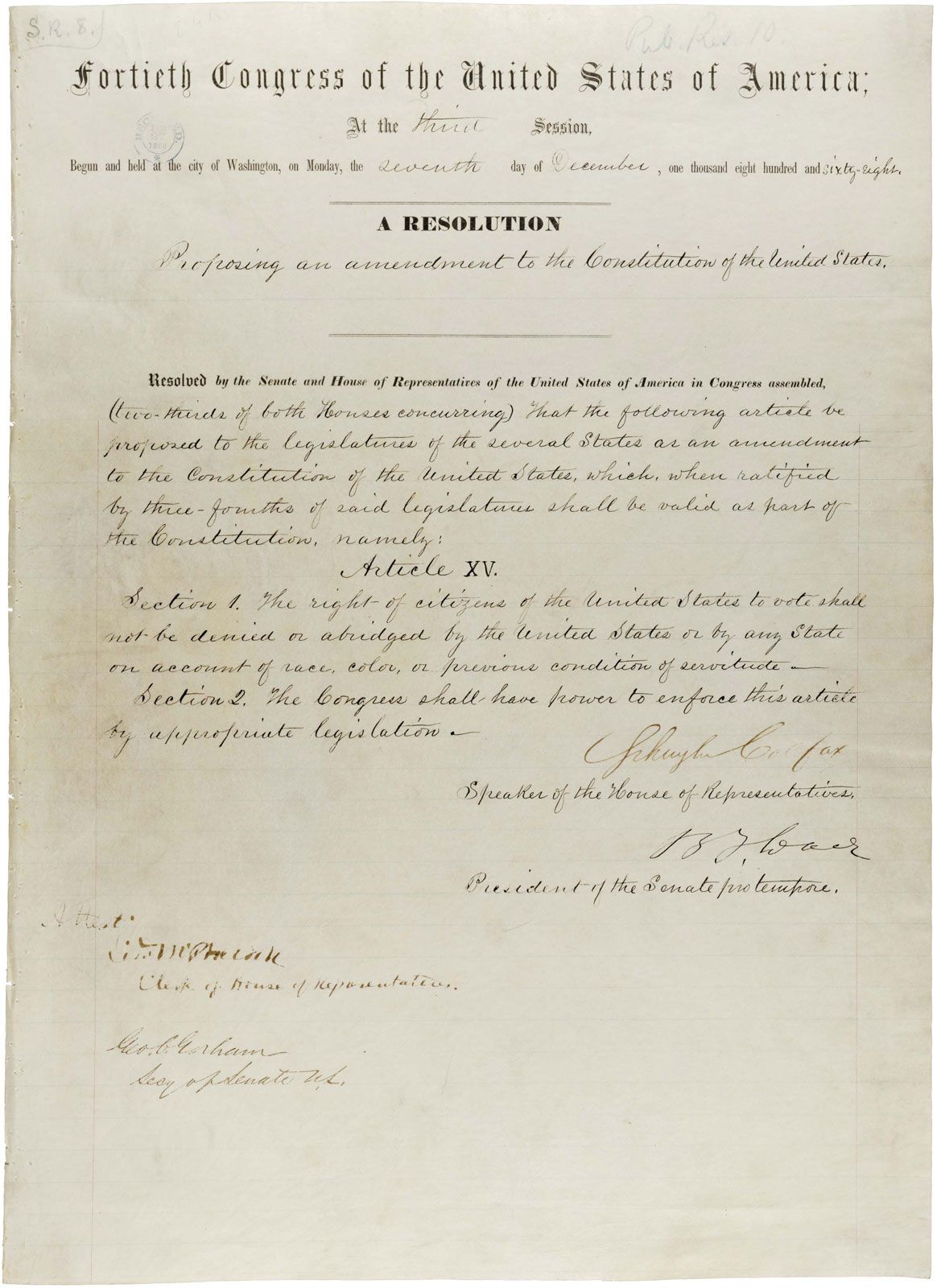
Fifteenth Amendment to the United States Constitution
Constitutional amendmentWikipedia
121
MENTIONS
68
EPISODES
62
PODCASTS
Search complete. 121 mentions across 68 episodes found for "Fifteenth Amendment to the United States Constitution".
Oct 29, 2026

AndyHOST
And now we're going to play a two truths and a lie.
AndyHOST
The 15th Amendment.
KellyPANELIST
Okay,
AndyHOST
yeah.

Steven HuefnerGUEST
But most of those statutes are, historically speaking, relatively recent.
Steven HuefnerGUEST
And we go back mainly to the Voting Rights Act of 1965, which was an effort to provide more meaningful protection of voting rights than the 15th Amendment, which was adopted just after the Civil War to prohibit discrimination on the basis of race in how elections were conducted.
Steven HuefnerGUEST
But that 15th Amendment despite its aspirations, had not been particularly effective as Jim Crow laws took hold throughout the South.
Steven HuefnerGUEST
And those were, of course, enforced in ways that had a dramatic disenfranchising effect on primarily Black voters.
Steven HuefnerGUEST
And so Congress in 1965 said, we want to do more to try to make voting more accessible to all Americans and to prevent racial discrimination in voting, the Voting Rights Act then is in fact one of the key sources for the Department of Justice's monitoring program that, as Andrew was describing, has existed long before this election.

Lurie Daniel FavorsHOST
I mean, not in any enforceable, meaningful way.
Lurie Daniel FavorsHOST
We technically had it with the 15th Amendment, but then white people's racism came and kicked that out the bill.
Lurie Daniel FavorsHOST
So that didn't work for very long.
Lurie Daniel FavorsHOST
I'm saying this because from 1619 until 1965, that is like a 345-year period out of the 400-plus years of this country's existence that we have not had a democracy.
5 MINS LATER
Lurie Daniel FavorsHOST
It's not just about having a presidential election and then being done.
Lurie Daniel FavorsHOST
It's about having a presidential election recognizing that presidents pick judges.
Lurie Daniel FavorsHOST
And when presidents pick judges and they install them for lifetime positions who are going to be able to interpret the 13th, 14th, and 15th Amendment, who are going to look at what an EPA act and what a Green New Deal is going to be able to do and to protect black and brown communities that have traditionally suffered under environmental racism.
Lurie Daniel FavorsHOST
When you have judges who are going to have the ability to essentially either bring us forward or take us back into Jim Crow, that matters.

Doug DoudsGUEST
So now it's going to be about emancipation, which is initially just executive authority.
Doug DoudsGUEST
But as we see with 13, 14, 15th Amendment to make that permanent.
Doug DoudsGUEST
And so the war aims are changing on the Union side.
Doug DoudsGUEST
So they are at the strategic level.

Hunter ParnellHOST
And what they're going to be hiding from you is that this is actually a great way to undo Reconstruction.
Hunter ParnellHOST
Like this is the vehicle in criminal law that can be another step in undoing the work of the 13th, 14th and 15th Amendment.
Hunter ParnellHOST
And I think that people need to be very on guard for this because it is not on the radar of people who don't think about the criminal legal system.
Hunter ParnellHOST
It's there's so much going on between Iran and tariffs and whatever the guy's tweeting every day that it's easy to lose track of this.

Michael G. MillerGUEST
The Reconstruction Amendments, for those who need a refresher, are the 13th, 14th, and 15th Amendments.
Michael G. MillerGUEST
The 15th Amendment is the really important one for our story.
Michael G. MillerGUEST
It's the one that disallows any voting bans on account of race.
Michael G. MillerGUEST
So neither Congress nor the states is allowed to directly disenfranchise someone based on the color of their skin.
Michael G. MillerGUEST
What's also important in there is the second section of this amendment.
Michael G. MillerGUEST
It's the one that probably is not taught in school and a lot less discussed, which gives Congress the power to act when states or municipalities infringe on people's voting rights on account of their race.
Michael G. MillerGUEST
The problem is that for a 90-year period after the 15th Amendment is enacted, the Supreme Court is not a partner in enforcing it.
Michael G. MillerGUEST
Indeed, it explicitly says that this is really only going to bind on federal actions and it really puts individuals or the state beyond the reach of federal action.

Stephanie PonzaneliHOST
So 14th Amendment, state and local governments.
Stephanie PonzaneliHOST
15th Amendment, the federal government.
Stephanie PonzaneliHOST
The way that I remembered it too is Fifth Fed, Fifth Fed.
Stephanie PonzaneliHOST
So hopefully that helps you.

SarahHOST
Those amendments were originally written mainly as limits on the federal government.
SarahHOST
But what would happen when a state violated a person's rights? What would the Constitution do about the millions of people it had allowed to be enslaved? Today, we are unlocking the 13th, 14th, and 15th Amendments, how they transformed the Constitution after the Civil War, what each one promised, and why writing rights into the Constitution did not automatically make those rights a reality.
SarahHOST
To understand why any of these amendments mattered, we need to go back to the beginning.
SarahHOST
In 1787, delegates gathered in Philadelphia to write the United States Constitution.

Michael ZeldinHOST
Exactly.
Michael ZeldinHOST
And though, of course, the election of Lincoln gets us the passage of the 13th, 14th, 15th Amendment.
Michael ZeldinHOST
So when you talk about the consequences of that election, it's...
Dana BashGUEST
Not to mention the Emancipation Proclamation, which, by the way, he was not...

Kevin MorrisGUEST
Thanks so much for having me on, Chris.
Krys BoydHOST
What did the Voting Rights Act achieve that the 14th and 15th Amendments could not do on their own?
Kevin MorrisGUEST
That's a great place to start.
Kevin MorrisGUEST
Often people say, talk about 1965.
Kevin MorrisGUEST
It brings Black Americans who had just so recently been enslaved into our political process.
Kevin MorrisGUEST
But then in 1876, the Supreme Court strikes down some of the tools that Congress had passed, some of the laws that they had passed called the Enforcement Acts.
Kevin MorrisGUEST
They passed these laws to actually make good on the promises of the 14th and 15th Amendments.
Kevin MorrisGUEST
And the Supreme Court said, you can't do it like that.
58 more episodes mention Fifteenth Amendment to the United States Constitution.
Create an account to see the whole feed, search across every transcript, and follow the entities you care about.