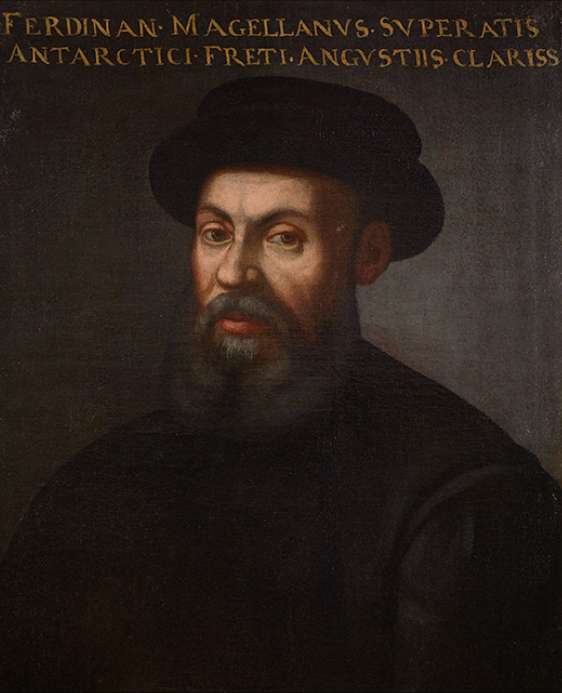
Ferdinand Magellan
Portuguese explorerWikipedia
257
MENTIONS
34
EPISODES
31
PODCASTS
Search complete. 257 mentions across 34 episodes found for "Ferdinand Magellan".
Oct 5, 2026

JoeyHOST
...
JoeyHOST
Ferdinand Magellan is my conquistador.
JoeyHOST
Christopher Columbus can never, dude.
JoeyHOST
[laughs]
Jack KellyHOST
Shout out Ferdinand Magellan, dude.
Jack KellyHOST
I had did a history project on him.
Jack KellyHOST
He just wanted to find the Fountain of Youth.

Aaron BennettNARRATOR
Thus began a long Marine presence on Guam.
Aaron BennettNARRATOR
The island, southernmost of the Marianas chain, was discovered by Ferdinand Magellan in 1521, but not occupied until 1688 when a small mission was established there by a Spanish priest and soldiers.
Aaron BennettNARRATOR
When control of the rest of the Mariana Islands, including Saipan and Tinian, all once German possessions, was given to Japan as a mandate power in 1919, Guam became an isolated and highly vulnerable American outpost in a Japanese sea.
Aaron BennettNARRATOR
This American territory, 35 miles long, nine miles at its widest and four at its narrowest, shaped like a peanut, with a year-long mean temperature of 79 degrees, fell quickly and easily in the early morning of 10 December 1941.

Grey FilastineHOST
Apparently, it's the 500-year anniversary of the first circumnavigation of the world.
Grey FilastineHOST
Ferdinand Magellan departed from Europe with five ships in the year 1519, with the same destination as Arcaquinaria, the Spice Islands.
Grey FilastineHOST
Although, long before the existence of the Panama Canal, his ships had to prod the South American coastline, sailing up each major river delta in a dangerous search for a path to the Pacific.
Grey FilastineHOST
It is geography's greatest irony that one hemisphere of Earth and most of its natural features are named after a trio of men who considered the whole continent an annoying obstacle.
Grey FilastineHOST
Columbus died a bitter man, refusing to accept his failure to find a western route to the Spice Islands.
Grey FilastineHOST
The entire continent is named for Amerigo Vespucci, who also spent his life parting the new continent's coastline in a fruitless search for a sea route towards the islands that we now call Indonesia.
Grey FilastineHOST
And Magellan's biggest namesake is the shortcut he finally found through the bottom of the Americas.
Grey FilastineHOST
The Portuguese were already going around Africa to reach Asia.

speaker_3NARRATOR
The Voyages of Discovery.
speaker_3NARRATOR
European discovery of the Philippines began with the great voyage of Magellan.
speaker_3NARRATOR
In recounting this discovery of the islands, there is the priceless narrative of one of Magellan's company, Antonio Pigafetta.
speaker_3NARRATOR
His book was written in Italian, but was first published in a French translation.
speaker_3NARRATOR
The original copies made by Pigafetta have disappeared, but in eighteen hundred, a text was discovered in the Ambrosian Library of Milan, Italy, and published.
speaker_3NARRATOR
Translations into English and other languages exist.
speaker_3NARRATOR
It may be found in several collections of voyages, and there is a good Spanish translation edition of recent date.
speaker_3NARRATOR
There are several other accounts of Magellan's voyage, but Pigafetta's was the best one written by an eyewitness, and his descriptions of the Bisaya Islands, Cebu, Borneo, and the Moluccas are wonderfully interesting and accurate.
speaker_3NARRATOR
The Voyages of Discovery.
speaker_3NARRATOR
European discovery of the Philippines began with the great voyage of Magellan, and recounting this discovery of the islands, there is the priceless narrative of one of Magellan's company, Antonio Pigafetta.
speaker_3NARRATOR
His book was written in Italian, but was first published in a French translation.
speaker_3NARRATOR
The original copies made by Pigafetta have disappeared, but in 1800 a text was discovered in the Ambrosian Library of Milan, Italy, and published.
speaker_3NARRATOR
Translations into English and other languages exist.
speaker_3NARRATOR
It may be found in several collections of voyages, and there is a good Spanish translation edition of recent date.
speaker_3NARRATOR
There are several other accounts of Magellan's voyage, but Pigafetta's was the best one written by an eyewitness, and his descriptions of the Bisaya Islands, Cebu, Borneo, and the Moluccas are wonderfully interesting and accurate.
speaker_3NARRATOR
There were several voyages of discovery between Magellan's time, 1521, and the Gospy's time, 1565.

Timothy FergusonNARRATOR
Earlier, on 21 June 1898, First Lieutenant John Twiggs' handsome Jack Myers had led a party of Marines ashore from the protected cruiser Charleston to accept the surrender of the Spanish authorities.
Timothy FergusonNARRATOR
who didn't know that a state of war then existed between spain and the united states thus began a long marine presence on guam the island southernmost of the marianas chain was discovered by ferdinand magellan in fifteen twenty one but not occupied until sixteen eighty eight when a small mission was established there by a spanish priest and soldiers when control of the rest of the mariana islands including saipan and tinian all once german possessions was given to japan as a mandate power in nineteen nineteen guam became an isolated and highly vulnerable american outpost in a japanese sea this american territory thirty-five miles long nine miles at its widest and four at its narrowest shaped like a peanut with a year-long mean temperature of seventy-nine degrees fell quickly and easily in the early morning of ten december nineteen forty one much of the japanese attack on guam came from her sister island of saipan one hundred fifty miles to the north the governor of guam captain george j macmillan the island governor was always
speaker_1ADVERTISER
a u s navy officer
Timothy FergusonNARRATOR
aware that he could expect no reinforcement or relief decided to surrender the territory to japanese naval forces foremost in his mind was the fate of the twenty thousand guamanians all american nationals who would inevitably suffer if a strong defense was mounted he felt the situation was simply hopeless he sent word to the one hundred fifty three marines of the barracks detachment at samay on a rote peninsula and the eighty man insular guard to lay down their arms even so in two days of bombing and fighting the garrison lost nineteen men killed and forty two wounded including four marines killed and twelve wounded operation forger in late nineteen forty three both the joint chiefs of staff jcs and later the combined chiefs of staff ccs agreed to the further direction of the pacific war general douglas macarthur commander of the southwest pacific area was to head north through new guinea to regain the philippines admiral chester w nimitz commander-in-chief u s pacific fleet and pacific ocean areas sinkpak sinkpoa proposed a move through the central pacific to secure a hold in the marianas the strategic bombing of japan would originate from captured fields on guam saipan and tinian the new strategic weapon for these attacks would be the be twenty nine bomber which had a range of three thousand miles while carrying ten thousand pounds of bombs the code name of the marianus operation was forager the central pacific drive began with the landing on tarawa in november nineteen forty three followed by the landings in the kwajalein atoll on roi nemur aniwatok and kwajalein itself In January 1944, Admiral Nimitz made final plans for Guam and selected his command structure for the Marianas campaign.

Arif HodzicNARRATOR
[gentle music] During the Age of Discovery, men set sail from Europe in search of new lands, wealth, and power.
Arif HodzicNARRATOR
One of these men was the Portuguese navigator Ferdinand Magellan, who was born in the late fifteenth century.
Arif HodzicNARRATOR
His travels to South America and the Philippines would go down in history.
Arif HodzicNARRATOR
This evening, we'll learn all about the Magellan expedition, an epic journey that changed people's understanding of the world.
Arif HodzicNARRATOR
We'll also look at Magellan himself and explore his complex legacy.
Arif HodzicNARRATOR
So just relax and let your mind drift as we explore the sleepy history of Ferdinand Magellan.
Arif HodzicNARRATOR
[fire crackling] Around the year 1480, Ferdinand Magellan was born in northern Portugal.
Arif HodzicNARRATOR
His family were minor nobility.

Una McIlvennaGUEST
But when it comes to the Pacific, that's a much more closely guarded secret.
Una McIlvennaGUEST
Thanks to Magellan, who's already circumnavigated the globe, the Spanish have information about the Pacific and they guard it very, very closely.
Una McIlvennaGUEST
So they know the coastline of South America very quite well from Chile right up to central Mexico because they are getting their silver and gold from Peru and they're transporting it up to central Mexico.
Una McIlvennaGUEST
So they've got that whole coastline up to parts of the California coast quite well mapped.
Una McIlvennaGUEST
So Martin Frobisher will try and find that.
Una McIlvennaGUEST
So the English are very much behind the Igbo and the Spanish are well, well in advance of them.
Suzanne HillHOST
So when Magellan's expedition, I mean, Magellan was killed before he completed it.
Suzanne HillHOST
So when that was completed, though, and that expedition had circumnavigated the world, everyone knew he'd done it, did they? It was just the maps that were kept secret.

KaylaHOST
So let's start with the earliest account that I've seen.
KaylaHOST
So in 1520, Ferdinand Magellan's expedition led him to the coast of what we now know as Patagonia.
KaylaHOST
it's around the southern end of south america and one of the men traveling with um ferdinand was a man named antonio pigafetta now thankfully pigafetta was a journal person he wrote down everything about his voyages this one in particular was very descriptive so he described unusually large humans and when i say unusually large some accounts from different people mind you said that they were so much taller than the average european that a normal a guy's normal height at that time would be around their waist area so we're talking nearly twice the size of a average heighted person let's say five five that's still like a 10 foot person now of course because this always happens right and i feel like that's another reason why the giants hide not because i don't know i don't want people to feel bad for them because i don't think the giants are good honestly but i think they know what humans can do Of course, Pigafetta, McGowan, and the rest of the crew decided that they were going to capture two of these men.
KaylaHOST
And they literally took them on the ship, trying to get them home to study them or maybe gallivant them around talking about their new discovery.
24 more episodes mention Ferdinand Magellan.
Create an account to see the whole feed, search across every transcript, and follow the entities you care about.