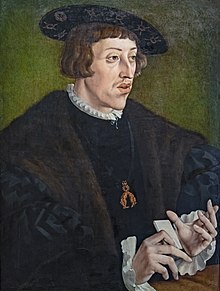
Ferdinand I, Holy Roman Emperor
Former Holy Roman emperorWikipedia
52
MENTIONS
18
EPISODES
16
PODCASTS
Search complete. 52 mentions across 18 episodes found for "Ferdinand I, Holy Roman Emperor".
Sep 28, 2026

Piotr NaterNARRATOR
These representations prevailed and it was as a Catholic that Stephen Bathory came to Poland, to the great disappointment of the Protestants.
Piotr NaterNARRATOR
It is true that, during the eleven years of his reign, 1575 to 1586, he never persecuted them, but he allowed himself to be entirely won over by the Jesuits, who represented themselves to him, as they had done to Emperor Ferdinand I, as zealous friends of learning, of general culture, and especially of the intellectual and moral elevation of the clergy.
Piotr NaterNARRATOR
Under his reign the Jesuits penetrated into Poland proper and soon a close network of their colleges extended over the whole realm.
Piotr NaterNARRATOR
As everywhere else they neglected the education of the common people, but took extreme pains to draw the sons of the nobility to their establishments and successfully.

Claire DonaldHOST
Exactly.
Claire DonaldHOST
And the deaths of her siblings between 1497 and 1500, Juana's older brother, Juan.
Claire DonaldHOST
Oh.
Tess BellomoHOST
Oh, Juan.
6 MINS LATER
Tess BellomoHOST
Or they kill their wives or they beat their wives.
Tess BellomoHOST
It's kind of just like.
Claire DonaldHOST
Meanwhile, her brother-in-law, King Henry VIII, is about to become, like, one of the most evil men in history.
Claire DonaldHOST
And, like,

Thomas777GUEST
And I think had there been more of a common front against the papacy, that would have been different, but even something short of an open military alliance.
Thomas777GUEST
But the It was on August 19th, the Bohemian estates declared that they were rescinding their recognition of Ferdinand's election, you know, concomitantly declaring that Frederick was their king.
Thomas777GUEST
Ferdinand was subsequently elected Holy Roman Emperor nine days later, which made war inevitable if Frederick accepted the Bohemian crown in lieu of bowing out with something approaching honor.
Thomas777GUEST
And he may very well have done that as most of his advice, in addition to being snubbed by his father-in-law, James, almost all of Frederick's advisory cabinet urged him to reject it, including the Duke of Savoy.
Thomas777GUEST
However, who he did enjoy backing from was Maurice of Orange and Christian of Anhalt, both of whom commanded substantial military forces in their own right.
2 HRS 53 MINS LATER
Thomas777GUEST
You know, it was a settlement that attended wider constitutional reforms that, you know, gave relief to poorer fiefdoms in terms of tax obligations and quotas.
Thomas777GUEST
And it tried to create some kind of uniformity in currency and elements of public order and like a rudimentary kind of policing and things like this.
Thomas777GUEST
But most importantly, Emperor Ferdinand pushed through as an aspect of the empire's fundamental legal regimen that there had to be a basic tolerance for the confessional orientation of fiefdoms under a common lordship.

ThomasGUEST
But the, uh...
ThomasGUEST
Ferdinand was, uh, for context, Ferdinand was, uh, the king of, uh, Bohemia.
ThomasGUEST
He was the Duke of Styria or the Prince of Styria.
ThomasGUEST
I can't remember his exact title.
ThomasGUEST
And he, he was on record as saying one time that he'd, he'd rather see his l- he'd rather see his kingdom destroyed than, than for heresy to be tolerated within its borders.
ThomasGUEST
Um, he was elected, uh, king of Bohemia by the electors in the Homi- Holy Roman Empire in the previous May, 1617.
ThomasGUEST
And Ferdinand, he declared that he would tolerate Protestant religious freedoms, many of which were laid down by the Peace of Augsburg, and we'll get into what that, the implications of that were.
ThomasGUEST
But owing to his, um, owing to his record of persecuting Protestants and outright crushing nascent Protestant revolts, there was a great concern over what his tenure would look like.

Adam JohnsonHOST
The very doctrine he had refused to renounce in front of the Inquisition.
Adam JohnsonHOST
The imperial throne was occupied by King Ferdinand, but his son, Archduke Maximilian, was the heir apparent.
Adam JohnsonHOST
and his court would become famous as one of the most tolerant in Europe.
Adam JohnsonHOST
Maximilian himself leaned toward Protestant thinking.
Pete QuiñonesHOST
The same month, the German parliament echoed the Austrians' warning against the rampant financial domination of Judaism.
Pete QuiñonesHOST
The Jews were bandits ten times over in their domination of the House of Austria, and took firm hold under Ferdinand I, brother of the Emperor Carlo Quinto.
Pete QuiñonesHOST
In Austria, they were permitted entry, and they remained there as servants of the Holy Emperor up to the time of Tursa, who favored them and permitted them to go into various provinces.
Pete QuiñonesHOST
In the German countries, there was an interdict on their... and introduced on their entry, except in Vienna.
Pete QuiñonesHOST
The same month, the German parliament echoed the Austrians' warning against the rampant financial domination of Judaism.
Pete QuiñonesHOST
The Jews were bandits ten times over in their domination of the House of Austria, and took firm hold under Ferdinand I, brother of the Emperor Carlo Quinto.
Pete QuiñonesHOST
In Austria, they were permitted entry, and they remained there as servants of the Holy Emperor up to the time of Tursa, who favored them and permitted them to go into various provinces.
Pete QuiñonesHOST
In the German countries, there was an interdict on their... and introduced on their entry, except in Vienna.

JoelHOST
I have a lot of respect for some of the discipline and rigor that goes into that.
JoelHOST
I personally don't hold to Tulip Calvinism as a personal doctrine.
JoelHOST
I don't think that's any... any surprise for people who watch a lot of these episodes, but I understand how people get there.
JoelHOST
And I think there's a, it's a worthwhile discussion if that discussion can be had civilly, which is not what happened in the 80 years.
35 MINS LATER
JoelHOST
So you have the Seabeggers and William of Orange, who is a Spanish Catholic, is standing on the sidelines.
JoelHOST
He's like, all right, I really need the Netherlands to win.
JoelHOST
I'm footing the bill personally for a lot of this stuff.
JoelHOST
The Seabeggers are winning, but I'm technically the wrong side of this.

speaker_3UNKNOWN
Last year's accompanying exhibition focused on the fate of the royal insignia during the Second World War.
speaker_3UNKNOWN
This year's exhibition, subtitled The Habsburgs 500, traces the history of the crown jewels, from Ferdinand I's accession to the throne in 1526 to the end of the 18th century.
speaker_3UNKNOWN
It follows the jewels from their storage at Karlstein Castle through their transfer to Vienna during the Thirty Years' War to their ceremonial return to Prague in 1791.
speaker_3UNKNOWN
It was then that they became one of the modern symbols of Czech statehood, historical continuity and national identity.
8 more episodes mention Ferdinand I, Holy Roman Emperor.
Create an account to see the whole feed, search across every transcript, and follow the entities you care about.