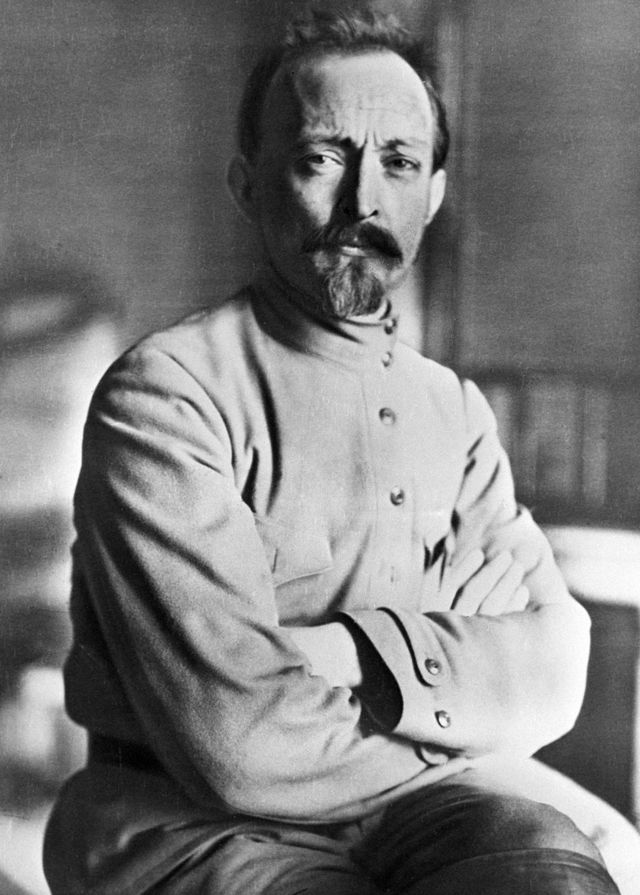
Felix Dzerzhinsky
Revolutionary and politicianWikipedia
24
MENTIONS
13
EPISODES
10
PODCASTS
Search complete. 24 mentions across 13 episodes found for "Felix Dzerzhinsky".
Oct 18, 2026

J. Otto PohlGUEST
But they all are from the Pale of Settlement, and a lot of them have, uh, Jewish spouses.
J. Otto PohlGUEST
For instance, the first head of the Cheka, Dzerzhinsky, was Polish, but his wife was Jewish.
J. Otto PohlGUEST
The second guy, Menzhinsky, is Polish, but as I said, already, uh, assuming power in '23.
J. Otto PohlGUEST
He's, he's already, uh, have to basically give over running of the organization to Yagoda because he's not physically able to do it himself.

Michael MoynihanHOST
You don't find that in Russia.
Michael MoynihanHOST
And you see that the kind of resuscitation of old kind of Soviet myths and statues of Dzerzhinsky going back up, etc.
Michael MoynihanHOST
Like it's important, right, to control that narrative.
Michael MoynihanHOST
But the incredible thing to me, and I'm wondering what you think about this.
Pete QuiñonesHOST
However, we should be wary of possible exaggerations here as we remember similar accusations in espionage made by Russian military authorities during the war in 1915.
Pete QuiñonesHOST
The Soviets quickly formed a revolutionary government for Poland headed by F. Dzerzhinsky.
Pete QuiñonesHOST
In it were Y. Markalevsky and F. Kohn.
Pete QuiñonesHOST
Of course, they were surrounded by bloodwork specialists and ardent propagandists.

Pete QuiñonesHOST
However, we should be wary of possible exaggerations here as we remember similar accusations in espionage made by Russian military authorities during the war in 1915.
Pete QuiñonesHOST
The Soviets quickly formed a revolutionary government for Poland headed by F. Dzerzhinsky.
Pete QuiñonesHOST
In it were Y. Markalevsky and F. Kohn.
Pete QuiñonesHOST
Of course, they were surrounded by bloodwork specialists and ardent propagandists.

Martin Cruz SmithGUEST
I see them in different places, in- in different offices.
Martin Cruz SmithGUEST
I'll see a statue of Dzerzhinsky, who was the first, uh, head of the secret police.
Martin Cruz SmithGUEST
Or I'll see a- a- a portrait of- of Stalin.
Martin Cruz SmithGUEST
And then I read, uh, I talk to Russians, and they say, "Yes.

Michael RossiGUEST
You wanted to get rid of your Lenin statues.
Michael RossiGUEST
You want to rename streets that were previously named after Stalin or Dzerzhinsky.
Michael RossiGUEST
Go ahead.
Michael RossiGUEST
But the minute that you start dismantling monuments to the Red Army or, you know, statues to Yuri Gagarin or Pushkin, this is now seen as an attempt at de-rucifying the country.

Simon WhistlerHOST
Tell everyone you can." Lenin soon fell into a coma and was declared dead later that day.
Simon WhistlerHOST
Joseph Stalin, General Secretary of the Communist Party and Lenin's right-hand man, immediately took charge of the funeral arrangements, assembling a special committee called the Commission for Organizing Lenin's Funeral, headed by Felix Dzerzhinsky, head of the OGPU secret police.
Simon WhistlerHOST
Shortly after Lenin's first stroke in 1922, Stalin had met secretly with Politburo members to discuss what to do in the event of the leader's death.
Simon WhistlerHOST
While Stalin suggested that Lenin's body be preserved and displayed for all Soviet citizens to see, the others balked at this idea, likening it to the worship of saints' corpses and other holy relics in the Russian Orthodox Church, to which the new communist state was vehemently opposed.

William CooperHOST
Its main task became the neutralization and dissolution of genuine political opposition by nationalists and anti-Soviet intellectuals.
William CooperHOST
The KGB was ordered to create controlled political opposition and to introduce it to Western intelligence services along the lines of Dzerzhinsky's trust.
William CooperHOST
As this Mr. Golitsyn revealed in the early 1960s, the KGB began the creation of a controlled dissident movement with a skillful controlled dispute between liberal writers like Alexander Bardovsky, Yevgeny Yevtushenko, and Nikolai Voznesinsky, and conservatives like Vsevolod Kochetov.
William CooperHOST
The KGB recruited and developed important agents of influence allied with the dissidents among leading Soviet scientists like Andrei Sakharov and Peter Kapitsa.

Giles MiltonGUEST
She's called Claire Sheridan, and she sculpts several of the main, the principal architects of the revolution.
Giles MiltonGUEST
She sculpts Lenin, uh, Dzerzhinsky, and she c- sculpts Trotsky.
Giles MiltonGUEST
So she spends a lot of time on her own in the room with him, and they develop a very, very close friendship.
Giles MiltonGUEST
Claire Sheridan is a great believer in free love.
9 MINS LATER
William DalrympleHOST
You thought Trotsky would double-check or someone else would call him up and say, "Where are you?"
Giles MiltonGUEST
Well, Stalin had thought of that as well.
Giles MiltonGUEST
He calls his old mate Dzerzhinsky, running the checker, and ensures that any telegrams and any messages sent to Trotsky to tell him the date has been changed, um, don't get through.
Giles MiltonGUEST
And so on the day of the funeral, Stalin, center stage, delivers a eulogy.
3 more episodes mention Felix Dzerzhinsky.
Create an account to see the whole feed, search across every transcript, and follow the entities you care about.