Federal Writers' Project
Government agencyWikipedia
15
MENTIONS
14
EPISODES
14
PODCASTS
Search complete. 15 mentions across 14 episodes found for "Federal Writers' Project".
Nov 3, 2026

speaker_28NARRATOR
Transcriptions Thousands of pages of handwritten and typed interviews conducted between 1936 and 1940 by government writers who were sent into homes across 24 states with a single instruction, get their stories before they're gone.
speaker_28NARRATOR
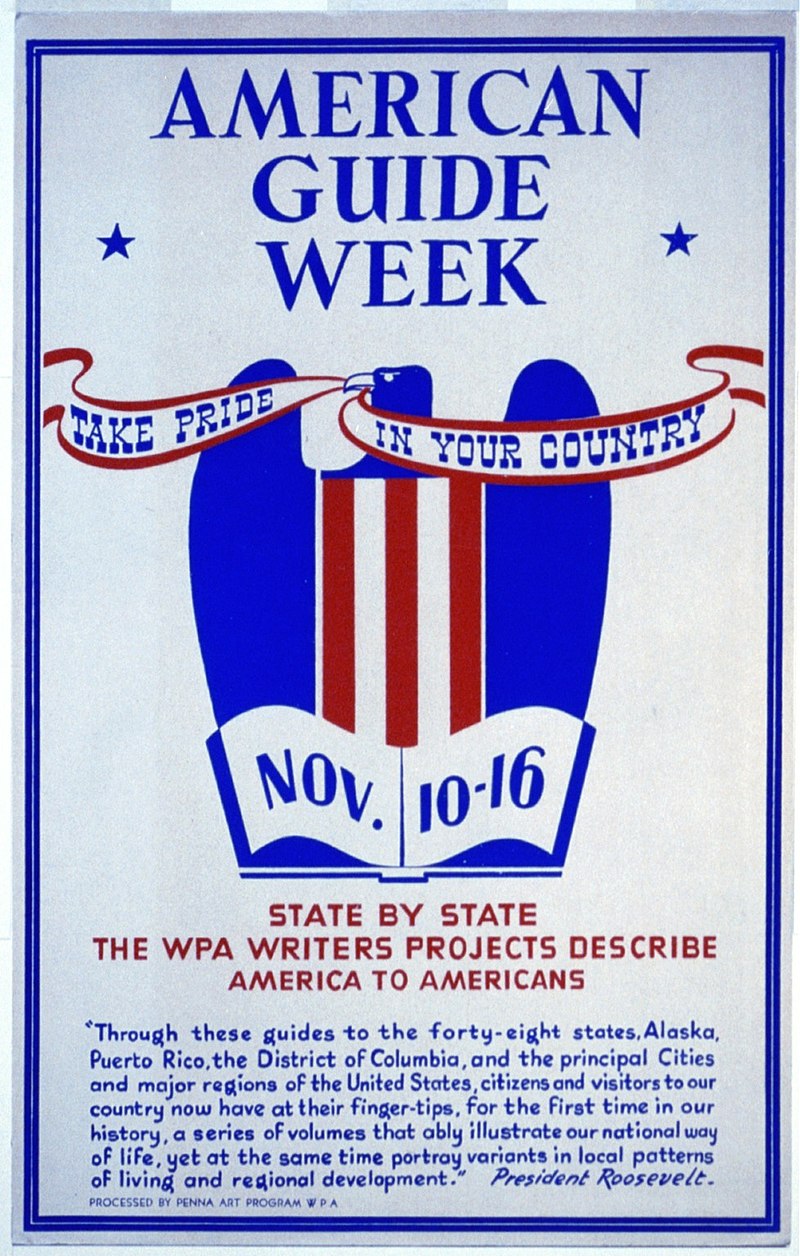
The programme was called the Federal Writers' Project, a branch of Roosevelt's New Deal that employed out-of-work journalists, novelists and researchers to document the lives of ordinary citizens.
speaker_28NARRATOR
They collected 2,900 life histories.
speaker_28NARRATOR
Then they filed them in the Library of Congress, where they sat mostly unread for nearly 40 years.

Brandon SchexnayderHOST
You see, back in the 30s, a local Gullah woman named Addie Knox shared an account of a strange creature she claimed to have encountered while traveling through the woods near her home.
Brandon SchexnayderHOST
And her story was recorded by Genevieve Wilcox Chandler, a local folklorist collecting oral histories for the Federal Writers Project, an initiative established during the Great Depression preserved the stories and traditions of communities throughout the U.S. Well, fortunately for us, Addie's account was published in a 1941 collection of South Carolina folklore.
Brandon SchexnayderHOST
Addie claimed that her encounter took place one evening while she was out clamming near a swampy stretch of countryside known locally as Parsonage Branch.
Brandon SchexnayderHOST
And on this particular occasion, she said that the tide had come in rather late, leaving her out traveling through the woods just as the last of the daylight was starting to fade.

Count ChoculaHOST
Thank you, Charlie.
Count ChoculaHOST
I should stipulate that in addition to Charlie's recollections, the source for today's episode would have included Federal Writers Project in Oregon, an article by Tom Nash, published August 26, 2022 in the Oregon Encyclopedia.
Count ChoculaHOST
That is our show for today.
Count ChoculaHOST
Thanks again for listening.

Richard RomanHOST
She was a dedicated educator, and she taught at Jackson State University for about three decades, and she also founded the Institute for the Study of History, Life, and Culture of Black People, now known as the Margaret Walker Center.
Richard RomanHOST
Throughout her career, she participated in the Federal Writers Project.
Richard RomanHOST
She engaged in notable copyright litigation regarding her literary works.
Richard RomanHOST
And she received recognition for her contributions to African American literature before her death in 1998.

George BagbyGUEST
And if you get injured on the job, well, hopefully you've got a family member that cares whether you starve to death and they will take you into their hut and they will feed you whatever rations they can spare.
George BagbyGUEST
For this reason, very interestingly, in the Federal Writers Project in the 1930s, when the Roosevelt administration sends journalists out to interview former slaves and ask them about their lives, You get a lot of very interesting information from these oral accounts.
George BagbyGUEST
These are very elderly slaves, former slaves at that point.
George BagbyGUEST
They frequently talk about the period of Reconstruction as a time where they're very happy to be free, but they also speak of the time as worse than slavery.

George BagbyGUEST
And if you get injured on the job, well, hopefully you've got a family member that cares whether you starve to death and they will take you into their hut and they will feed you whatever rations they can spare.
George BagbyGUEST
For this reason, very interestingly, in the Federal Writers Project in the 1930s, when the Roosevelt administration sends journalists out to interview former slaves and ask them about their lives, You get a lot of very interesting information from these oral accounts.
George BagbyGUEST
These are very elderly slaves, former slaves at that point.
George BagbyGUEST
They frequently talk about the period of Reconstruction as a time where they're very happy to be free, but they also speak of the time as worse than slavery.

Clint SmithHOST
designed specifically for the sale of mixed-race women for sexual concubinage and prostitution.
Clint SmithHOST
In 1937, a formerly enslaved man, W.L. Bost, explains some of these dynamics to an interviewer for the Federal Writers Project, a New Deal-era initiative which recorded the oral testimonies of over 2,300 formerly enslaved people in the late 1930s.
Clint SmithHOST
As we mentioned before, Black testimonies were often filtered through white perspectives.
Clint SmithHOST
So when published, these conversations in the Federal Writers Project were often written with a heavy dialect attributed to the Black interviewees.
Clint SmithHOST
Bost is reported as having said, Plenty of the colored women have children by the white men.
Clint SmithHOST
She know better than to not do what he say.

Stephen WadeGUEST
That was Erie Douglas.
Stephen WadeGUEST
She was the head of the Federal Writers' Project in Mississippi at the time.
Stephen WadeGUEST
And then here's some of the other pictures that, uh, Sam Hazel, he was important to, to them because he was singing British ballads, and he had been a man who unloaded cotton boats, you know.
Stephen WadeGUEST
So, and so the style, it was real clear to, uh, to, uh, Herbert Halpert that there was more here about environment than there was, uh, that it wasn't about blood inheritance or anything.

Lauren Nicole HenleyGUEST
And so I was very cautious in outing kind of what I was doing while I was, especially if I was traveling kind of by myself, um, doing some of these projects.
Lauren Nicole HenleyGUEST
You know, I spent a week in Natchitoches, Louisiana, at Northwestern State University, looking through their Federal Writers' Project collection, um, because there was an effort during the WPA to actually kind of record part of this story, which is quirky, and a lot of it is based on just a very small selection of newspaper articles, and it's sensationalized.
Lauren Nicole HenleyGUEST
But it wasn't until maybe towards the end of the trip, day four or five, where I finally outed to the archivist exactly what I was doing, as opposed to coming in from the beginning and saying, "I want the folder that's Clementine's story." I looked through the entire collection just to get context, and then finally said, "This is the thing that I really want." And so those who know are interested, but I think a lot of people just don't know the story.
Sullivan SummerHOST
So th- there were, uh, there were a series of murders, um, as we said, throughout the, throughout the Rice Belt.

Lauren Nicole HenleyGUEST
And so I was very cautious in outing kind of what I was doing while I was, especially if I was traveling kind of by myself, doing some of these projects.
Lauren Nicole HenleyGUEST
You know, I spent a week in Natchitoches, Louisiana at Northwestern State University looking through their Federal Writers Project collection because there was an effort during the WPA to actually kind of record part of this story, which is quirky and a lot of it is based on just a very small selection of newspaper articles and it's sensationalized but it wasn't until maybe towards the end of the trip say four or five where I finally outed to the archivist exactly what I was doing as opposed to coming in from the beginning and saying I want the folder that's Clementine's story I looked through the entire collection just to get context and then finally said this is the thing that I really want and And so those who know are interested, but I think a lot of people just don't know the story.
Sullivan SummerHOST
So there were a series of murders, as we said, throughout the Rice Belt.
Sullivan SummerHOST
And, you know, naturally before there is an arrest, a trial, anything like that, there are suspects.
4 more episodes mention Federal Writers' Project.
Create an account to see the whole feed, search across every transcript, and follow the entities you care about.