Fairness doctrine
59
MENTIONS
21
EPISODES
20
PODCASTS
Search complete. 59 mentions across 21 episodes found for "Fairness doctrine".
Sep 11, 2026

Joanna ColesHOST
Mm-hmm
Michael WolffHOST
... called the Fairness Doctrine.
Michael WolffHOST
Now, the Fairness Doctrine has not been enforced, not been, um, uh, in, and I don't even actually know the official legal status of it.
Michael WolffHOST
Is it still, is it still a regulatory principle as it once was? So when there were three networks-
Joanna ColesHOST
Mm-hmm
Michael WolffHOST
And this went by, b- became obsolete with the rise of w- well, cable networks, not to mention social media, not to mention, um, so many other aspects of, of, um, of m- modern communications.
Michael WolffHOST
Now, because cable is not over the air, it cannot be re- it is not regulated by the FCC.
Michael WolffHOST
So they could not then say to cable stations, "You c- you, you have ..." They could not enforce a fairness doctrine.

JJHOST
Wow.
JJHOST
They lobbied the cig- the tobacco industry lobbied to get all the commercials banned because there was a thing in the '70s or '60s called like the Fairness Doctrine.
AlanHOST
Yeah.
JJHOST
Which meant that for every like smoking, like promotional thing, and they, they owned like collectively like 3 to 10% of the market, like tobacco industry back in the '70s and '80s, when it come to TV advertising.

Mickey HuffHOST
Jeff, let's start with you and go back to the Roots.
Mickey HuffHOST
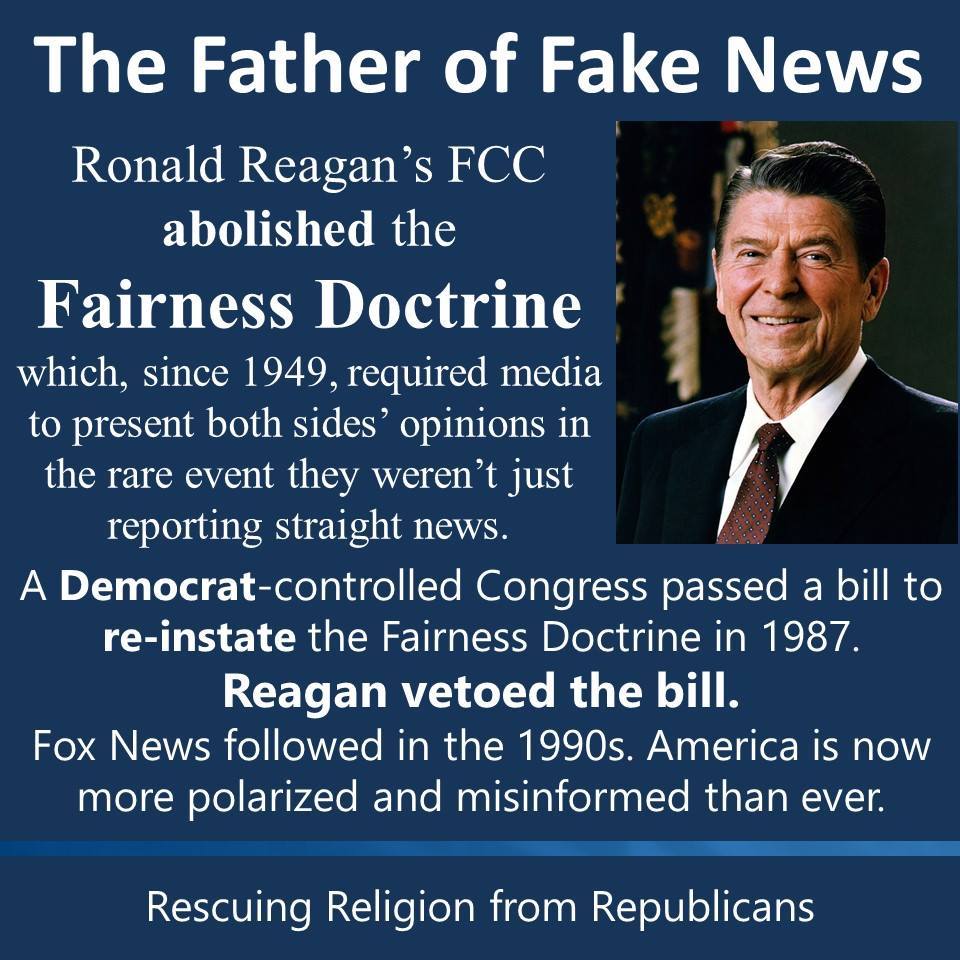
Mid-80s, Reagan years, on the cusp of repealing the Fairness Doctrine, right? About a decade before we saw, you know, a radical ramp up in conglomerates and mergers.
Mickey HuffHOST
But it all really started in the 80s.
Mickey HuffHOST
And that's where you started Fairness and Accuracy and Reporting.

Ian MastersHOST
But towards the end of his life, he endorsed Ronald Reagan in 1980 and later personally escorted Reuben Murdoch into Reagan's Oval Office.
Ian MastersHOST
And that, I take it, was when they decided to get rid of the Fairness Doctrine, which sort of moderated political speech in the media.
Ian MastersHOST
And ever since then, this massive advantage of the Republicans have had with right-wing media, Rush Limbaugh, all of that stuff that wouldn't have been possible prior to the ending of the Fairness Doctrine.
Ian MastersHOST
So why is it that the Republicans have created this network that Roy Cohn was at the pinnacle of, that was so effective? And one of the legacies of the McCarthy era was that it really hoisted the canard that anybody that was progressive on domestic issues was therefore aiding and abetting the foreign Soviet enemy.
Ian MastersHOST
And it shrunk the Democratic Party in many ways, made them the Me Too Party, that we're just as tough on communists as you guys are.

David WaldmanHOST
You have to.
David WaldmanHOST
The Fairness Doctrine, which doesn't exist anymore and hasn't for a long time, and of course won't exist under a Donald Trump FCC ever unless they need it to exist for a single case, in which case they'll bring it back, prosecute somebody, and then erase it from the books again.
David WaldmanHOST
but I guess there's nothing to, to present, but I mean, not the democratic party.
David WaldmanHOST
Maybe they ought to be, I don't like to tell them how to do their job, but I suppose you could ask for some kind of equal time.

Hladini ShaktiGUEST
Well, we can go back to legislative history for that.
Hladini ShaktiGUEST
So there's something called the Fairness Doctrine.
Hladini ShaktiGUEST
Let me see.
Hladini ShaktiGUEST
Legislative and rules history.
Hladini ShaktiGUEST
So let's pull this up.
Hladini ShaktiGUEST
The Fairness Doctrine was established in 1949, and it wasn't passed by Congress.
Hladini ShaktiGUEST
It was the FCC, the Federal Communications Commission, introduced it.
Hladini ShaktiGUEST
the Fairness Doctrine in 1949 that required that if the holders of a broadcast license, if you were granted a broadcast license and controversial issues, of public importance had to be fairly represented.

Chauncey WadsworthGUEST
Oh, interesting.
Chauncey WadsworthGUEST
I was going to say, because I was going to make a connection to the Fairness Doctrine, which obviously forced television shows like the McLaughlin Report to show both sides.
Chauncey WadsworthGUEST
But that's interesting that it was on throughout the 90s.
Chauncey WadsworthGUEST
When was that? I believe it was the late 80s under the Reagan administration.
Chauncey WadsworthGUEST
Yeah, the
DaveHOST
Fairness Doctrine was under Reagan.
GavinHOST
So that was maybe right after.
GavinHOST
So it was from 1982 to 2016, which I didn't realize.

MikeHOST
is now.
MikeHOST
But did that all come apart with the Fairness Doctrine? Was that part of the reason? why we now can do whatever we want in terms of buying radio stations.
MikeHOST
Is that something that came after the Fairness Doctrine?
EdPANELIST
It was related in that they basically said, there's such a diversity of thought now, we don't need that anymore.
EdPANELIST
If you're liberal, you can find a liberal station.
MikeHOST
is now.
MikeHOST
Uh, but, uh, Did that all come apart with the Fairness Doctrine? Was that part of the reason why we now can do whatever we want in terms of buying radio stations? Or is that something that came after the Fairness Doctrine?
EdPANELIST
It was related in that they basically said, there's such a diversity of thought now, we don't need that anymore.
EdPANELIST
If you're liberal, you can find a liberal station.

Tony MazurHOST
What does Walter Cronkite have to tell us today? He's like a grandfatherly figure, sitting you down, you sit on his lap, and he's going to tell you the news of the day.
Tony MazurHOST
You know, it's almost hard to believe it's been less than 40 years since the upending of the Fairness Doctrine.
Tony MazurHOST
For you Zoomers out there, there was something called the Fairness Doctrine, where if you were hosting a show, you could not do so with a biased edge.
Tony MazurHOST
That if, say, you were a conservative, you had to give the liberal equal time.
Tony MazurHOST
And it was called Point Counterpoint.
Tony MazurHOST
But because we live in a monoculture, you thought when it was one person hosting the show because they had to deal with this fairness doctrine that they were going to give you the unbiased truth.
Tony MazurHOST
Not always the case, as we saw with, once again, Walter Cronkite and the Tet Offensive during the Vietnam War.
Tony MazurHOST
But because they upended that fairness doctrine in 1987, it gave rise to talk radio hosts like Rush Limbaugh or Fox News and then since then Newsmax and One America News and even podcasts like the one you are listening to right now.
11 more episodes mention Fairness doctrine.
Create an account to see the whole feed, search across every transcript, and follow the entities you care about.