Fast radio burst
15
MENTIONS
7
EPISODES
7
PODCASTS
Search complete. 15 mentions across 7 episodes found for "Fast radio burst".
Oct 1, 2026

Andrew RennieHOST
She's already trained as an astronaut, but she hasn't got a chance to fly yet.
Andrew RennieHOST
Well, it just so happens that courtesy of the Goddard Space Flight Centre, I have a feature here called how the Hubble Space Telescope has helped track down a phenomena called fast radio bursts.
Andrew RennieHOST
Let's take a listen.
speaker_11NARRATOR
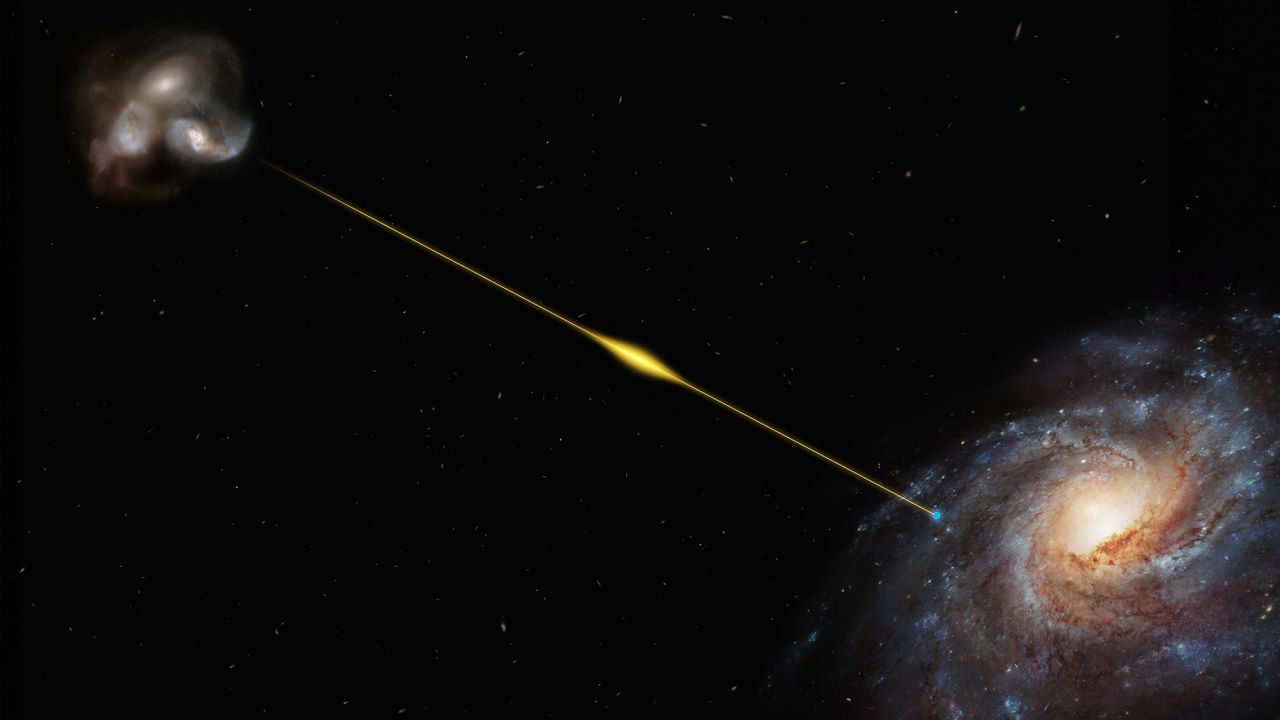
Fast radio bursts, or FRBs, are extraordinary events that generate as much energy in a thousandth of a second as the Sun does in an entire year.
speaker_11NARRATOR
Astronomers using NASA's Hubble Space Telescope have traced the locations of five brief, powerful radio blasts to the spiral arms of five distant galaxies.
speaker_11NARRATOR
Because these radio pulses disappear in much less than the blink of an eye, researchers have had a hard time tracking down where they come from and what causes them.

speaker_1HOST
There is a tantalizing hypothesis connecting them, yes.
speaker_1HOST
Fast radio bursts, or FRBs, are these immensely powerful millisecond duration flashes of radio waves originating from deep space.
speaker_1HOST
Their origin remains one of astronomy's greatest unresolved mysteries.
speaker_0HOST
Okay.
speaker_1HOST
Several theorists have noted that the predicted radio components of a rebounding Planck star explosion beautifully match the energetic and temporal profiles of certain FRBs.
speaker_0HOST
Wow.
speaker_1HOST
If this connection holds, every time a radio telescope detects an FRB, we might literally be watching a 13 billion-year-old quantum time capsule finally bursting open, releasing pristine primordial matter and geometry waves from the very dawn of time.

Nick CoatsworthHOST
Found some extraordinary phenomena.
Nick CoatsworthHOST
The one that I really took on my fancy was called, they're called FRBs or fast radio bursts.
Nick CoatsworthHOST
Now, if you want a bit of sci-fi, but in reality rich, get this.
Nick CoatsworthHOST
These little bursts of energy, they flash and fade over milliseconds and and yet have more energy than the sun puts out in a year.
Richard BakerHOST
the SOFON sort of
Nick CoatsworthHOST
coming in and, you know, creating a countdown and stopping physics and all that kind of stuff.
Nick CoatsworthHOST
Maybe it's the fourth dimension or indeed could the FRBs, the fast radio bursts, be evidence of a cosmic war, Rich Baker?
Richard BakerHOST
Well, the fast radio bursts, could they be things that are designed to travel over a huge distance with enormous power to attract attention? Like, so could they be being deliberately sent to by someone to be received by us.

Alfredo CarpinetiGUEST
Exactly.
Moiya McTierHOST
What is it about FRBs that excites you so much?
Alfredo CarpinetiGUEST
That, uh, two decades ago we didn't know they existed.
Moiya McTierHOST
Yeah.
32 MINS LATER
Moiya McTierHOST
You said-
Alfredo CarpinetiGUEST
Yes
Moiya McTierHOST
... you have a whole chapter on FRBs.
Alfredo CarpinetiGUEST
Yes.

AnnaHOST
So the new work, published Tuesday the 8th of September in Nature Astronomy, led by Kriti Sharma at Caltech with Vikram Ravi, Liam Connor, and Elizabeth Krause at the University of Arizona among the co-authors.
AnnaHOST
109 fast radio bursts, each localized to a host galaxy so it has a redshift as well as a dispersion measure, out to a redshift of about 0.3.
AnnaHOST
Relatively local deliberately because that's where feedback effects are most measurable.
AnnaHOST
Most of the bursts come from the Deep Synoptic Array, the DSA 110, a Caltech instrument at Owens Valley in California built to catch these things and pin them to a galaxy in real time.
AnnaHOST
Ravi's assessment is blunt.
AnnaHOST
It'll be a game changer.
AnnaHOST
Sharma's is that they've established fast radio bursts as a leading probe of the distribution of matter in the universe and that the data can now sharpen experiments asking about dark matter, dark energy, and the mass of the neutrino.
AnnaHOST
For something that was a single unexplained blip in an Australian archive 19 years ago, that's quite a promotion.

AnnaHOST
So the new work, published Tuesday the 8th of September in Nature Astronomy, led by Kriti Sharma at Caltech with Vikram Ravi, Liam Connor, and Elizabeth Krause at the University of Arizona among the co-authors.
AnnaHOST
109 fast radio bursts, each localized to a host galaxy so it has a redshift as well as a dispersion measure, out to a redshift of about 0.3.
AnnaHOST
Relatively local deliberately because that's where feedback effects are most measurable.
AnnaHOST
Most of the bursts come from the Deep Synoptic Array, the DSA 110, a Caltech instrument at Owens Valley in California built to catch these things and pin them to a galaxy in real time.
AnnaHOST
Ravi's assessment is blunt.
AnnaHOST
It'll be a game changer.
AnnaHOST
Sharma's is that they've established fast radio bursts as a leading probe of the distribution of matter in the universe, and that the data can now sharpen experiments asking about dark matter, dark energy, and the mass of the neutrino.
AnnaHOST
For something that was a single unexplained blip in an Australian archive 19 years ago, that's quite a promotion.