familial hypercholesterolemia
Genetic disorderWikipedia
77
MENTIONS
21
EPISODES
19
PODCASTS
Search complete. 77 mentions across 21 episodes found for "familial hypercholesterolemia".
Oct 20, 2026

Dave FeldmanGUEST
It seemed to be very consistent with this lipid hypothesis that indeed this was going to be the case.
Dave FeldmanGUEST
And the catch is, until recently, you just didn't get people with LDL levels as high as what Brown and Goldstein saw without something like homozygous FH.
Dave FeldmanGUEST
That's changed.
Dave FeldmanGUEST
Lean mass hypersponders, I personally know.
Dave FeldmanGUEST
It would be assumed that there would be a lot of the same symptoms observed in many of those lean mass hypersponders who have very high, high levels of LDL.
Dave FeldmanGUEST
And again, I say this with caution because we really need prospective data to really know.
Dave FeldmanGUEST
But thus far, for example, we don't see the xanthomas that were observed anywhere near at the levels that homozygous FH children would see.
Dave FeldmanGUEST
They seem typical of general population overall.

Douglas RothrockGUEST
Well, it didn't work, still doesn't work.
Douglas RothrockGUEST
If you have FH, you are gonna have a heart attack at age 20.
Douglas RothrockGUEST
Or if you have type one diabetes, you're gonna have a heart attack at age 30, if it's untreated properly.
Douglas RothrockGUEST
Okay.
Douglas RothrockGUEST
So, you know, the outliers are always the things we look at.
Douglas RothrockGUEST
But FH, you know, for the people that don't know that, that's familiar, hypercholesterolemia, where you have genetically only half the LDL receptors and your total cholesterol is in the 500 range.
Douglas RothrockGUEST
And those people are very prone to heart attacks at early age.
Douglas RothrockGUEST
So, you know, and I don't go with guidelines when it comes to cholesterol treatment, because I see a lot of women, for instance, who have elevated LDL cholesterols and I don't automatically put them on a statin like a lot of my colleagues do.

Graham TullochGUEST
Is that what you're referring to?
Katrina UmbachGUEST
Yeah, FH.
Graham TullochGUEST
Okay.
Katrina UmbachGUEST
Familial hypercholesterolemia.

Vince RountreeGUEST
Now, does that mean that there, you know, are not people that have a genetic predisposition that means that they'll definitely get it? That's a small number.
Vince RountreeGUEST
It's just like FH for heart disease, uh, familial hypercholesterolemia-
Rip EsselstynHOST
Right
Vince RountreeGUEST
... or, or, or familial hypo- hypolipidemia.

Ross WalkerGUEST
But you also might have familial hypercholesterolemia where your cholesterol sits at 7.58, but your HDL's only 1 and your triglycerides might be normal at 1 or 1.2, but your LDL is a, even though it's large, mainly large, it's a different configuration and doesn't fit into the standard receptor as well and it's still very atherogenic.
Ross WalkerGUEST
So that's where the calcium score tells you.
Ross WalkerGUEST
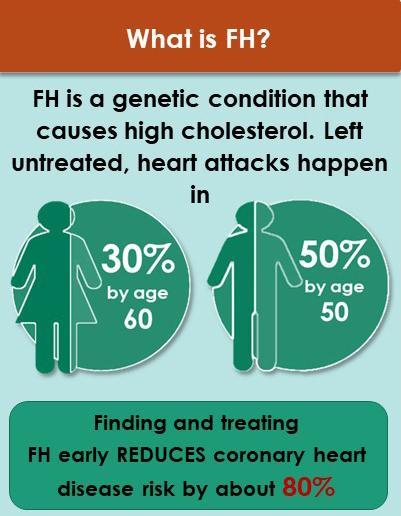
Now, here's the thing about FH, that 50% of people with FH will have a vascular event by age 50.
Paul TaylorHOST
Wow.
Ross WalkerGUEST
But if you're an opt- if you're an optimist, 50% of people with FH-
Paul TaylorHOST
Won't
Ross WalkerGUEST
... won't have a vascular event.
Paul TaylorHOST
...

David DiamondGUEST
So as a scientist, let's ask a couple simple questions to test the hypothesis.
David DiamondGUEST
That there should be a reduction in lifespan in people diagnosed with FH.
David DiamondGUEST
They should die young, which is what you're taught in medical school.
David DiamondGUEST
And that a pharmacological reduction of cholesterol should improve outcomes and should enhance lifespan.
David DiamondGUEST
So I started looking at the papers.
David DiamondGUEST
And this is one of the first ones that I came across.
David DiamondGUEST
One of the largest studies on people with FH, ancient study, 1966, very important general medicine, and they're looking at the thousands of people who are diagnosed with FH, and what do they find? No evidence that people with FH actually have a shorter lifespan.
David DiamondGUEST
In fact, you find it's routine.

Daniel EdmundowiczGUEST
Um, I must say, and maybe to a fault, I am not a huge, uh, genetic screener in this situation when someone like this comes with an LDL cholesterol of 190 or greater, frankly 180, you know, without secondary cause.
Daniel EdmundowiczGUEST
Um, the phenotype of FH is very variable.
Daniel EdmundowiczGUEST
Um, it's not an all or none phenomenon.
Daniel EdmundowiczGUEST
And some of the really recalcitrant high cholesterol syndromes that we all see in patients, um, y- th- many of them are phenotypes that are, you know, variable FH, um, not what we usually think of as the patients we used to put on apheresis and whatnot.
Daniel EdmundowiczGUEST
So the answer to the question is, yes, there is value to screening genetically here, and the value would be for patient education, uh, understanding screening of the rest of the family members, making it very clear that this is a genetic, um, a genetic abnormality in the family and th- don't ever get interested in cigarettes, you know, stay active, et cetera, et cetera.
Daniel EdmundowiczGUEST
You know, counseling things.

Pam TaubHOST
However, we tend to really focus on this in the later stages of life, especially after someone has had a cardiovascular event, and we need to start screening earlier.
Pam TaubHOST
So for instance, we should screen young children greater than two years of age if they have a family history of premature ASCVD or severe hypercholesterolemia or familial hypercholesterolemia.
Pam TaubHOST
And we should also be screening between ages nine and eleven to identify familial hypercholesterolemia.
Pam TaubHOST
Then we should be screening at age, uh, nineteen and rechecking every five years and use evidence-based equations such as PREVENT to identify ASCVD risk.
Pam TaubHOST
As we get older, we really want to be aiming for an LDL-C less than one hundred in those who have a PREVENT risk score less than ten percent.
12 MINS LATER
Pam TaubHOST
You do have to look deeper.
Pam TaubHOST
You have to look for risk enhancers.
Pam TaubHOST
You have to look at family history, including if they have a familial hypercholesterolemia.

Pam TaubHOST
We need to start screening earlier.
Pam TaubHOST
So for instance, we should screen young children greater than two years of age if they have a family history of premature ASCVD or severe hypercholesterolemia or familial hypercholesterolemia.
Pam TaubHOST
And we should also be screening between ages nine and eleven to identify familial hypercholesterolemia.
Pam TaubHOST
Then we should be screening at age, uh, nineteen and rechecking every five years and use evidence-based equations such as PREVENT to identify ASCVD risk.
Pam TaubHOST
As we get older, we really want to be aiming for an LDL-C less than one hundred in those who have a PREVENT risk score less than ten percent.
12 MINS LATER
Pam TaubHOST
You do have to look deeper.
Pam TaubHOST
You have to look for risk enhancers.
Pam TaubHOST
You have to look at family history, including if they have a familial hypercholesterolemia.
11 more episodes mention familial hypercholesterolemia.
Create an account to see the whole feed, search across every transcript, and follow the entities you care about.