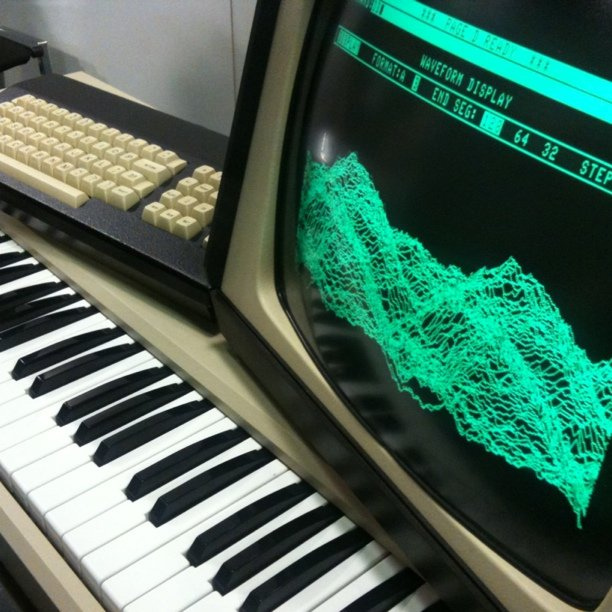
Fairlight CMI

Fairlight CMI

Musical instrumentWikipedia

Search complete. 28 mentions across 11 episodes found for "Fairlight CMI".

Sep 11, 2026

Catherine Anne DaviesGUEST
18:26
It
Paul LesterHOST
18:26
is in a way, though, quite an old argument, because I remember when John Peel was horrified by Art of Noise's inter-battle with the Art of Noise in 1983, the EP that contained, you know, it was put together using the Fairlight, which was, you know, a computer devised to sort of put together fragments of old songs into a new context.
Paul LesterHOST
18:51
So I suppose this is just taken to the nth degree, isn't
Daryl EasleaHOST
18:53
it? Well, yeah, you go back to what you said about choice.
Daryl EasleaHOST
19:08
Yeah,
Catherine Anne DaviesGUEST
19:08
I mean, you look at hip-hop.
Catherine Anne DaviesGUEST
19:09
records you know and an early kind of sampling and I use the Fairlight in a lot of my records too but you're putting it into a new context and you're you're making a human choice you are still having to build all of that architecture around it and the arrangement and you're still having to play the other instruments even if you don't have to play it even if you're generating it through you know midi triggered sounds or samples it's so completely different to just typing in a couple of verbal prompts and then thinking that you're you know the new Brian Wilson
Paul LesterHOST
19:40
So on the new album, your new album, as we once were, number one in the vinyl charts, the only chart that matters.
speaker_0HOST
16:23
In 1980, Kate Bush released Never Forever.
speaker_0HOST
16:27
This featured use of the Fairlight CMI synthesizer.
speaker_0HOST
16:32
This art pop masterpiece made history as being the first ever album by a British female solo artist to hit number one on the UK albums chart.
speaker_0HOST
16:44
It had iconic singles Babushka and Army Dreamers.
Steve LevineHOST
12:07
So he does another bit.
Steve LevineHOST
12:09
And then I've got the Fairlight in the corner.
Steve LevineHOST
12:11
He said, why don't we just sample it? And I went...
Steve LevineHOST
12:15
Well, yeah.
Lewis Borge-CardonaHOST
12:16
For
Steve LevineHOST
12:17
those that don't know, the Fairlight was the very, very first sampling machine.
Steve LevineHOST
12:21
It was a gigantic computer that cost the price of a house, but it did enable you to sample any sound that you could possibly hear and put that on a keyboard.
Steve LevineHOST
12:31
So here we have a Beatle so ahead of the curve, goes, you know what, sample me.
Bob CooverGUEST
4:07
You said it was a way back in the day for you to digitally create sounds.
Bob CooverGUEST
4:13
They didn't have memory back when the Fairlight or the PPG were coming out.
Bob CooverGUEST
4:19
And what they did was say, can I reduce a sample? For instance, I've got one in the third wave of me saying groove synthesis.
Bob CooverGUEST
4:28
Can I reduce that from me recording the words groove synthesis down to something that is just 64 single cycle waveforms and reproduce it? Well, if I could, oh my God, have I saved a lot of memory.
Bob CooverGUEST
8:26
combine them.
Bob CooverGUEST
8:27
And what's interesting about what Anthony said going into the history of this – Whereas the PPG was the first commercially available wavetable synthesizer, and those were just recordings that, as Anthony just said, usually had very similar harmonic structure as you walk through it.
Bob CooverGUEST
8:46
The Fairlight, which was also actually a wavetable synthesizer, but they never said it, that actually was literally additive.
Bob CooverGUEST
8:57
you would take and you would add harmonics to a given what they called a frame, and instead of having 64 single cycle waves, you would have 128 frames, and you could morph between them, like only set up two of them, or you could actually walk through them with each one defined, just like a wavetable.
Jesse CastroHOST
61:12
taken you and we'll go back.
Jesse CastroHOST
61:17
What is happening? Alright, did you know there are Orc hits in this song? Specifically, the Fairlight CMI Orc 5.
Jesse CastroHOST
61:27
And did you know that original sample came from Stravinsky's Firebird Suite? Internal dance of all the subjects of Cache by the Philharmonia Orchestra.
Jesse CastroHOST
61:39
I bring this up every time whenever I'm at a party or I'm out with friends and Nobody wants to talk about it.
JD RyznarHOST
52:51
Percussion by Mike Baird.
JD RyznarHOST
52:54
Fairlight samplers programmed by Gary Chang.
JD RyznarHOST
52:57
Synthesizer, Jay Graydon, Robbie Buchanan.
JD RyznarHOST
53:00
There you go.
Popnerd

Popnerd

Episode 6 - Mike Stock

Aug 27 · 2 Mentions

Holly CarnegieHOST
20:39
And what was the writing process for that song? Did you sit with a piano or sit with a guitar, or how did that work?
Mike StockGUEST
20:46
To begin with, there was a guy called Ian Curnow who had a Fairlight, and he was programmer, and I sat with him.
Mike StockGUEST
20:53
Um, I don't, I don't know why.
Mike StockGUEST
20:54
There's never any, a particular format that you stick to, but in some occasions we just got the Fairlight and we liked a couple of the sounds on it.
Mike StockGUEST
21:01
So I got him to u- it was kind of a rosy sound, to get the basic chords down.
Holly CarnegieHOST
21:06
Yeah
Keith HopwoodGUEST
29:25
The idea was to do...
Keith HopwoodGUEST
29:28
the sort of giant land sequences all with very synthetic, you know, and the guy we were working with at that point had just got this Fairlight, which was like a monster.
Keith HopwoodGUEST
29:40
Yeah.
Keith HopwoodGUEST
29:42
And the other bits in England were all totally orchestral.
Gareth DaviesHOST
29:49
great experience.
Gareth DaviesHOST
29:50
Yeah.
Gareth DaviesHOST
29:51
The Fairlight, of course, responsible for most of the 80s output of music.
Gareth DaviesHOST
29:56
Oh, yeah.
Jason BrenningerHOST
30:10
It isn't known if the title of the song was also inspired by Miles Davis' 1957 album Birth of the Cool, but considering his interest in Davis' work, it isn't out of the question.
Jason BrenningerHOST
30:22
Using his Camille voice and a hard-rocking guitar track, Prince created an aggressive song about brand new days, laying down a blend of lin and real drums and covering it with Prophet VS and Fairlight synths as well as bass.
Jason BrenningerHOST
30:36
For a track about spiritual renewal, it contained what could be seen as insults aimed at those who were no longer on his journey.
Jason BrenningerHOST
30:44
We are here, where are you? As a possible dig at Wendy and Lisa, asking for a larger salary, he threw in the line, It ain't about the money, we just want to play.
Ashley WagnerHOST
25:23
There's this track that's there throughout the entire, uh, song, and it's this drone.
Ashley WagnerHOST
25:28
So musical engineer David Botterill, um, built this up by recording sustained tones from a Prophet 5 synth, a Fairlight, a Stratocaster, and then also, like, a little bit of Peter Gabriel's own voice.
Ashley WagnerHOST
25:44
And then he layered that up and then tuned all of them to the same key, and then that kind of, like, lives underneath all of this music.
Ashley WagnerHOST
25:55
And so that creates this, like, atmosphere-

1 more episode mentions Fairlight CMI.

Create an account to see the whole feed, search across every transcript, and follow the entities you care about.

We value your privacy

We use cookies to understand how you use our platform and to improve your experience. Click “Accept All” to consent, or “Decline non-essential” to opt out of non-essential cookies. Read our Privacy Policy.