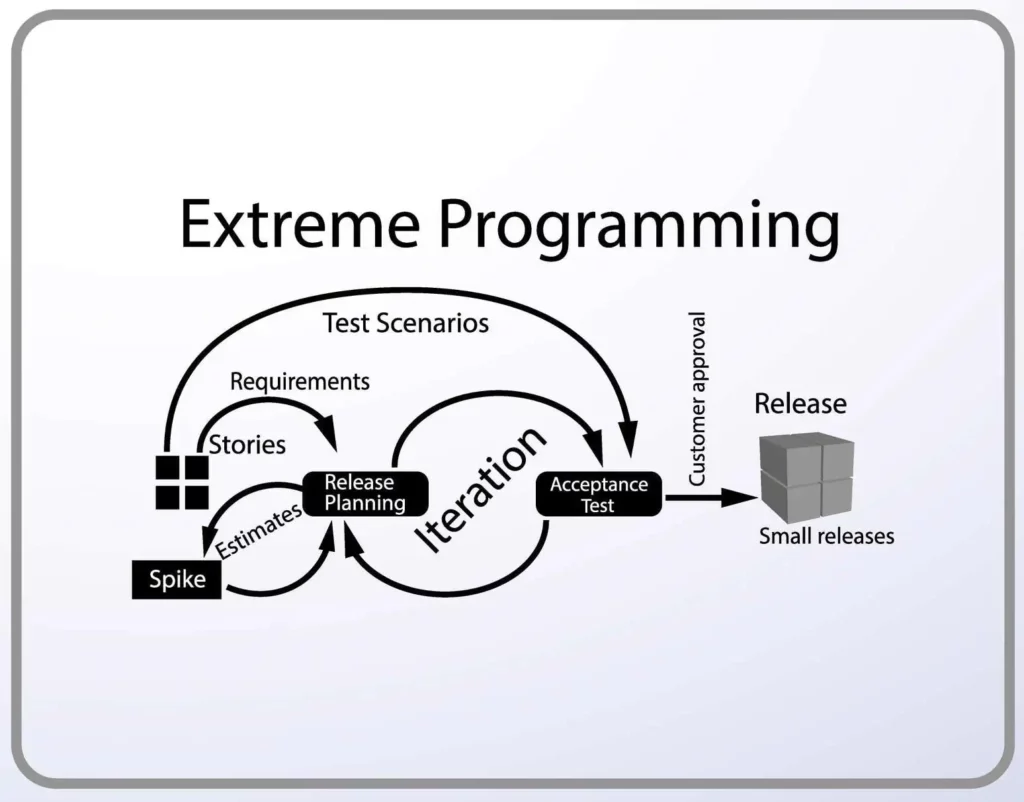
Extreme programming
79
MENTIONS
10
EPISODES
7
PODCASTS
Search complete. 79 mentions across 10 episodes found for "Extreme programming".
Nov 18, 2026

Jeffrey LikerGUEST
So anyway, the companies are doing well.
Jeffrey LikerGUEST
And again, a lot of the Agile software techniques and this company, Menlo, their model was called Extreme Programming, which is a form of Agile.
Jeffrey LikerGUEST
And there's Scrum, there's all these different methods And they're countermeasures to what was called the waterfall design process, where you go from concept to the initial software to test.
Jeffrey LikerGUEST
And there's different departments, and you're handing off your work in batches.

Elisabeth HendricksonGUEST
So, gee, seriously, one? Wait a minute.
Elisabeth HendricksonGUEST
I know you must be on an XP project because I know you.
Elisabeth HendricksonGUEST
This is Mark.
Elisabeth HendricksonGUEST
How many of you are trying but not there yet on Agile? Oh, okay.
Elisabeth HendricksonGUEST
It is difficult to explain to people who don't understand why anybody would think that software testing is fun how I can find it so exciting.
Elisabeth HendricksonGUEST
As a test obsessed person, I was surprised to hear somebody who I thought was test infected say that testers were irrelevant.
Elisabeth HendricksonGUEST
So I figured I got to go find out for myself what life is like for a tester on an XP project.
Elisabeth HendricksonGUEST
And I got lucky enough to get a contract on an XP project where I was a designated tester working with the development team on this XP project.
Jeff SutherlandGUEST
Unfortunately, When you, like in the stillbook cartoon, recently I was working with a large consultancy in the Microsoft area out in Redmond.
Jeff SutherlandGUEST
And they had visited a company who said they were doing XP.
Jeff SutherlandGUEST
And they said, well, are you doing pair programming? No, we're not doing that.
Jeff SutherlandGUEST
Well, how about continuous integration? No, we're not doing that.
Jeff SutherlandGUEST
Well, they went through every XP process or engineering practice.
Jeff SutherlandGUEST
And they said, well, what are you doing? They said, well, we're doing no documentation.
Jeff SutherlandGUEST
That's Agile.
11 MINS LATER
Jeff SutherlandGUEST
That would be hugely successful.
Tom WhiteGUEST
And the basic idea is to be able to write tests that are very understandable by both developers and by the customers that we're developing software for.
Tom WhiteGUEST
This is particularly relevant because Kazoom is an XP company.
Tom WhiteGUEST
It's been active since it was set up.
Tom WhiteGUEST
So we're always talking about customers.
Tom WhiteGUEST
I think Larry Wall's quite He talks a lot about the influences from natural language in Perl.
Tom WhiteGUEST
So in this framework that we're going to talk about, we're going to acknowledge the different linguistic devices that we're using.
Tom WhiteGUEST
So functional, illiterate functional testing goes back to XP.
Tom WhiteGUEST
So we're talking about the unit of delivery of XP is a kind of functional unit.

Jeffrey PalermoHOST
James is a recipient of the Gordon Pask Award for contributions to the Agile practice.
Jeffrey PalermoHOST
He's also an early adopter of extreme programming, and he's previously served three years as a VP of engineering at Open Sesame.
Jeffrey PalermoHOST
And James last joined me in 2021 to talk about the second edition of the Art of Agile Development.
Jeffrey PalermoHOST
And he's been doing a lot of teaching and speaking in consulting sense.
8 MINS LATER
Jeffrey PalermoHOST
They have in-house software teams, and of course, they're wrestling with it.
Jeffrey PalermoHOST
And they're constantly trying to figure out how to move at the speed of business.
Jeffrey PalermoHOST
And that's what, I mean, extreme programming and continuous integration and automated deployments, all these practices, GitOps, all these practices are around making something automated and streamlined so that we can get ourselves out of that loop and be the bottleneck so that we can keep up with the pace that we want our business to go.
Jeffrey PalermoHOST
And so those managers are building They're buying Cursor and Grok and Claude and Copilot and these other tools and they're spending the money like you mentioned.

Daniel Terhorst-NorthGUEST
So what that means, their approach to design and their approach to programming and things just didn't jive with me.
Daniel Terhorst-NorthGUEST
One of the things that had happened during that first year at ThoughtWorks is I became very much into XP kind of technical practices like test-driven development, continuous integration, pair programming, those kind of things.
Daniel Terhorst-NorthGUEST
And I found they were fantastic for writing software and building good systems and also for creating shared understanding of systems.
Adam BienHOST
One question about that.
Daniel Terhorst-NorthGUEST
Yes.
Adam BienHOST
Because when XP came out, I was a little bit confused.
Adam BienHOST
Because if you watch someone doing whatever she or he would like to do, let's say learning to play guitar, drums, do sports, or whatever is challenging...
Adam BienHOST
You will never get the idea to write spec first completely and then create a plan and execute the plan without any regards to weather or your available instruments or whatever you have.

Kevin GoldsmithHOST
At Microsoft, we were very much doing waterfall.
Kevin GoldsmithHOST
At Booleg, we adopted extreme programming, which leaned heavily on quality through developer-written unit tests.
Kevin GoldsmithHOST
The original extreme programming book didn't really have a role for test at all.
Kevin GoldsmithHOST
The architect who championed adopting extreme programming really liked to call manual testing monkey testing.
Kevin GoldsmithHOST
And we had manual testers at that point.
Kevin GoldsmithHOST
It was insulting.
Ivar JacobsonHOST
Uh, the interesting thing is that the academic community ha- are really taking on using it because for the first time in the history of, uh, software development, uh, academics can teach what is the, what is the core of software development, what is it that you always do, and they don't need to teach a particular method.
Ivar JacobsonHOST
In Sweden, for instance, one university teaches Scrum, another university Extreme Programming, and a third one Kanban.
Ivar JacobsonHOST
So when people come out and they meet, they're sitting there with no foundation and have to fight to get to some agreement.
Ivar JacobsonHOST
Have you seen that, by the way?

Peter SchmidtHOST
It's called Test Driven Development, or TDD for short.
Peter SchmidtHOST
It's a concept that goes back to an engineer called Ken Beck, who also developed an agile software methodology called Extreme Programming, or XP for short.
Peter SchmidtHOST
He argues that test-driven development, TDD, doesn't only make sure you have sufficient tests for your code, but it also drives better software design.
Peter SchmidtHOST
Of course, when you start writing tests first, they will all fail, because you haven't got anything implemented yet, until you put some meat on the bone, so to speak.

Peter MaddisonHOST
And I'm looking forward to a very exciting conversation today.
Peter MaddisonHOST
Dave and I are joined by Nick Kirsten, who had a book out earlier in the year, which I'm sure some of you have read.
Peter MaddisonHOST
And so I think with no further ado, Nick, would you like to go ahead and introduce yourself?
Mik KerstenGUEST
Hello, Peter.
Mik KerstenGUEST
It's great to be here.
Mik KerstenGUEST
Yeah, so I'm Vic Kirsten.
Mik KerstenGUEST
I previously wrote this book, Project to Product, that had, I think, an interesting mark on the industry in terms of how people thought about agility and the way it was, I think, always meant to be thought about, which is more end-to-end and more connected to the business and the organization.
Mik KerstenGUEST
And then since then, I've been asked a lot about, you know, is a product operating model sufficient for agility? And my answer to that was this next book, Output to Outcome.