extracellular matrix
45
MENTIONS
15
EPISODES
14
PODCASTS
Search complete. 45 mentions across 15 episodes found for "extracellular matrix".
Oct 2, 2026

Dave KrullHOST
Evidence of a phenotypic shift.
Dave KrullHOST
One of the most striking findings was the increased expression of genes involved in extracellular matrix, ECM, remodeling and collagen production.
Dave KrullHOST
Tumor-associated MECs showed elevated levels of multiple collagen genes, matrix metalloproteinases, MMP2, MMP9, MMP11, and MMP14, and ECM-associated proteins such as SPARC and lumican.
Dave KrullHOST
At the same time, these cells demonstrated reduced expression of traditional epithelial markers, including KRT5, KRT7, and KRT14.
Dave KrullHOST
This combination of changes suggests a transition away from their normal barrier-forming role and toward a more mesenchymal fibroblast-like phenotype that may contribute to tumor progression.

Arjun KhemaniHOST
Got it.
Arjun KhemaniHOST
What do you make of the recent CML-ACE paper, uh, which showed that you can engineer an enzyme that basically removed the CML from the extracellular matrix, um, uh, in aged human, uh, tissue samples? So, um, just curious what your, what your thoughts are.
Aubrey de GreyGUEST
Yeah, of course, I'm absolutely ecstatic about it.
Aubrey de GreyGUEST
It's a really big step forward towards restoring elasticity of the extracellular matrix.
Aubrey de GreyGUEST
This enzyme on its own, even if it could be expressed appropriately in vivo, would not do that because CML, the thing that it attacks and removes, is not a cross-link.
Aubrey de GreyGUEST
It's a, an adduct on just one protein.
Aubrey de GreyGUEST
Um, the focus that I've had historically is on glycation, non-enzymatic glycosylation, the formation of, uh, new chemical bonds between proteins that are not supposed to be linked together.
Aubrey de GreyGUEST
Um, but there are various others.

Chase JacksonHOST
As a result, no two fascia systems are alike.
Chase JacksonHOST
This collagen and fluid-based matrix of extracellular matrix, ECM, remodels itself along the lines of load, impact, pressure, and stress, aka Davis's Law, making fascia a highly trainable and adaptable system.
Chase JacksonHOST
And the last bullet point, studies indicate that fascia tissue has six to eight times more sensory nerve endings than red muscle, making it the body's largest sensory organ.
Chase JacksonHOST
So again, what Bill is saying here, and he, again, super intelligent guy.
14 MINS LATER
Chase JacksonHOST
And when I get into a strength training, a lot of the exercises I saw athletes doing in the weight room did not look like what I was seeing them do on the court.
Chase JacksonHOST
And I remembered what I learned from Dr. Gary Gray at the Gray Institute about how we can load any exercise three-dimensionally.
Chase JacksonHOST
This led me to work with my team to develop a three-dimensional matrix training program that targets the core movement patterns of basketball.
Chase JacksonHOST
Wright's eight movements are squat, lunge, leap, pivot, jump, hop, reach, swing.

Amy MayerHOST
like the fascia tissue sticking to itself, but they're not talking about that.
Amy MayerHOST
They're talking about things like adhesion of the cell to the ECM or think about a sperm and an egg interaction they need to adhese together.
speaker_1SOUNDBITE_SPEAKER
Excuse
Amy MayerHOST
me
Amy MayerHOST
And I did find a couple other articles about integrins, but that was primarily what they were about was how they were looking at different drugs that might target integrins in order to help solve specific pathologies.
Amy MayerHOST
So I don't have the biochemistry background to understand those articles.
Amy MayerHOST
So I am not even going to attempt to tell you what was happening in them other than they're looking at drugs and And I think we know there's other ways to keep the fascial system healthy and contribute to good communication between the integrins and the cell or the ECM and the cell via the integrins, I should say.
Amy MayerHOST
Not that I'm saying we shouldn't be looking at drugs to help people with things.

Daniel J. GuerraHOST
So go back to thinking about the caveolae and the podosomes because a lot of activity in the vasculature is occurring at those specific membrane loci.
Daniel J. GuerraHOST
particularly cell intrusion and then cell invasion, for example, a metastatic cancer, or for example, just a macrophage, which involves, remember the extracellular matrix.
Daniel J. GuerraHOST
So cells have to move through the ECM to get to the tissue boundary to ultimately end up going through endothelial barriers.
Daniel J. GuerraHOST
So that occurs often enough that we know very well there are pathophysiological as well as normal physiological, like macrophages and neutrophils moving through that way, coming from, again, normal processes and the regulation of the immune response.
Daniel J. GuerraHOST
But Also, corruption of the regulation of that cellular intrusion invasion when you, of course, look at cancer metastasis, and that could be linked often to obesogenic state and, yes, of course, chronological disease we call aging, primarily discussing chronological aging associated with senescence.

Lisa HarrisGUEST
It's non-toxic.
Lisa HarrisGUEST
And we can actually target either the upper layers of the skin or deeper in the ECM.
Lisa HarrisGUEST
which is then we can sort of like remodel and structure collagen from within and that without any signs of redness, bleeding, any bruising, much safer, more pleasant for the clients.
Ida FennellyHOST
That's wonderful.
26 MINS LATER
Lisa HarrisGUEST
damage? In my signature treatments, I'll use radiofrequency.
Lisa HarrisGUEST
which will remodel the tissue.
Lisa HarrisGUEST
So it sends off a heat protein response that will help to trigger and remodel collagen production that's in your ECMO.
Lisa HarrisGUEST
And also then we will use EMS, which is your electrical muscle stimulation.

Lisa HarrisGUEST
Um, I actually know the scientist, um, at SynerSeo, and we have the most amazing, um, electroporation.
Lisa HarrisGUEST
And the results are unbelievable because, one, you don't get any side effects, two, it's safe, it's non-toxic, and we can actually target either the upper layers of the skin or deeper in the ECM, which is then we can sort of like remodel and structure collagen from within and that without any signs of redness, bleeding, any bruising.
Lisa HarrisGUEST
Much safer and more pleasant for the client.
Ida FanelliHOST
That's wonderful.
26 MINS LATER
Lisa HarrisGUEST
So I use, um...
Lisa HarrisGUEST
in my signature treatments, I'll use radio frequency, which will remodel the tissue, so it sends off a heat protein response that will help to trigger and remodel collagen production.
Lisa HarrisGUEST
That's in your ECMA.
Lisa HarrisGUEST
And also, then we will use, uh, EMS, which is your electrical muscle stimulation, um, because that's also connected to the fascia as well.

SammyHOST
So it's really important that the membrane opens the door both to let things in and to kick them out.
SammyHOST
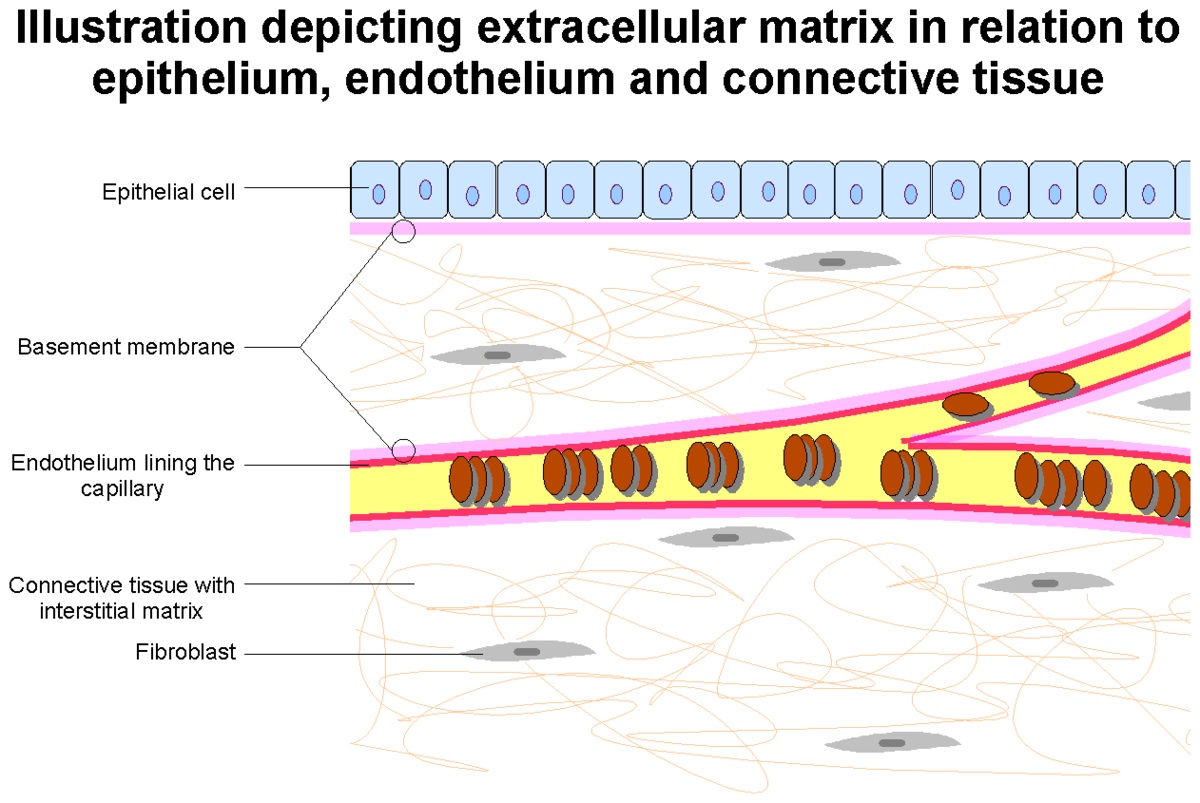
Now surrounding our cellular castle wall, we find the enchanted forest of the extracellular matrix.
SammyHOST
Here, the tangled web of fibers holds together neighboring cells and helps them maintain their shape.
SammyHOST
Made of proteins, carbohydrate chains, and water, the matrix of each one of our organs is unique to its function.
10 MINS LATER
SammyHOST
But since it needs to get out of the pancreas cells and move throughout the whole body, it sends the message that the blood sugar levels are high, a signal that cells should start feeding themselves.
SammyHOST
So like a Trojan horse, the water-loving insulin inside the pancreas cells disguises itself by hiding inside a container with its own phospholipid bilayer called a vesicle.
SammyHOST
As it approaches the cell's exterior, the vesicle becomes part of the cell membrane, dumping insulin out into the extracellular matrix in a process called exocytosis.
SammyHOST
And when a cell needs to take in something big, the membrane dents inward, creating a lipid bubble around the new addition and pulling it inside via a vesicle made from the cell membrane itself, in a similar process called endocytosis.

Maxwell StockGUEST
The first inflammatory event is what causes inflammation.
Maxwell StockGUEST
neutrophils come in they release peroxide they kind of kill everything and then you have your macrophages come in they kind of eat everything and then you have these fibroblasts that can come in and that's a it's a simplification but the fibroblasts come in and they build back that ECM they're the fibroblasts are kind of the They make the elastin, they make the collagen that you can rebuild your ECM, your extracellular matrix.
Maxwell StockGUEST
So that's kind of how TSC works.
Maxwell StockGUEST
It really reduces that inflammation, allows that wound healing to really kick in.
Daniel J. GuerraHOST
Well, we have to talk about the mechanical and biochemical characteristics of what first is encountered, and that's the extracellular matrices.
Daniel J. GuerraHOST
And so we have to start thinking about biochemical and physical signaling that is perceived by cells through the biochemical matrix we call the ECM, the extracellular matrix.
Daniel J. GuerraHOST
And of course, because it's an extracellular matrix, we have to talk about bidirectional interactions.
Daniel J. GuerraHOST
That means from the cell out and outside the cell in, of course, in a cell population.
Daniel J. GuerraHOST
So that means there has to be straight up chemical sensing, such as binding to receptors.
Daniel J. GuerraHOST
But there's also going to be a mechanosensing.
Daniel J. GuerraHOST
We know this because the extracellular matrix and the outer leaflet of the plasma membrane are involved in a restructuring of that interaction when we see a change that can then develop into a disease state like a cancer.
Daniel J. GuerraHOST
So I've talked a lot about adhesions and integrin molecules.
5 more episodes mention extracellular matrix.
Create an account to see the whole feed, search across every transcript, and follow the entities you care about.