Every Student Succeeds Act
United States federal legislationWikipedia
28
MENTIONS
14
EPISODES
10
PODCASTS
Search complete. 28 mentions across 14 episodes found for "Every Student Succeeds Act".
Oct 12, 2026

Mark DeschaineGUEST
Very few of you applied.
Mark DeschaineGUEST
So then that gets sunsetted, and now we have what? Every student succeeds act, which gives us what? States an awful lot more opportunity to tell their story and to ask for changes, or they can stay with the existing structure.
Mark DeschaineGUEST
How many states actually asked for something new and novel? Not a whole lot.
Mark DeschaineGUEST
They want to stay with the existing structure because, one, it's easier.
19 MINS LATER
Mark DeschaineGUEST
But there are tons of videos out there of folks sharing these cell phones to do what? To get access to content that is interested so that they can move and help their communities do whatever or get some information and possibly get a remote degree or whatever.
Mark DeschaineGUEST
I mean, distance learning is A blessing and a curse in so many different ways, depending on what you want to do with it and the requirements that are in place to give you access to it.
Mark DeschaineGUEST
And I think that's why a lot of people are saying, wait a second, your roles, rules, responsibilities, requirements are such that I'm willing to take the Every Student Succeeds Act idea individually.
Mark DeschaineGUEST
a variation and the centralized pieces, mostly the federal government are saying, go for it.

Mary CooganHOST
It's a federal law passed in nineteen ninety-four as part of the Improving America's Schools Act.
Mary CooganHOST
Later, it was folded into No Child Left Behind, then into the Every Student Succeeds Act.
Mary CooganHOST
Why did it happen? In the early nineties, concern was growing about school violence and guns on K12 campuses.
Mary CooganHOST
Lawmakers responded with a simple idea: zero tolerance.
Mary CooganHOST
ESSA, the Every Student Succeeds Act.
Mary CooganHOST
What happens when a law shifts power from Washington to your local school board and to kids in detention or foster care? Meet ESSA, the law quietly rewriting the American school day.
Mary CooganHOST
Welcome to Kid Law.
Mary CooganHOST
Nine, foster care enrollment protections built into ESSA.
Mary CooganHOST
Ten, why advocacy groups still watch state ESSA plans closely.
Mary CooganHOST
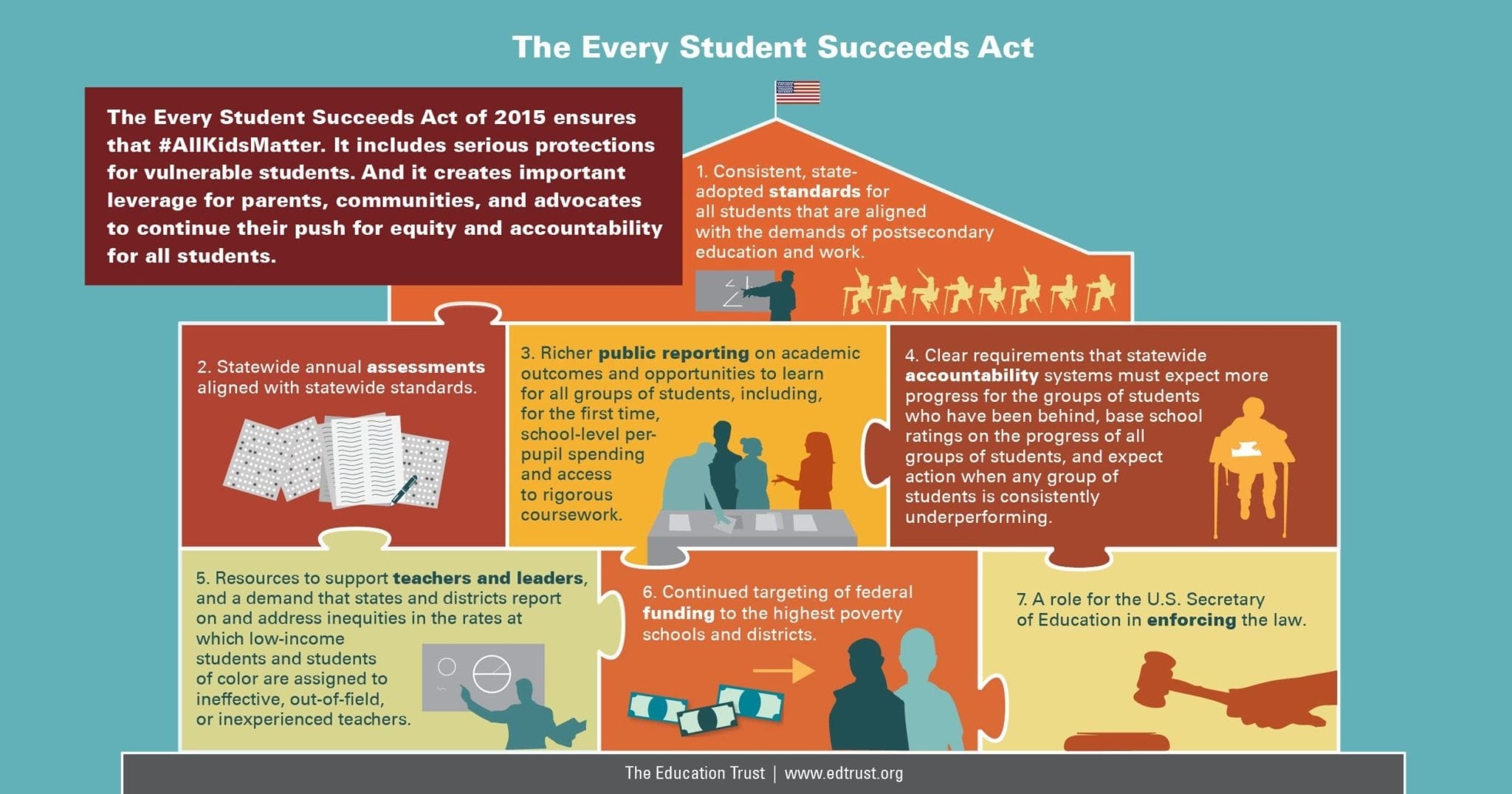
ESSA, the Every Student Succeeds Act, became the primary K twelve education law in two thousand fifteen, replacing No Child Left Behind's rigid test-only model.
Mary CooganHOST
It shifts real authority to states, letting them design accountability systems, set standards, and choose interventions for struggling schools while preserving core equity protections for disadvantaged students.
Mary CooganHOST
This episode explores how ESSA reshaped testing, funding flexibility, and teacher evaluation, plus its lesser-known reach into the justice system.

Spencer TaylorGUEST
in a mental health epidemic, and we, you know, aren't asking the right questions, and that's what I'm trying to expose with this film.
Spencer TaylorGUEST
When you eliminate recess, when you eliminate playtime, and what we've done really since 2016 with the No Child Left Behind bill and then the Every Student Succeed Act really kind of built upon this obsession with standardized testing, is we've gotten so far away from what learning actually is.
Spencer TaylorGUEST
And that was kind of one of the most shocking things I learned on this journey, going to all these different countries, interviewing neuroscientists and some of the, you know, leaders in education, is I realized I didn't even know what learning was.
Spencer TaylorGUEST
I didn't even know the definition of education.

Frank RodriguezGUEST
And what happened right at that point, if you think back to it historically, and we talk about this, I think in chapter one, that No Child Left Behind went away at the end of 2015.
Frank RodriguezGUEST
And what came in to replace it, ESSA, Every Student Succeeds Act, was a lot more, you know, like personally tailored instruction, less accountability on assessments.
Frank RodriguezGUEST
Not that You know, draconian accountability is great either.
Frank RodriguezGUEST
But once that shift happened through the E-rate, funding happened where funding exploded to where every district could have broadband and be able to have 30 Chromebooks on at the same time in every classroom.

Katie NovakGUEST
And they've basically said all of their member states should make sure that all inclusive schools are using the lens of universal design for learning.
Katie NovakGUEST
The Every Student Succeeds Act, which is our federal legislation here in the United States, talks about universal design for learning.
Katie NovakGUEST
And so there is absolutely a framework that you can advocate for and with.
Katie NovakGUEST
But I think that...
Mary CooganHOST
Seven, how ESEA intersects with the school-to-prison pipeline.
Mary CooganHOST
Eight, what NCLB and ESSA changed about federal oversight.
Mary CooganHOST
Nine, how advocacy groups push for equity and accountability.
Mary CooganHOST
Ten, what twenty twenty-six reforms could reshape ESEA's future.
speaker_1NARRATOR
Congress reauthorizes it roughly every five years.
speaker_1NARRATOR
In two thousand and two, it became No Child Left Behind.
speaker_1NARRATOR
In twenty fifteen, it became the Every Student Succeeds Act, or ESSA.
speaker_1NARRATOR
At its heart sits Title one A, ESEA's foundational purpose.

Kellen JonesGUEST
The one catch, the one interesting thing is that a lot of the recruitment costs were not coming out of the local taxpayer pocket.
Kellen JonesGUEST
They were paying for it with a Title II fund So ESSA, Every Student Succeed Act funds, that is federal money that's about $2,000 or $3,000 a pop in most cases that is supposed to help with teacher recruitment.
Kellen JonesGUEST
Now, that could be spent, and I think when Congress created it, they were thinking of spending it on local teacher recruitment.
Kellen JonesGUEST
But in this case, it's being spent on foreign teacher recruitment.

Alfie KohnHOST
Mm-hmm
Harry FederGUEST
... um, which is now under the, uh, Every Student Succeeds Act passed in 2016, which was the successor to No Child Left Behind.
Harry FederGUEST
Um, so every student in every state is tested, uh, in math and ELA from grades three through eight.
Harry FederGUEST
Um, they get tested in each of those things once in high school, and these are just federally required tests.
5 MINS LATER
Alfie KohnHOST
Right
Harry FederGUEST
... by, by using i-Ready.
Alfie KohnHOST
So, uh, the Every Student Succeeds Act, ESSA, which was the successor, as you pointed out, to the Many Children Left Behind Act that so many of us were, were, uh, were doing our best-
Harry FederGUEST
I like to use Jesse Jackson's, uh, term.
Mary CooganHOST
Education law is doing real work here, too.
Mary CooganHOST
The Every Student Succeeds Act requires school stability for students in foster care.
Mary CooganHOST
That includes staying in the school of origin when it serves the child, immediate enrollment, transportation planning, and designated points of contact linking schools and child welfare agencies.
Mary CooganHOST
CASAs use those provisions as leverage.
4 more episodes mention Every Student Succeeds Act.
Create an account to see the whole feed, search across every transcript, and follow the entities you care about.