Event-related potential
4
MENTIONS
3
EPISODES
3
PODCASTS
Search complete. 4 mentions across 3 episodes found for "Event-related potential".
Sep 27, 2026

Mike WardGUEST
So, you know, it made complete sense to partner with Collin when we reached out a few weeks ago.
Mike WardGUEST
So last March, Firefly, we made a press release where we announced that we identified students EEG and ERP biomarkers where we actually can identify the difference between the inattentive type, the hyperactive arousal type, or if someone actually doesn't have ADHD and maybe just has insomnia or sleep issues, which happens quite frequently, we come to find out from many of our psychiatrists.
Mike WardGUEST
So we took all of our microdata and with the mind of Dave DiCaprio, who went to MIT and is a trained engineer and data scientist, and won the CMS AI challenge a few years ago, we incorporated AI into our Firefly reports that when a provider does a 20-minute EEG with Firefly, one of the first things that will pop up on that report is actually an AI analysis on the cognitive biomarker findings and what type of biomarkers a patient may or may not have indicating the type of ADHD, all of which is designed to help a provider read and interpret that report.
Owen Scott MuirHOST
And so you took EEG data, which I had Dave on this show before, and he told me that essentially we're reading 250 megabytes per person, which is a lot more than the data density of the words they crank out in 20 minutes.

Paola TelferGUEST
And that is a test while they are doing a task, a standardized task that has been around for decades.
Paola TelferGUEST
And so I would add that everything we're collecting So the EEG, the ERPs, and the outputs, the performance outputs.
Paola TelferGUEST
So your accuracy, reaction time.
Paola TelferGUEST
We're capturing all of those during stress load on the brain.

Mark JohnsonGUEST
And roughly speaking, well, yes, we used technologies such as fMRI, functional MRI, fNIRS, or optical imaging.
Mark JohnsonGUEST
and EEG or ERP.
Mark JohnsonGUEST
And using all those different methods and looking at all of these different aspects of social brain function, we did in fact find that early atypicalities, some of those early atypicalities in the social brain sort of extended to the whole group of infant sibling babies.
Mark JohnsonGUEST
Others were more specifically related to those who went on to get a later diagnosis of autism.
27 MINS LATER
Tessel BazelmansGUEST
And these very first early responses show us something about the fact that they perceive that there's something visual to see.
Tessel BazelmansGUEST
And then later on, we can see, and we're talking here still about hundreds of milliseconds, so slightly later on, we can see that they see that what they're seeing is a face.
Tessel BazelmansGUEST
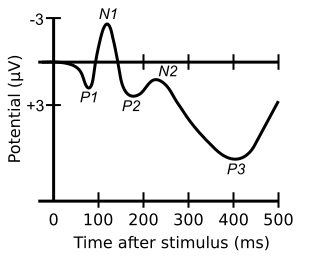
And then that kind of gets processed even further, and they're starting to kind of interpret what the face is looking like, what the emotions are, where the gaze is looking, etc., So what we kind of compared is how we see differences starting to emerge in this kind of ERP, what we call it, event-related potential response in the brain when we show it faces versus non-faces and changes in gaze of the person.
Tessel BazelmansGUEST
And so we did this for three-year-olds.