Event Horizon Telescope
48
MENTIONS
21
EPISODES
19
PODCASTS
Search complete. 48 mentions across 21 episodes found for "Event Horizon Telescope".
Nov 2, 2026

Kimberly ArcandGUEST
That is where the action is, like that's the downtown.
Kimberly ArcandGUEST
Some of you have probably seen, like, the first images of a black hole from the Event Horizon Telescope, for example.
Kimberly ArcandGUEST
I mean, I never thought I would see that in my lifetime, I'll be honest.
Kimberly ArcandGUEST
Like, that was just amazing.

Jana LevinHOST
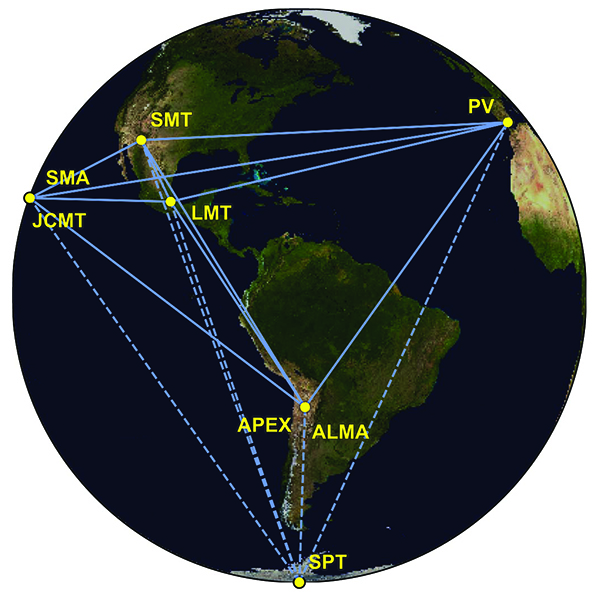
So how can it be done? Harvard astrophysicist Shep Doeleman and a team of 250 researchers achieved this extraordinary feat by linking a group of radio telescopes around the world.
Jana LevinHOST
This network, called the Event Horizon Telescope, produced the first image of a supermassive black hole in the galaxy M87, around 55 million light years away, and the first image of the black hole at the heart of our galaxy.
Jana LevinHOST
In this episode, Doliman tells co-host Jan Eleven how he turned the Earth into a telescope capable of seeing a black hole, the incredible level of science and collaboration that was required to achieve this, how the images have furthered our understanding of these exotic objects, and how movies of black holes may be possible by the early 2030s.
Jana LevinHOST
Listen on Apple Podcasts, Spotify, TuneIn, or your favorite podcasting app, or you can stream it from Quanta.
Jana LevinHOST
So let me tell you about Shep.
Jana LevinHOST
Shep is a senior research fellow at Harvard University, the assistant director of Harvard's Black Hole Initiative, also an astrophysicist at the Smithsonian Astrophysical Observatory.
Jana LevinHOST
And he was the founding director of the Event Horizon Telescope Consortium, which is a network of observatories around the world, which gave us the first and only images humanity has ever captured of black holes.
Steve StrogatzHOST
Hmm.

Scott ManleyHOST
part of a broader set of cuts in astronomy and nuclear and particle physics, which are going to have impacts across the US, across the UK.
Scott ManleyHOST
Like the James Clerk Maxwell Telescope, that's one that was involved in the Event Horizon Telescope, this millimeter wave observatory that's able to perform these microwave, not even microwave, these millimeter wave observations, which they could synchronize with other observations and get these closeup images of black holes.
Scott ManleyHOST
Well, so yeah, they're no longer gonna be funding that.
Scott ManleyHOST
So this is like, I don't know what's going on here.

Janna LevinHOST
Shep is a senior research fellow at Harvard University, the assistant director of Harvard's Black Hole Initiative, also an astrophysicist at the Smithsonian Astrophysical Observatory.
Janna LevinHOST
And he was the founding director of the Event Horizon Telescope Consortium, which is a network of observatories around the world, which gave us the first and only images humanity has ever captured of black holes.
Steve StrogatzHOST
This sounds like it's going to be a great discussion of science at its best.
Janna LevinHOST
Yeah, it's an epic story.
16 MINS LATER
Janna LevinHOST
You're talking about connecting these dishes around the globe.
Janna LevinHOST
Now, it's over decades that this work really begins in imagination, conception, execution.
Janna LevinHOST
But when was the Event Horizon Telescope as a project officially founded?
Shep DoelemanGUEST
Well, it depends.

Kimberly ArcandGUEST
I didn't expect it.
Kimberly ArcandGUEST
But Chandra has worked in such great synchronicity with the Event Horizon Telescope because you can look really close at that black hole.
Kimberly ArcandGUEST
But to me, what's super interesting about black holes is what trouble they make causing around them, right? All the environment that's around that black hole kind of tells you the coolest story of what's happening and what you get as a result.
Kimberly ArcandGUEST
And that's the view that Chandra really provides.

George NooryHOST
After a five-year hiatus, Professor Heino Falker is back with us, an astrophysicist, author, his book is Light in the Darkness, pioneer in black hole research at Redwood University in the Netherlands.
George NooryHOST
Co-founder of the Event Horizon Telescope Project, he helped lead the effort that produced and unveiled the world's first image of a black hole, an asteroid.
George NooryHOST
He was named in recognition of his scientific contributions, and here he is back on Coast to Coast.
George NooryHOST
Tino, welcome back.

Mat KaplanHOST
He's an award-winning astrophysicist.
Mat KaplanHOST
He's the guy who actually went up to make the announcement of the first image, actual image of a black hole from the Event Horizon Telescope.
Mat KaplanHOST
A fascinating book with a little bit of a spiritual angle to it as well, published by HarperOne.
Mat KaplanHOST
That'll be yours if you're chosen by Random.org, as Michael Kaspo was this week.

David KippingHOST
This, indeed, is exactly how PDS-70 was imaged with ALMA, which has a baseline of 16 kilometers.
David KippingHOST
The Event Horizon Telescope took this idea to the extreme, using telescopes across the Earth to famously image the black hole in Messier 87.
David KippingHOST
To date, these astronomical interferometric images, also known as aperture synthesis, have been limited to wavelengths of light much longer than visible light.
David KippingHOST
For example, this photo is really a microwave image.

Sarah RugheimerGUEST
Yeah, well, you can look at the region around it.
Sarah RugheimerGUEST
So there's the black hole itself, which is hard to image, though we did get a cool image of it with the Event Horizon Telescope.
Sarah RugheimerGUEST
That was a few years ago.
Sarah RugheimerGUEST
Really worth checking out.
Sarah RugheimerGUEST
No, I don't know.
Sarah RugheimerGUEST
You know, but the thing that's weird about this is we can't easily take direct photos of black holes.
Sarah RugheimerGUEST
Obviously, Event Horizon Telescope, you can look up those images.
Sarah RugheimerGUEST
But this is using James Webb to look at the material that's around the black hole.
11 more episodes mention Event Horizon Telescope.
Create an account to see the whole feed, search across every transcript, and follow the entities you care about.