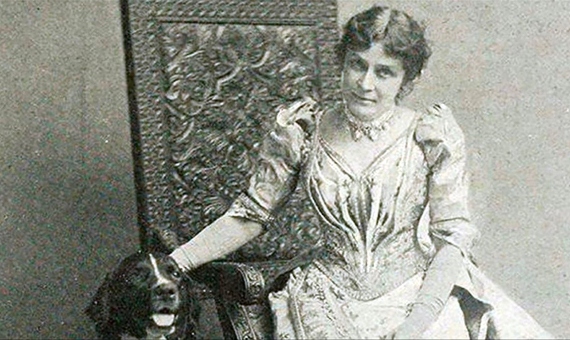
Eunice Newton Foote
American scientist and inventorWikipedia
17
MENTIONS
7
EPISODES
6
PODCASTS
Search complete. 17 mentions across 7 episodes found for "Eunice Newton Foote".
Sep 24, 2026

SammyHOST
Let's pay a visit to the theater of life.
SammyHOST
Back in 1856, Eunice Foote, an American scientist and suffragette, was thinking about how the sun's warmth affected different gases.
SammyHOST
In those days, the scientific community was a- a bit like a fort with a handmade no girls allowed sign out front.
SammyHOST
But Foote wasn't deterred and ran her experiments anyway.

TheoHOST
Pouillet began measuring the planetary energy budget and pointed toward particular gases.
TheoHOST
Then Eunice Newton Foote and John Tyndall would start testing gases directly.
TheoHOST
And I love that progression because climate science didn't appear all at once in somebody's divine flash of insight.
TheoHOST
One person found a discrepancy.
Tracy HarrisHOST
So yeah, let's keep going.
Tracy HarrisHOST
Can you summarize her contribution and then catch us up to the guy who began to question whether the oceans may not be able to capture the emissions human industry was generating?
TheoHOST
Eunice Newton Foote enters the story in 1856, and I'm already fond of her because she did something beautifully direct.
TheoHOST
She put different gases in glass cylinders, placed them in sunlight, and measured how hot they became.

JBPANELIST
So then, is John Tyndall actually the person who discovered the greenhouse effect? Digging deeper, his name dominates the search results.
JBPANELIST
But two other names were prominent, Joseph Fourier and Eunice Foote.
JBPANELIST
Let's look at both.
JBPANELIST
Hey Google, who is Joseph Fourier? David Wogan wrote an article in Scientific American explaining how our understanding of heat-trapping gases goes back to 1824 with Joseph Fourier.
JBPANELIST
As always, I encourage you to read for yourself and ask your own questions, but this is my short take.
JBPANELIST
Fourier figured out that our atmosphere traps and radiates heat, while Tyndall pinpointed the exact gases, like carbon dioxide, that are actually doing the work.
JBPANELIST
As for the other notable name in our findings, looking into Eunice Foote's contribution to this discovery reveals a lot, and much of it is controversial.
JBPANELIST
I like what I found on the New York City Public Schools website.
SageHOST
Like we measure the ways carbon dioxide traps heat in lamps all the time.
SageHOST
Something we've been doing ever since Eunice Newton Foote placed glass cylinders of it in direct sunlight and observed how it heated much more quickly than a cylinder with ordinary air.
SageHOST
And that was all the way back in 1856.
SageHOST
Ultimately, what kind of study works best can depend on a lot of factors.

Patrick GeogheganHOST
But there are also some astonishing recoveries in the book.
Patrick GeogheganHOST
For example, the story of Eunice Foote and her discoveries when it comes to experiments with gases and carbon dioxide and things that we would now associate as being so crucial to the climate movement.
Marieke BiggGUEST
Yeah, it's an incredible story about an American scientist and an inventor who was working in the sort of mid-1800s from a home laboratory who conducted an experiment that provided kind of a rudimentary evidence for what we today call the greenhouse effect.
Marieke BiggGUEST
And her discoveries, they were documented, but not really included in the most influential scientific journals of the time.

Brenda BuntingGUEST
This poem is called A Muse of Global Warning.
Brenda BuntingGUEST
And I have a quote by Eunice Foote.
Brenda BuntingGUEST
An atmosphere of that gas, carbon dioxide, would give the Earth a high temperature.
Brenda BuntingGUEST
This moment, before women were allowed to be science, defined what global warming was.