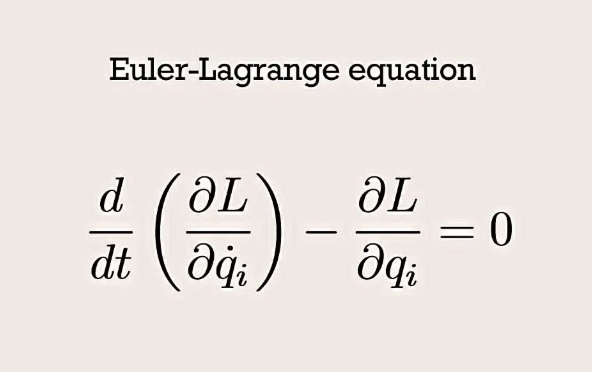
Euler–Lagrange equation
9
MENTIONS
4
EPISODES
4
PODCASTS
Search complete. 9 mentions across 4 episodes found for "Euler–Lagrange equation".
Sep 20, 2026

Onno BenshopCORRESPONDENT
In 1760, a publication by Swiss polymath Leonhard Euler indicated the existence of three stationary points between any two large bodies.
Onno BenshopCORRESPONDENT
known today as L1, L2 and L3 In 1772, Italian-born French mathematician, physicist and astronomer Joseph-Louis Lagrange discovered two more stationary points, L4 and L5 Known as the Euler-Lagrange or Lagrange points, some of these locations are being used today for solar observations, predictions and early warning systems Launched on 24 September 2025 and in orbit at L1 between the Sun and Earth, at a distance of 1.5 million kilometres from Earth, the Solar 1 satellite acts as an early warning for solar storms.
Onno BenshopCORRESPONDENT
Since particles travel slower than the speed of light, this provides about 15 minutes warning for extreme CMEs, and longer for slower events It became fully operational on the 10th of June 2026 As part of the same Space Situational Awareness Program, ESOLA-1, is the European Space Agency's Vigil Space Mission Intended to be placed at L5, 150 million kilometres from Earth, it will be able to observe solar activity as the Sun rotates towards Earth, and reports indicate that this will increase early CME warning by two to four hours.
Onno BenshopCORRESPONDENT
Vigil will also allow for four to five days space weather forecasts.

Onno BenshopCORRESPONDENT
In 1772, Italian-born French mathematician, physicist and astronomer Joseph-Louis Lagrange discovered two more stationary points, L4 and L5.
Onno BenshopCORRESPONDENT
Known as the Euler-Lagrange or Lagrange points, some of these locations are being used today for solar observations, predictions and early warning systems.
Onno BenshopCORRESPONDENT
Launched on 24 September 2025, and in orbit at L1 between the Sun and Earth, at a distance of 1.5 million kilometres from Earth, the Solar 1 satellite acts as an early warning for solar storms.
Onno BenshopCORRESPONDENT
Since particles travel slower than the speed of light, this provides about 15 minutes warning for extreme CMEs, and longer for slower events It became fully operational on the 10th of June, 2026 As part of the same Space Situational Awareness Program as Solar One is the European Space Agency's Vigil Space Mission Intended to be placed at L5, 150 million kilometers from Earth, it will be able to observe solar activity as the Sun rotates towards Earth, and reports indicate that this will increase early CME warning by two to four hours.

Onno BenshopCORRESPONDENT
In 1772, Italian-born French mathematician, physicist and astronomer Joseph-Louis Lagrange discovered two more stationary points, L4 and L5.
Onno BenshopCORRESPONDENT
Known as the Euler-Lagrange or Lagrange points, some of these locations are being used today for solar observations, predictions and early warning systems.
Onno BenshopCORRESPONDENT
Launched on 24 September 2025, and in orbit at L1 between the Sun and Earth, at a distance of 1.5 million kilometres from Earth, the Solar 1 satellite acts as an early warning for solar storms.
Onno BenshopCORRESPONDENT
Since particles travel slower than the speed of light, this provides about 15 minutes warning for extreme CMEs, and longer for slower events It became fully operational on the 10th of June, 2026 As part of the same Space Situational Awareness Program as Solar One is the European Space Agency's Vigil Space Mission Intended to be placed at L5, 150 million kilometers from Earth, it will be able to observe solar activity as the Sun rotates towards Earth, and reports indicate that this will increase early CME warning by two to four hours.

Alberto PadoanHOST
And I'm curious now, there's a few links that I couldn't help making.
Alberto PadoanHOST
So I guess, you know, in my notes now, I have the next phase of your career, and that's from 1998 onwards, 19-- maybe even a bit later, about passivity-based control, starting with the work with Mark Spong in robotics, uh, and also then in Euler-Lagrange systems.
Alberto PadoanHOST
And I guess my question is, in many of these publications, I see two terms that really stand out to me.
Alberto PadoanHOST
One is control by interconnection, and the other one is essentially putting energy back in control, essentially intelligent control, and that's the other term that I had in mind.
12 MINS LATER
Alberto PadoanHOST
Mm-hmm.
Alberto PadoanHOST
I guess I'll mention a few publications again for our audience, torque regulation of induction motors with Espinosa, where basically, I mean, the key idea that I read in that paper at least seemed to have been voltage with stator current.
Alberto PadoanHOST
Um, essentially, you could treat the motor as an Euler-Lagrange passive system, even though up until then you were only considering mechanical systems, as you say, and then you essentially started working on electromechanical systems.
Alberto PadoanHOST
And then you have a series of papers that essentially culminate in a, in a book, Ortega, Luria, Nicklasson, and Sira Ramirez called Passivity-Based Control of Euler-Lagrange Systems, nineteen ninety-eight.