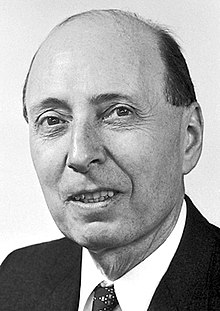
Eugene Wigner
Hungarian-American theoretical physicistWikipedia
25
MENTIONS
19
EPISODES
17
PODCASTS
Search complete. 25 mentions across 19 episodes found for "Eugene Wigner".
Sep 29, 2026

Adi ProssGUEST
When it comes to biology, living things, they behave in ways that physics and chemistry simply don't seem to – they're not able to address.
Adi ProssGUEST
I mean, the great physicists of the 20th century, Erwin Schrödinger and – Niels Bohr, Eugene Wigner.
Adi ProssGUEST
Basically, if I were to paraphrase what they had to say about life, it was that biology makes no sense to a physicist.
Adi ProssGUEST
And now that was a century ago, and you'd think, well, we've moved on from there, and there have been, in fact, developments.

Addy ProssGUEST
When it comes to biology, living things, they behave in ways that physics and chemistry simply don't seem to – they're not able to address.
Addy ProssGUEST
I mean, the great physicists of the 20th century, Erwin Schrodinger and – Niels Bohr, Eugene Wigner.
Addy ProssGUEST
Basically, if I were to paraphrase what they had to say about life, it was that biology makes no sense to a physicist.
Addy ProssGUEST
And now that was a century ago, and you'd think, well, you know, we've moved on from there, and there have been, in fact, developments.

Addy ProssGUEST
When it comes to biology, living things, they behave in ways that physics and chemistry simply don't seem to – they're not able to address.
Addy ProssGUEST
I mean, the great physicists of the 20th century, Erwin Schrodinger and – Niels Bohr, Eugene Wigner.
Addy ProssGUEST
Basically, if I were to paraphrase what they had to say about life, it was that biology makes no sense to a physicist.
Addy ProssGUEST
And now that was a century ago, and you'd think, well, you know, we've moved on from there, and there have been, in fact, developments.

Perry MarshallHOST
It led to me co-founding a cancer early detection startup a year and a half ago.
Perry MarshallHOST
I wrote a paper with Cy Gart and Stu Kaufman a year ago, and it was a springboard off of, this is Eugene Wigner, and he wrote a paper in 1960 called The Unreasonable Effectiveness of Mathematics in the Natural Sciences.
Perry MarshallHOST
And in this paper, It's almost a meditation on how beautiful and incredible it is that in physics everything obeys mathematics.
Perry MarshallHOST
and that there are discoveries that were made in mathematics 150 years ago, somebody with nothing but a piece of paper, and suddenly that exact same thing appears in particle physics, and it works perfectly.
Perry MarshallHOST
And I want to explain the rationale behind this paper because I think this reveals a bottleneck that's been going on in science for about 100 years.
Perry MarshallHOST
So in life, in the world, I see three very different levels of causation that exist.
Perry MarshallHOST
The first level is physical chemical laws, and those are the things that Eugene Wigner was talking about in his paper.
Perry MarshallHOST
Gravitation and electromagnetics and waves and all the things in physics that very often exact equation, exact answer exist.

MikeHOST
The question of whether quantum mechanics has implications for your own consciousness, observation, the nature of reality is a legitimate open question in philosophy of physics, maybe not settled science.
MikeHOST
physicists, including Eugene Wigner, John Wheeler, Roger Penrose have all treated it as a live question.
MikeHOST
I mean, the confident dismissal of the question is a cultural choice.
MikeHOST
It is not a scientific conclusion.

Avshalom ElitzurGUEST
Although those people who thought about it were geniuses.
Avshalom ElitzurGUEST
So it was Eugene Wigner and, uh, von Neumann, two giants.
Michael ShermerHOST
Yeah.
Avshalom ElitzurGUEST
Uh, let's first defend their reasoning.

speaker_0HOST
Wait, if the math doesn't mandate a cut anywhere in the physical chain, where does it stop?
speaker_1HOST
This led the Nobel laureate Eugene Wigner to propose a deeply controversial solution in 1961.
speaker_1HOST
He published an essay arguing that the physical chain of atoms remains in a probability state until it encounters something entirely non-physical.
speaker_0HOST
Non-physical?
speaker_1HOST
Yes.
speaker_1HOST
The chain terminates at human consciousness.
speaker_1HOST
Wigner argued that the non-physical mind of the observer is the only thing capable of forcing the universe to choose a definitive state.
speaker_0HOST
I can imagine how well bringing the non-physical mind into a physics department went over.

Robert BarronHOST
I'm looking for the law of the stars." All of science, I remind them, depends upon the mystical intuition that reality is marked by intelligibility.
Robert BarronHOST
I think I've told you before about, uh, the great physicist Eugene Wigner, who writes this article in 1960 called The Unreasonable Effectiveness of Mathematics in the Physical Sciences.
Robert BarronHOST
What struck Wigner, who was a secular Jew, by the way, not a religious man, what struck him was how weird, that we need the most abstract, complex mathematics to describe the qualities of physical reality.
Robert BarronHOST
Why should that be true? That there's such a rich intelligibility patterning within physical things.

RenéHOST
Galileo famously described nature as a book written in the language of mathematics.
RenéHOST
Centuries later, physicist Eugene Wigner wrote about something he called the unreasonable effectiveness of mathematics in the natural, in neural sciences.
RenéHOST
Why does abstract mathematics fit the universe so well? The simulation perspective offers a simple answer because the foundation of reality itself is mathematical or informational.
RenéHOST
If the universe consists of computational relationships, then mathematics would not be merely as useful as a tool.

Dalton McGeeHOST
I just want to say it right.
Dalton McGeeHOST
In August of 1939, Leo Szilard and Eugene Wigner drafted a letter warning of extremely powerful bombs of a new type by the Germans.
Dalton McGeeHOST
A letter that was signed by what theoretical physicist before being delivered to President Roosevelt?
Sara CalloriGUEST
I think that was Albert Einstein.
9 more episodes mention Eugene Wigner.
Create an account to see the whole feed, search across every transcript, and follow the entities you care about.