Euclid
SpacecraftWikipedia
58
MENTIONS
7
EPISODES
6
PODCASTS
Search complete. 58 mentions across 7 episodes found for "Euclid".
Sep 16, 2026

Niklas NienassHOST
Or we had also Mars Express, or still having that, where, where there's a lot of ground trips around Mars.
Niklas NienassHOST
Um, and then there's, there's the research for dark matter with Euclid, which started, I think, two years ago, which is crazy to i- to, to research these dark matter and dark energy things.
Valérie ChartrainHOST
Oh, and isn't Europe also with the Columbus module on the ISS?
Niklas NienassHOST
Yeah, and let's not forget the big Earth observation programs like Copernicus, um, which is, you know, Europe is really world-renowned for that because it's so excellent data, um, for climate monitoring or disaster response and everything else.
20 MINS LATER
Niklas NienassHOST
So let's see.
Niklas NienassHOST
The public goods and the research is quite good.
Niklas NienassHOST
You know, we have named these great, um, projects like, uh, Euclid or Mars Express or Copernicus, Galileo.
Valérie ChartrainHOST
Yeah.

David KippingHOST
New discoveries from JWST and Euclid have revealed a jumbo mystery for modern astronomy.
David KippingHOST
It's an enigma that defies our theories of planet and star formation and may even make our dreams of going interstellar a little bit easier.
David KippingHOST
Today we're exploring the puzzling discovery of free-floating worlds with no star to call home, rogue planets that appear to be everywhere.
9 MINS LATER
David KippingHOST
In one recent paper by Wangedao, they suggest that a stellar flyby could rip off a pair of Jupiters and form a jumbo if the two planets happen to be closely aligned during the encounter.
David KippingHOST
In another paper coming out of Leiden, they suggest that ejections just don't work and you really do need to form them in pairs to begin with, so the jury is still out on this one.
David KippingHOST
To me, this puzzle has been exacerbated by a result from just a couple of weeks ago by the newly commissioned Euclid Space Telescope.
David KippingHOST
Pointing again at the nearby Sigma Orionis cluster, The team have cataloged rogue planets and have measured the distribution of their frequency versus mass.
David KippingHOST
We call this diagram the initial mass function or IMF in astronomy and it is one of the most important plots that we make.

Alex McColganHOST
We need to map the entire skeleton, or at least much more of it.
Alex McColganHOST
And that is where another mission, Euclid, comes in.
Alex McColganHOST
Launched in 2023, he says Euclid mission is designed to piece together a more accurate picture of the cosmic web structure and history, and dig into the nature of dark matter and dark energy.
Alex McColganHOST
Euclid will help us measure galactic shapes with precision, revealing how dark matter distorts space through gravitational lensing, and measure redshifts, giving us a 3D position for each galaxy.
Alex McColganHOST
This combination will allow Euclid to infer the locations of the dark matter filaments, not just the galaxies on them, and give us precise locations to look for more gas.
Alex McColganHOST
By 2030, Euclid will likely be able to confirm if the cosmic web matches results from the XMM Newton filament discovery, and the pattern seen in the cosmic microwave background.
Alex McColganHOST
If it's a perfect match, that would be one of the strongest confirmations of the Big Bang model in the history of science.
Alex McColganHOST
If not, then something is fundamentally missing in our standard model, whether it's our understanding of dark matter, gravity, or the early universe.

Zsófi SzalaváriHOST
And the rest of the universe, actually the majority of it, is made up of dark energy, which we know even less about.
Zsófi SzalaváriHOST
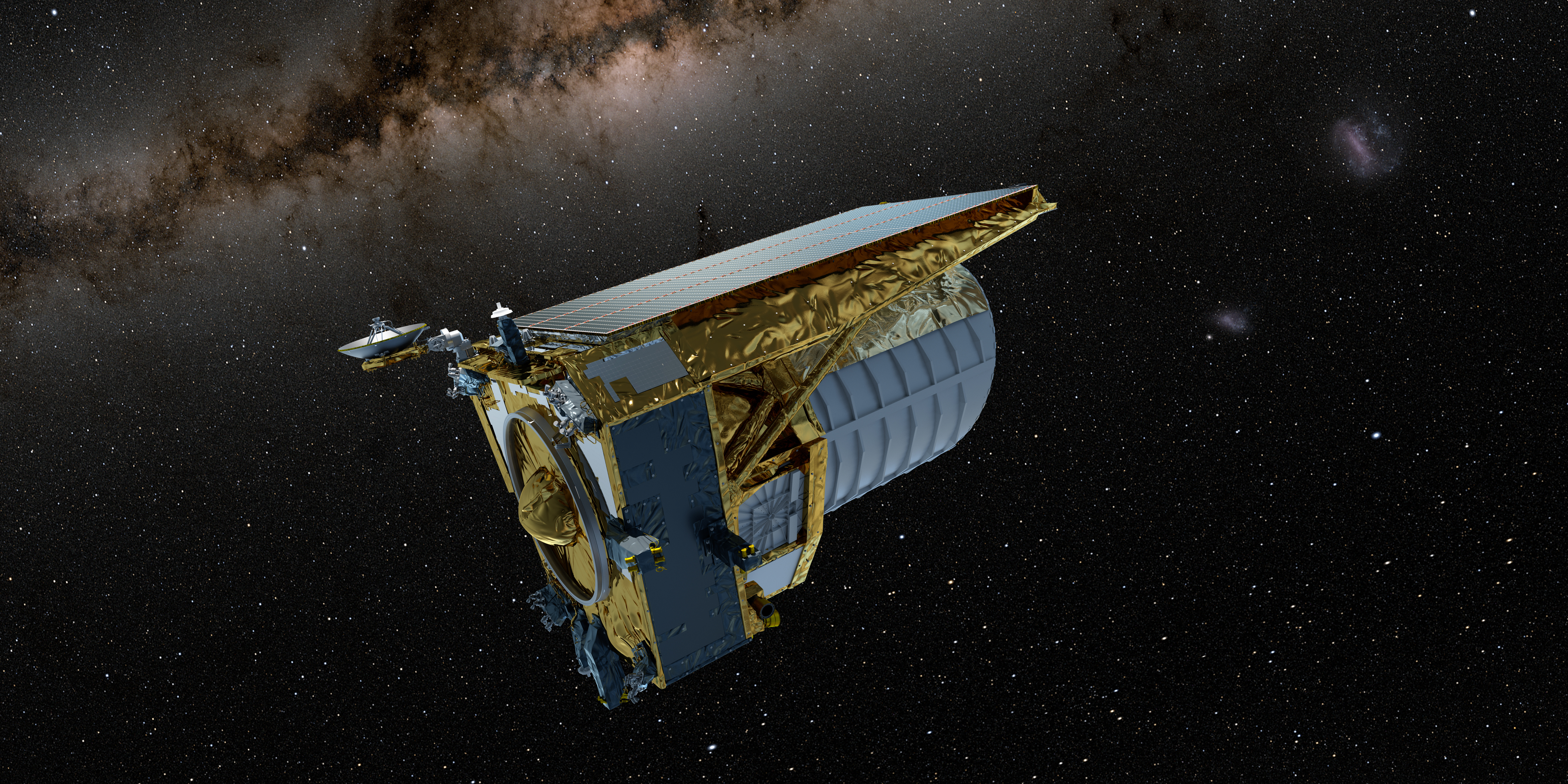
And because so much is still unknown about dark matter and dark energy, in 2023, ESA launched its Dark Universe Detective, the Euclid Space Telescope.
Zsófi SzalaváriHOST
It's a mission to chart the large-scale structure of the universe.
Zsófi SzalaváriHOST
So essentially, Euclid is creating a map of the galaxies out in the universe, similarly to how the Gaia Space Telescope created a map of the stars in our Milky Way galaxy, as we discussed in the last episode.
Zsófi SzalaváriHOST
And for this, Euclid is carrying on board two instruments, a 600-megapixel camera that observes in the optical wavelengths with high resolution, and a second instrument that observes in a near-infravent, which is able to measure distances of galaxies and their spectra.
Zsófi SzalaváriHOST
And with these cameras, the Euclid Space Telescope is allowing us to see objects in the universe that were considered to be very, very hard to detect before.
Zsófi SzalaváriHOST
And this brings us to our sonification of today.
Zsófi SzalaváriHOST
The sonification I brought for this episode was made by Danish sound artist Claus Nielsen, also known as Maple Pools, with help on the data from Parsa and Mamdadi.

Paul MecurioHOST
Exactly.
Neil deGrasse TysonHOST
Uh, uh, Jason, the last time we had you on, you talked about the Euclid mission.
Neil deGrasse TysonHOST
We'll get an update on that, uh, later in this conversation.
Neil deGrasse TysonHOST
So, so l- just tell us all about the Nancy Grace Roman Telescope.
Jason RhodesGUEST
That's right.
Jason RhodesGUEST
The James Webb Space Telescope is there.
Jason RhodesGUEST
Uh, the Euclid space telescope, which I talked to you about, uh, last time, is there, and there's telescopes there, uh, like the Planck space telescope.
Jason RhodesGUEST
This is a telescope that, uh, European Space Agency launched, uh, quite a while ago to study the earliest light in the universe.