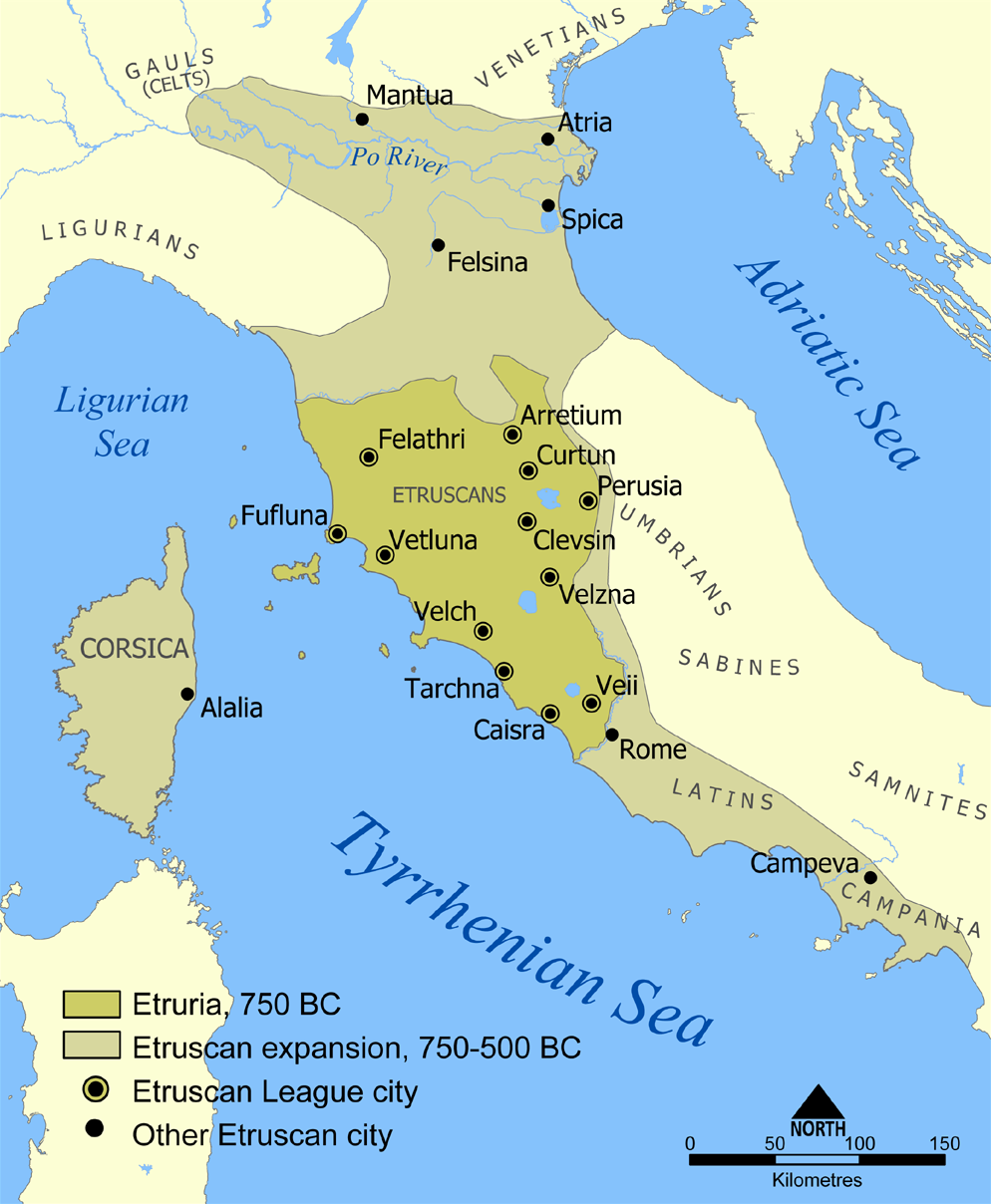
Etruscan civilization
564
MENTIONS
176
EPISODES
166
PODCASTS
Search complete. 564 mentions across 176 episodes found for "Etruscan civilization".
Sep 12, 2026

speaker_4NARRATOR
The ancient Etruscans always were married in the streets, before the door of the house, which was thrown open after the ceremony.
speaker_4NARRATOR
In the memoirs of the Etruscan Academy of Cortona is a drawing of a picture found in Herculaneum, representing a marriage at which a sorceress is practicing divination with five stones.
speaker_4NARRATOR
The Syracusian virgins, when about to enter the matrimonial state, used to go in procession to the temple of Diana, the goddess of chastity, preceded by chanters, musicians, and persons carrying flowers and vessels of incense, and accompanied by tame tigers, leopards, and the like animals.
speaker_4NARRATOR
The Acritus, in his second idyll, alludes to this custom.
3 HRS 41 MINS LATER
speaker_4NARRATOR
This, however, is a far-fetched reason for church door marriages.
speaker_4NARRATOR
The true origin of the custom may, perhaps, be traced in the almost universal desire from the earliest ages to make marriage a public ceremony.
speaker_4NARRATOR
We have shown that such a desire prevailed among the Jews, Greeks, Romans, and Etruscans, as well as other people.
speaker_4NARRATOR
The old missiles direct the placing of the man and the woman at the church door during the service, and at the end of it, they shall proceed with him up to the altar.

A. RodrigoNARRATOR
The Romans, after making a truce on conditions satisfactory to the Gauls, and being thus, contrary to their expectation, reinstated in their home and as it were now started on the road of aggrandizement, continued in the following years to wage war on their neighbors.
A. RodrigoNARRATOR
After subduing all the Latins by their valor and the fortune of war, they fought first against the Etruscans, then against the Celts, and next against the Samnites, whose territory was conterminous with that of the Latins on the east and north.
A. RodrigoNARRATOR
After some time, the Tarentines, fearing the consequences of their insolence to the Roman envoys, begged for the intervention of Pyrrhus.
A. RodrigoNARRATOR
This was in the year preceding the expedition of those Gauls who met with the reverse at Delphi and then crossed to Asia, 280 BC.
A. RodrigoNARRATOR
The Romans had ere this reduced the Etruscans and Samnites and had vanquished the Italian Celts in many battles, and they now for the first time attacked the rest of Italy, not as if it were a foreign country, but as if it rightfully belonged to them.
A. RodrigoNARRATOR
Their struggle with the Samnites and Celts had made them veritable masters in the art of war, and after bravely supporting the war with Pyrrhus and finally expelling himself and his army from Italy, 274 BC, they continued to fight with and subdue those who had sided with him.
A. RodrigoNARRATOR
When with extraordinary good fortune they had reduced all these peoples and had made all the inhabitants of Italy their subjects excepting the Celts, they undertook the siege of Rhegium, now held by certain of their compatriots.
4 HRS 16 MINS LATER
A. RodrigoNARRATOR
Chapter 16.

speaker_5NARRATOR
It may be seen, moreover, by reason of the statues found at Viterbo at the beginning of the pontificate of Alexander VI, that sculpture was in great esteem and in no small perfection among the Etruscans.
speaker_5NARRATOR
And although it is not known precisely at what time they were made, it may be reasonably conjectured, both from the manner of the figures and from the style of the tombs and of the buildings, no less than from the inscriptions in those Etruscan letters, that they are most ancient and were made at a time when the affairs of this country were in a good and prosperous state.
speaker_5NARRATOR
But what clearer proof of this can be sought, seeing that in our own day, that is, in the year 1554, there has been found a bronze figure of the Chimera of Bellerophon, in making the ditches, fortifications, and walls of Arezzo, from which figure it is recognized that the perfection of that art existed in ancient times among the Etruscans, as may be seen from the Etruscan manner, and still more from the letters carved on a paw, about which, since they are but few and there is no one now who understands the Etruscan tongue, it is conjectured that they may represent the name of the master as well as that of the figure itself, and perchance also the date, according to the use of those times.
speaker_5NARRATOR
This figure, by reason of its beauty and antiquity, has been placed in our day by the Lord Duke Cosimo in the hall of the new rooms in his palace, wherein there have been painted by me the acts of Pope Leo X.
speaker_5NARRATOR
And besides this, there were found in the same place many small figures in bronze, after the same manner, which are in the hands of the said Lord Duke.

Katerina FerraraHOST
Then we traveled to Aquileia, one of the Roman Empire's largest cities and one of the earliest centers of Christianity in Europe.
Katerina FerraraHOST
Last week, we climbed the hills above Florence to Fiesole, where the Etruscans built a thriving city centuries before Florence existed and where the Medici later found inspiration for the Renaissance.
Katerina FerraraHOST
Today, we're beginning an entirely new chapter within the series.
Katerina FerraraHOST
Next, we're going to talk about the Renaissance courts of power.

Jeni RydeGUEST
Some sections, though, of this trail have been lost to modern highways, so it's been a bit rerouted.
Jeni RydeGUEST
But other segments still follow the old cobbled, stoned Roman roads, medieval paths, and sometimes even farm tracks which cross some ancient Etruscan and also Roman ruins.
Lauren MackayHOST
Could you still follow it today? Do people follow it? Yeah,
Jeni RydeGUEST
people do follow it and do mainly different sections of it.
13 MINS LATER
Jeni RydeGUEST
Most of these towns remain quite intact, you know, medievally intact.
Jeni RydeGUEST
Cobblestones and ancient walls, etc., lots of lovely hidden piazzas, etc.
Jeni RydeGUEST
They've got very deep history which dates back to Etruscan times and Roman period.
Jeni RydeGUEST
And some of them became medieval city-states and some strategic outposts were to protect not only against invaders but also things like the plague.

TannerHOST
Etruria is a cool name for a vessel.
TannerHOST
The homeland of the Etruscans.
TaylorHOST
They dug deep on some of these names.
TannerHOST
Etrurial jurors.

Rick StevesHOST
Its massive basilica remains a favorite destination for countless pilgrims today.
Rick StevesHOST
Volterra was an Etruscan capital centuries before Christ.
Rick StevesHOST
Within its ancient wall, the town's rustic center offers an evocative Tuscan charm.
Rick StevesHOST
San Gimignano, with its prickly skyline, stands like a medieval mirage on its hilltop.

Mark GagnonHOST
And then the Greek showed up, of course.
Mark GagnonHOST
The Greeks, they're all over there just putting their little swarthy fingers into everything.
Mark GagnonHOST
And then you have the Etruscans, each leaving, like, a different kind of a imprint on this place.
Mark GagnonHOST
And so Pompeii, like most of the Mediterranean region, kinda grows up with, like, this mixed sort of, like, hodgepodge of cultures and trade routes and all these different, you know, s- kind of like human affects that kind of leave a, a print on the place.
Mark GagnonHOST
So Rome only took full, full control of the city around, like, the 1st century BC.

BlueHOST
Great." And this...
BlueHOST
Unfortunately, this was right after the Etruscans video, which like absolutely kicked my ass, um, in terms of how long it took to, to assemble that.
BlueHOST
So I'm like, "Oh, okay, I was thinking that I'll do the Odyssey detailed diatribe next, but okay, I'll do this for the sponsor.
BlueHOST
It'll be fine timing.
BlueHOST
Great, whatever." Um, ended up working out okay, um, because I, I did enough research that I had just a, a whole bucket full of notes, and I spent...
BlueHOST
Usually a script will take like two or three, or in the case of the Etruscans, like four days to write it all out because there's a lot of information-
IndigoHOST
Mm-hmm
BlueHOST
... to organize and sift through and make it fit, make it flow.

Louise J. BellNARRATOR
Populations of essentially different culture, tastes, and pursuits have vied with one another in their superstitious adoration of it.
Louise J. BellNARRATOR
Greek crosses of equal arms adorned the tomb of Midas of Phrygia, and long before the time of the Etruscans, the inhabitants of northern Italy erected crosses over the graves of their dead.
Louise J. BellNARRATOR
The cross was common to Mexico.
Louise J. BellNARRATOR
White marble crosses were found on the island of St. Ulloa by its discoverers.
166 more episodes mention Etruscan civilization.
Create an account to see the whole feed, search across every transcript, and follow the entities you care about.