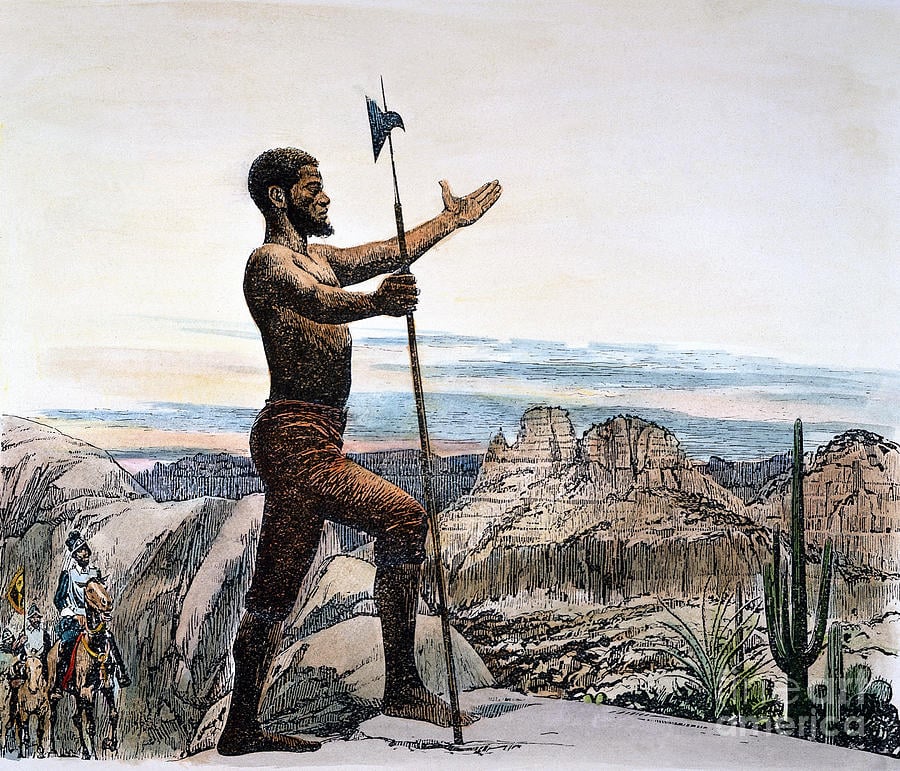
Esteban de Dorantes

Esteban de Dorantes

ExplorerWikipedia

Search complete. 57 mentions across 12 episodes found for "Esteban de Dorantes".

Oct 1, 2026

speaker_2NARRATOR
64:29
But this was not always true, and there is one well-known case which, despite the propaganda of 400 years, survives as a clear and important instance of Negro leadership in exploration.
speaker_2NARRATOR
64:40
This is the romantic story of Stephen Durantis, or as he is usually called, Estevanico, who sailed from Spain in 1527 with the expedition of Panfilo de Narvaez.
speaker_2NARRATOR
64:53
This fleet of five vessels and 600 colonists and soldiers started from Cuba and landed in Tampa Bay in 1582, but disaster followed disaster until at last there were but four survivors, of whom one was Estevanico, an Arab Negro from Azamor on the Atlantic coast of Morocco.
speaker_2NARRATOR
65:12
He is elsewhere described as black and a person of intelligence.
speaker_2NARRATOR
65:15
Besides him there was his master Durantis and two other Spaniards, De Vaca and Maldonado.
speaker_2NARRATOR
65:21
For six years these men maintained themselves by practicing medicine among the Indians and were the first to reach Mexico from Florida by the overland route.
speaker_2NARRATOR
65:32
Estevanico and De Vaca went forward to meet the outposts of the Spaniards established in Mexico.
speaker_2NARRATOR
65:38
Estevanico returned with an escort and brought on the other two men.
speaker_4NARRATOR
65:56
But this was not always true, and there is one well-known case which, despite the propaganda of 400 years, survives as a clear and important instance of Negro leadership in exploration.
speaker_4NARRATOR
66:07
This is the romantic story of Stephen Durantis, or as he is usually called, Estevanico, who sailed from Spain in 1527 with the expedition of Panfilo de Narvaez.
speaker_4NARRATOR
66:20
This fleet of five vessels and 600 colonists and soldiers started from Cuba and landed in Tampa Bay in 1582, but disaster followed disaster until at last there were but four survivors, of whom one was Estevanico, an Arab Negro from Azamor on the Atlantic coast of Morocco.
speaker_4NARRATOR
66:39
He is elsewhere described as black and a person of intelligence.
speaker_4NARRATOR
66:43
Besides him there was his master Durantis and two other Spaniards, De Vaca and Maldonado.
speaker_4NARRATOR
66:49
For six years these men maintained themselves by practicing medicine among the Indians and were the first to reach Mexico from Florida by the overland route.
speaker_4NARRATOR
66:59
Estevanico and De Vaca went forward to meet the outposts of the Spaniards established in Mexico.
speaker_4NARRATOR
67:05
Estevanico returned with an escort and brought on the other two men.

Unknown podcast

Journey of Alvar Núñez Cabeza de Vaca-Alvar Núñez Cabeza de Vaca

Sep 30 · 1 Mention

speaker_3UNKNOWN
216:32
The next morning all those who were strong enough came along, and at the end of three journeys we halted.
speaker_3UNKNOWN
216:40
alonso del castillo and estevanico the negro left with the women as guides and the woman who was a captive took them to a river that flows between mountains where there was a village in which her father lived and these were the first abodes we saw that were like unto real houses Castillo and Estevanico went to these, and after holding parley with the Indians, at the end of three days Castillo returned to where he had left us, bringing with him five or six of the Indians.
speaker_3UNKNOWN
217:13
He told how he had found permanent houses, inhabited, the people of which ate beans and squashes, and that he had also seen maize.
speaker_3UNKNOWN
217:26
End of section 7 Section 8 of The Journey of Alvar Núñez Cabeza de Vaca and His Companions From Florida to the Pacific, 1528-1536.
Sue AndersonNARRATOR
240:15
The next morning all those who were strong enough came along, and at the end of three journeys we halted.
Sue AndersonNARRATOR
240:23
alonso del castillo and estevanico the negro left with the women as guides and the woman who was a captive took them to a river that flows between mountains where there was a village in which her father lived and these were the first abodes we saw that were like unto real houses Castillo and Estevanico went to these, and after holding parley with the Indians, at the end of three days Castillo returned to where he had left us, bringing with him five or six of the Indians.
Sue AndersonNARRATOR
240:57
He told how he had found permanent houses, inhabited, the people of which ate beans and squashes, and that he had also seen maize.
Sue AndersonNARRATOR
241:10
End of section 7 Section 8 of The Journey of Alvar Núñez Cabeza de Vaca and His Companions From Florida to the Pacific 1528-1536 This is a LibriVox recording.

Unknown podcast

Journey of Alvar Núñez Cabeza de Vaca-Alvar Núñez Cabeza de Vaca

Sep 23 · 7 Mentions

speaker_0ADVERTISER
0:51
Who knew ice cold drinks could be so...
Sue AndersonNARRATOR
1:00
INTRODUCTION TO THE JOURNEY OF ALVAR NÚÑEZ CABEZA DE VACA AND HIS COMPANIONS FROM FLORIDA TO THE PACIFIC 1528-1536 the journey of alvar nunez cabeza de vaca and his companions from florida to the pacific fifteen twenty eight fifteen thirty six translated by fanny bandelier introduction this volume offers the original narrative of the first white man to cross north america the remarkable journey of alvar nunez cabeza de vaca andres dorantes alonso del castillo maldonado and the moore estevanico from florida to northwestern mexico sonora and sinaloa near the pacific coast antedates the expeditions of coronado and de soto whose histories have already been published in the trail makers nevertheless it is proper to publish his narrative later compared with either of them the journey of cabeza de vaca and his companions is an episode important an incident brought about by a disastrous failure this history describes the only and comparatively meager results of the expedition undertaken by panfilo de narvaez in fifteen twenty seven and an outcome which had nothing more to do with narvaez and his ill-conducted scheme yet it is certain that the appearance of cabeza de vaca and his fellow sufferers at culiacan and their statements directed the attention of the spanish authorities at the young city of mexico to the north more than the reports about the seven cities and the raids which nuno de guzman had made in that direction nevertheless the importance of the story of cabeza de vaca must not be overestimated a perusal of the narrative shows that the forlorn wanderers were not as it has long been admitted the discoverers of new mexico they never saw nor do they claim to have seen any of the so-called pueblos they only heard of them in a more or less confused manner on the other hand more precise than their information on this point is what they said about the plains their indians and it seems above all doubt that the first knowledge of the american bison or buffalo is due to their descriptions on the minds of the spanish occupants of mexico especially on what may be called the floating population proportionately large at the time as everywhere in newly occupied countries the impression of the feat performed by the travelers and the tale of their unequaled sufferings produced a much greater effect than on the authorities the people saw in their reports an outline for a possible advance into the unknown beyond the picture of the country traversed was in the main not enticing but the allusion to permanent settlements beyond the unprepossessing plains was looked upon as full of promise the outcome was a moderate excitement among the adventurous and the idle and this excitement was ably taken advantage of by the viceroy of new spain don antonio de mendoza this high functionary as sagacious as he was cautious regarded the real merits of cabeza de vaca who is the representative figure in the whole episode with reserve on february eleventh old style fifteen thirty seven he wrote to the empress recommending cabeza de vaca and dorantes the letter mentions dorantes but it was castillo who went to spain with cabeza de vaca recommending cabeza de vaca and dorantes to the benevolence of the monarch in consideration of what they have done in it this country and suffered and their disposition to continue there and here wherever they may be sent he does not seem to attach more than a modest importance to the practical results of their adventures in that same letter he states that the wanderers had already made a report to him on their journey which report he had sent to the empress previously it cannot be the one contained in oviedo's historia general y natural de indias edition of eighteen fifty volume three book thirty five since the latter was directed to the audiencia of santo domingo there is a fragment of a relation attributed to cabeza de vaca alone without date in volume fourteen of the documentos ineditos de indias it reads like a rsum or condensation of the narrative presented in this volume This fragment terminates abruptly at the time when a meeting of Cabeza de Vaca and Dorantes was being prepared.
Sue AndersonNARRATOR
6:30
It is entitled Relación de Cabeza de Vaca, Tesorero que fue en la conquista, and preceded by a truncated copy of the directions which the king issued to Cabeza de Vaca as factor of the expedition.
Sue AndersonNARRATOR
6:45
Whether this document, noticed in the index under a very misleading title, is perhaps the first report mentioned in the letter of Mendoza from February 1537, I am unable to decide thus far, but there are some indications favoring the supposition.
Sue AndersonNARRATOR
9:48
Several of his descendants held comparatively high positions, among them Don Pero Fernandez Cabeza de Vaca, elected Grand Master of the Order of Knights of St. James in 1383. the career of alvar nunez cabeza de vaca in america was particularly unfortunate after the disastrous termination of narvaez's expedition and his almost miraculous return to spain he obtained as a reward for his sufferings the position of governor of the settlements on the la plata river vacant since the death of pedro de mendoza reaching his post in fifteen forty one he soon became the object of sinister intrigues on the part of his subordinates the animosity against him broke out in fifteen forty three in open revolt He was seized and sent to Spain as a prisoner.
Sue AndersonNARRATOR
10:47
His mild captivity there lasted eight years.
Sue AndersonNARRATOR
10:51
It is asserted that he lived in Seville to an advanced age and occupied, up to his demise, the date of which I have not yet been able to find, an honorable and fairly lucrative position concerning the conduct of cabeza de vaca as governor on the la plata or paran the opinions of eyewitnesses are divided some speak in his favor others like the german ulrich or huldrich schmidl of straubing accused him of haughty demeanor towards his men and cruelty oviedo who knew him personally and conversed with him on the matter is noncommittal it seems likely that cabeza de vaca was an honest and well-intentioned man and he may have been a good subaltern but unfit for superior command hence he proved a failure as soon as raised to a position beyond the scope of his abilities of the three companions of cabeza de vaca little is known andres dorantes who had been a captain with narvaez was the son of pablo dorantes a native of hebraleon castilla maldonado was from salamanca and the son of dr castillo y aldonza maldonado he is said to have remained in spain whereas dorante stayed in mexico and entered in fifteen thirty eight into an agreement with the viceroy for a journey of exploration to the north or sinaloa it was never carried out lastly the negro estevanico was an arab moor from the town of azamor on the atlantic coast of morocco it is therefore not unlikely that he was not a negro proper but from one or other of the tribes of the desert his subsequent fate is well known as guide and advance scout of father marcos of niza he became the victim of his own imprudence or lack of understanding of the differences in customs and beliefs between indian tribes far distant from each other it is well known that cabeza de vaca wrote two principal works both of which were published at valladolid in fifteen fifty five by francisco fernandez de cordova the first one of these two books is a second issue of the one translated here the other gives an account of his vicissitudes in paraguay and what is now the argentine republic and bears the title of comentarios de alvar nunez cabeza de vaca adelantado y gobernador del rio de la plata
Matt Rogers and Bowen YangADVERTISER
13:33
This is Matt Rogers from Lost Culture East.
Sue AndersonNARRATOR
148:33
I told him my purpose was to go to a country of Christians, and that I followed this direction and trail.
Sue AndersonNARRATOR
148:41
Andres Dorantes said that for many days he had been urging Castillo and Estevanico to go further on, but they did not risk it, being unable to swim and afraid of the rivers and inlets that had to be crossed so often in that country.
Sue AndersonNARRATOR
148:56
Still, as it pleased God our Lord to spare me after all my sufferings and sickness, and finally let me rejoin them, they at last determined upon fleeing, as I would take them safely across the rivers and bays we might meet.
Sue AndersonNARRATOR
149:12
But they advised me to keep it secret from the Indians, as well as my own departure, lest they would kill me forthwith, and that to avoid this it was necessary to remain with them for six months longer, after which time they would remove to another section in order to eat prickly pears.

12 MINS LATER

Sue AndersonNARRATOR
161:56
For a mere nothing, they break up wedlock.
Sue AndersonNARRATOR
161:59
Dorantes remained only a few days with those Indians and then escaped.
Sue AndersonNARRATOR
162:04
Castillo and Estevanico went inland to the Iguases.
Sue AndersonNARRATOR
162:09
All those people are archers and well-built, although not as tall as those we had left behind us.
Sue AndersonNARRATOR
208:11
The next morning all those who were strong enough came along, and at the end of three journeys we halted.
Sue AndersonNARRATOR
208:18
alonso del castillo and estevanico the negro left with the women as guides and the woman who was a captive took them to a river that flows between mountains where there was a village in which her father lived and these were the first abodes we saw that were like unto real houses Castillo and Estevanico went to these, and after holding parley with the Indians, at the end of three days Castillo returned to where he had left us, bringing with him five or six of the Indians.
Sue AndersonNARRATOR
208:52
He told how he had found permanent houses, inhabited, the people of which ate beans and squashes, and that he had also seen maize.
Sue AndersonNARRATOR
209:05
End of section 7 Section 8 of The Journey of Alvar Núñez Cabeza de Vaca and His Companions From Florida to the Pacific 1528-1536 This is a LibriVox recording.

Unknown podcast

Americans All, Immigrants All-U. S. Department of the Interior Office of Education

Sep 15 · 1 Mention

Mark SmithNARRATOR
87:18
A pilot on one of Columbus' ships was Pedro Alonzo, Negro.
Mark SmithNARRATOR
87:24
First explorers in New Mexico led by Estevanico, Moroccan.
Mark SmithNARRATOR
87:30
First settlers of Alabama, who accompanied de Soto in 1540, were Robles, Negro, and Ferriada, Greek.
Mark SmithNARRATOR
87:39
First reliable map of Virginia and Maryland made by Augustine Herman, Czech.
Mark SmithNARRATOR
79:18
A pilot on one of Columbus' ships was Pedro Alonso, Negro.
Mark SmithNARRATOR
79:23
First explorers in New Mexico led by Estevanico, Moroccan.
Mark SmithNARRATOR
79:29
First settlers of Alabama, who accompanied De Soto in fifteen forty, were Robles, Negro, and Ferriada, Greek.
Mark SmithNARRATOR
79:39
First reliable map of Virginia and Maryland made by Augustine Herman, Czech.
Abdul El-SayedSOUNDBITE_SPEAKER
15:07
Muslims have been in this part of the country since fifteen twenty-seven.
Abdul El-SayedSOUNDBITE_SPEAKER
15:13
Estevanico of Azador, probably a name you've never heard, probably the first recorded Muslim to touch ground on what is now these United States of America.
Abdul El-SayedSOUNDBITE_SPEAKER
15:26
Estimates suggest up to fifty percent of people who were brought here against their will as slaves were Muslims.
Abdul El-SayedSOUNDBITE_SPEAKER
15:35
Literally built this country.

2 more episodes mention Esteban de Dorantes.

Create an account to see the whole feed, search across every transcript, and follow the entities you care about.

We value your privacy

We use cookies to understand how you use our platform and to improve your experience. Click “Accept All” to consent, or “Decline non-essential” to opt out of non-essential cookies. Read our Privacy Policy.