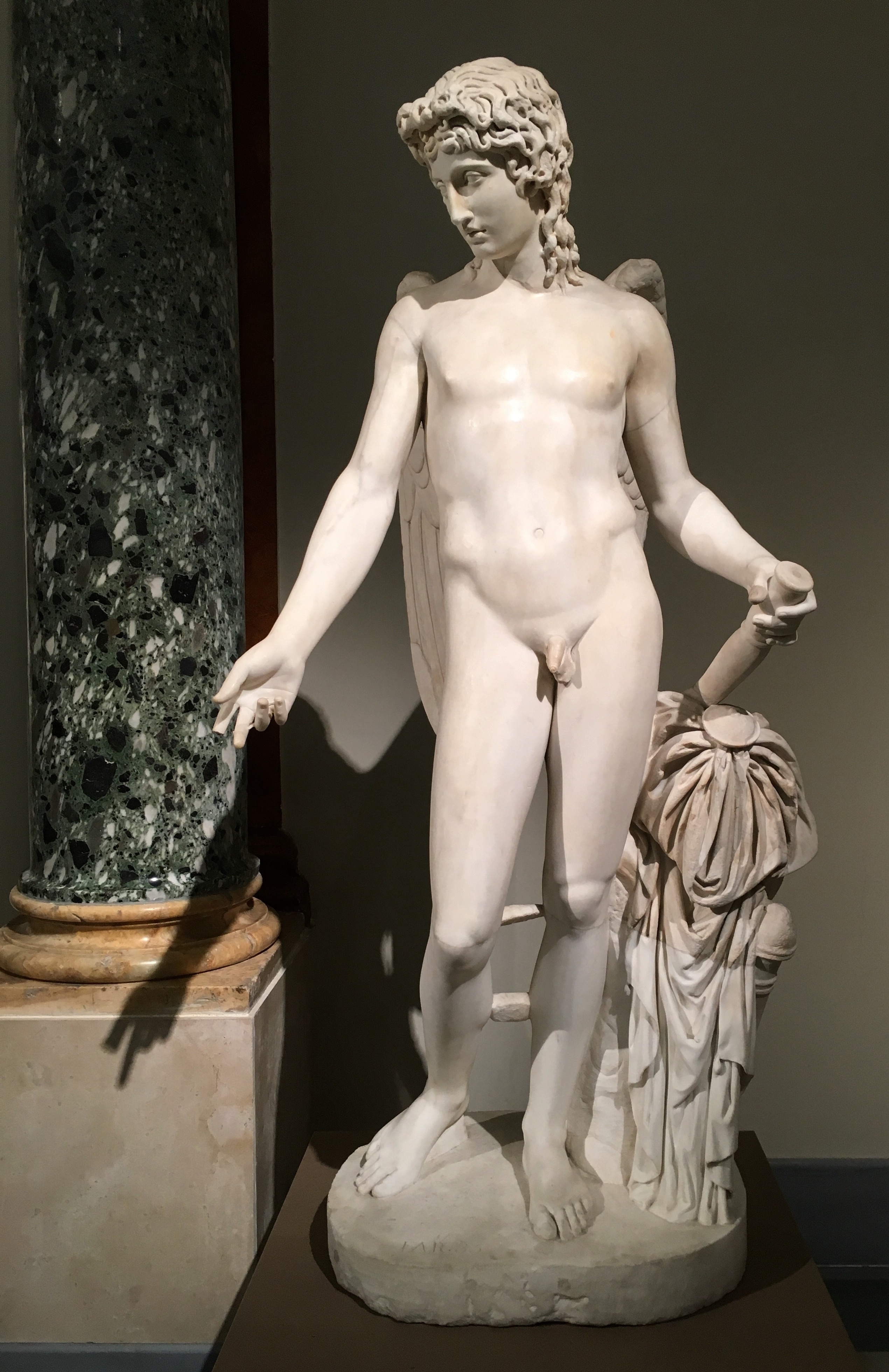
Eros
DeityWikipedia
273
MENTIONS
110
EPISODES
101
PODCASTS
Search complete. 273 mentions across 110 episodes found for "Eros".
Sep 17, 2026

BrandonHOST
Yeah, I know it's fascinating because what we're trying to talk about here is this idea of Ludwig Klages has this idea of the biocentric philosophy, right? Treating soul and cosmos as living and sold realities rather than abstract studied from a distance.
BrandonHOST
His central idea, the pandemonical describes a return to the primordial consciousness through direct magico erotic in the Eros sense encounter with the living powers of the cosmos.
BrandonHOST
His related concept of cosmogonic Eros names an erotic bond with the world that proceeds and exceeds rational analysis.
BrandonHOST
Um, and it's a very, uh, you know, arrows then stemming from the platonic worldview, even though I don't think a little clog us really like the platonic worldview.
BrandonHOST
Um, the arrows is the same thing you're working with when you're doing your, you know, Chinese medicine.
BrandonHOST
Um, you're doing your, you know, the, you're doing your, um, your qigong you know it's the same thing you're doing when you're doing great art it's when you're the Eros also is obviously that madness of love you have for a partner or a loved one it's ever changing and ever growing attraction Towards that expanse.
BrandonHOST
I like the idea of the intimacy of the beloved and the beloved being obviously, you know, the loved one.
BrandonHOST
But also there's this like the beloved is also for the that Sophia ask the feminine out there, the imaginative side.

Lea KorsgaardGUEST
Yeah, and you find it again and again and again, right? Psyche is, uh, the Greek word for butterfly, which Aristotle named.
Lea KorsgaardGUEST
It also mean, of course, psyche, soul, and also it's the name of a very particular goddess, a Greek goddess, who was born as a human being, but when she met Eros, the handsome god that she fell completely in love with, she was given by the chief god, Zeus, eternal life.
Lea KorsgaardGUEST
So she went through the, um, most fundamental transformation of them all from human to being a goddess.
Lea KorsgaardGUEST
And when she is depicted, you see her with butterfly wings.

ExpatriateNARRATOR
With the gramophone, the cinema, and the automatic pistol, the goddess of applied science has presented the world with another gift, more precious even than these, the means of dissociating life from propagation.
ExpatriateNARRATOR
Eros, for those who wish it, is now an entirely free god.
ExpatriateNARRATOR
His deplorable associations with Lucina may be broken at will.
ExpatriateNARRATOR
In the course of the next few centuries, who knows? The world may see a more complete severance.
ExpatriateNARRATOR
The family system will disappear.
ExpatriateNARRATOR
Society, sapped at its very base, will have to find new foundations.
ExpatriateNARRATOR
And Eros, beautifully and irresponsibly free, will flit like a gay butterfly from flower to flower through a sunlit world.
ExpatriateNARRATOR
It sounds lovely, said Anne.

Eli OlsbergGUEST
Simple, plain and simple.
Eli OlsbergGUEST
I do think Eros was a response to that for those two months, which I'm very grateful for, because like, you know, what I loved about those two months was the first month was a lot more hardcore and a lot more like the stuff that was.
Eli OlsbergGUEST
Yes, I remember that.
Eli OlsbergGUEST
Yeah.
8 MINS LATER
Casey ScottHOST
Yeah.
Eli OlsbergGUEST
if if they were to come up but like yeah the more deep cuts i feel like um oftentimes it doesn't happen there because it's it's comprised of an audience that's half they know what they're getting into because they're familiar they're they go they wait for the grindhouse nights and then the other half are people who are trying it out and it doesn't work and they leave and if if any of those behaviors happen they're they're policed pretty quickly yeah um right So if, what was his name, Tyler? If Tyler knows, if he's experienced that at other screenings, I haven't, but they could be at ones that I just haven't been to.
Gentry AustinHOST
Yeah, he did say that during the Eros month, maybe he had experienced that a little bit, but...
Eli OlsbergGUEST
oh well i don't know if i i don't i feel bad putting this guy on blast again but uh there was a guy who very famous there was a person during the uh fireworks woman who was laughing so uncomfortably loud oh yes it was i mean i'm talking social media letterbox you name it people talked about it and my understanding is he felt really bad about it after i think he

speaker_7ADVERTISER
Terms at DKNG.co slash offer.
David RonaldNARRATOR
i will send evil for thy stealthy fire while all embrace it and their vain desire the sire who rules the earth and sways the pole had said and laughter filled his secret soul he bade the artist god his hest obey and mould with tempering waters ductile clay infused as breathing life and form began the supple vigor and the voice of man her aspect fair as goddess above a virgin's likeness with the brows of love he bade minerva teach the skill that dies the web with colors as the shuttle flies he called the magic of love queen to shed a nameless grace around her courteous head instilled the wish that longs with restless aim and cares of dress that feed upon the fame bade hermes last implant the craft refined of artful manners and a shameless mind he said their king the inferior powers obeyed the fictile likeness of a bashful maid rose from the tempered earth by jove's behest under the forming god the zone and vest were clasped and folded by minerva's hand the heaven-born graces and persuasion decked her round limbs with chains of gold the hours of loose lock twined her temples with spring flowers the whole attire minerva's curious care formed to her shape and fitted to her air but in her breast the herald from above full of the counsels of deep thundering jove wrought artful manners wrought perfidious lies in speech that thrills the blood and lulls the wise her did the interpreter of gods proclaim and name the woman with pandora's name since all the gods conferred their gifts to charm for man's inventive race the buteus harm moreover what is said also about the casket is fitted of itself to excite laughter for example will on may on earth the sons of men abode from ills apart and labors irksome load and sore diseases bringing age to man now the sad life of mortals is a span the woman's hands a mighty casket bear she lifts the lid she scatters griefs in air alone beneath the vessels rims detained hope still within the unbroken cell remain nor fled abroad so willed cloud gatherer jove the woman's hand had dropped the lid above now to him who would give to these lines a grave allegorical meaning whether any such meaning be contained in them or not we would say are the greeks alone at liberty to convey a philosophic meaning in a secret covering or perhaps also the egyptians and those of the barbarians who pride themselves upon their mysteries and the truth which is concealed within them while the jews alone with their lawgiver and historians appear to you the most unintelligent of men and is this the only nation which has not received a share of divine power and which yet was so grandly instructed how to rise upwards to the uncreated nature of god and to gaze on him alone and to expect from him alone the fulfilment of their hopes but as celsus makes a jest also of the serpent as counteracting the injunctions given by god to the man taking the narrative to be an old wives fable and has purposely neither mentioned the paradise of god nor stated that god is said to have planted it in eden towards the east and that there afterwards sprang up from the earth every tree that was beautiful to the sight and good for food and the tree of life in the midst of the paradise and the tree of the knowledge of good and evil and the other statements which follow which might of themselves lead a candid reader to see that all these things had not inappropriately an allegorical meaning let us contrast with this the words of socrates regarding eros in the symposium of plato and which are put in the mouth of socrates as being more appropriate than what was said regarding him by all the others at the symposium the words of plato are as follow when aphrodite was born the gods held a banquet and there was present along with the others porus the son of metis and after they had dined penea came to beg for something seeing there was an entertainment and she stood at the gate porus meantime having become intoxicated with the nectar for there was then no wine went into the garden of zeus and being heavy with liquor lay down to sleep Bonilla, accordingly, formed a secret plot, with a view of freeing herself from her condition of poverty, to get a child by Porus, and accordingly lay down beside him, and become pregnant with Eros.
David RonaldNARRATOR
And on this account, Eros had become the follower and attendant of Aphrodite, having been begotten on her birthday feast, and being at the same time, by nature, a lover of the beautiful, because Aphrodite, too, is beautiful." seeing then that eros is the son of porus and penea the following is his condition in the first place he is always poor and far from being delicate and beautiful as most persons imagine but is withered and sunburnt and unshod and without a home sleeping always upon the ground and without a covering lying in the open air beside gates and on public roads possessing the nature of his mother and dwelling continually with indigence But on the other hand, in conformity with the character of his father, he is given to plotting against the beautiful and the good, being courageous and hasty and vehement, a keen hunter, perpetually devising contrivances, both much given to forethought and also fertile in resources, acting like a philosopher throughout the whole of his life.
David RonaldNARRATOR
a terrible sorcerer and dealer in drugs and a sophist as well neither immortal by nature nor yet mortal but on the same day at one time he flourishes and lives when he has plenty and again at another time dies and once more is recalled to life through possessing the nature of his father but the supplies furnished to him are always gradually disappearing so that he is never at any time in want nor yet rich and on the other hand he occupies an intermediate position between wisdom and ignorance now if those who read these words were to imitate the malignity of celsus which be it far from christians to do they would ridicule the myth and would turn this great plato into a subject of jest but if on investigating in a philosophic spirit what is conveyed in the dress of a myth they should be able to discover the meaning of plato they will admire the manner in which he was able to conceal on account of the multitude in the form of this myth the great ideas which presented themselves to him and to speak in a befitting manner to those who know how to ascertain from the myths the true meaning of him who wove them together now i have brought forward this myth occurring in the writings of plato because of the mention in it of the garden of zeus which appears to bear some resemblance to the paradise of god and of the comparison between penea and the serpent and the plot against porus by penea which may be compared with the plot of the serpent against the man it is not very clear indeed whether plato fell in with these stories by chance or whether as some think meeting during his visit to egypt with certain individuals who philosophized on the jewish mysteries and learning some things from them he may have preserved a few of their ideas and thrown others aside being careful not to offend the greeks by a complete adoption of all the points of the philosophy of the jews who were in bad repute with the multitude on account of the foreign character of their laws and their peculiar polity the present however is not the proper time for explaining either the myth of plato or the story of the serpent and the paradise of god and all that is related to have taken place in it as in our exposition of the book of genesis we have especially occupied ourselves as we best could with these matters but as he asserts that the mosaic narrative most impiously represents god as in a state of weakness from the very commencement of things and as unable to gain over to obedience even one single man whom he himself had formed we say in answer that the objection is much the same as if one were to find fault with the existence of evil which god has not been able to prevent even in the case of a single individual so that one man might be found from the very beginning of things who was born into the world untainted by sin for as those whose business it is to defend the doctrine of providence do so by means of arguments which are not to be despised so also the subjects of adam and his son will be philosophically dealt with by those who are aware that in the hebrew language adam signifies man and that in those parts of the narrative which appear to refer to adam as an individual moses is discoursing upon the nature of man in general for in adam as the scripture says all die and were condemned in the likeness of adam's transgression the word of god asserting this not so much of one particular individual as of the whole human race for in the connected series of statements which appears to apply as to one particular individual the curse pronounced upon adam is regarded as common to all the members of the race and what was spoken with reference to the woman is spoken of every woman without exception and the expulsion of the man and woman from paradise and their being clothed with tunics of skins which god because of the transgression of men made for those who have sinned contain a certain secret and mystical doctrine, far transcending that of Plato, of the souls losing its wings and being borne downwards to earth until it can lay hold of some stable resting place.
David RonaldNARRATOR
Chapter 41-50 of Against Celsus, Book 4, by Orgin.

Brad ListiHOST
I...
Brad ListiHOST
You know, he describes it as Thanatos and Eros.
Brad ListiHOST
You know, you kind of alluded to this earlier, Salman-
Rachel Eliza GriffithsGUEST
Mm-hmm

Tony AddisonNARRATOR
Ask me the dear suave question phrased of yore, Sappho, who grieveth now thy mad fond heart? Wouldst win her beauty, she who frowns apart, wild as thou lovest, she soon shall love thee more.
Tony AddisonNARRATOR
O fair Olympian, answer thus, I pray, release me from this torment, yield my arms the transport thirsted of her folded charms in glow that welds her heart to mine, for I Eros From the gnarled branches of the apple-trees, the heavy petals, lifted by the breeze, fluttered on puffs of odour fine and foul in the clear water of the garden well.
Tony AddisonNARRATOR
And some a bolder zephyr blew in sport across the marble reaches of my court, and some by sudden gusts were wafted wide towards sea and city down the mountainside.
Tony AddisonNARRATOR
Lesbos seemed Paphos, isled in rosy glow, green olive hills, the violet vale below, the air was azure fire and o'er the blue still sea the doves of Aphrodite flew.
Tony AddisonNARRATOR
My dreaming eyes saw Eros from afar, coming from heaven in his mother's car, in purple tunic clad, and at my heart the god was aiming his relentless dart.
Tony AddisonNARRATOR
He whom fair Aphrodite called her son, she the adored, she the imperial one, he passed as winds that shake the soul, as pains sweet to the heart, as fire that warms the veins.
Tony AddisonNARRATOR
He passed, and like my limbs dissolved in dew, relaxed and faint with passion quivered through, exhausted with spent thrills of dread delight, a sudden darkness rushing on my sight.

Phil ChenevertNARRATOR
I'll simply say Io.
Phil ChenevertNARRATOR
Trageus: To Hermes, the Graces, Hora, Aphrodite, Eros.
Phil ChenevertNARRATOR
Chorus: But not to Ares? Trageus: No.
Phil ChenevertNARRATOR
Chorus: Nor doubtless to Enyelios? Trageus: No.

Alan Davis DrakeNARRATOR
In the mass of material from which he had to choose, the difficulty was to know what to omit, and much skill is shown in fusing into a tolerably harmonious whole conflicting mythological and historical details.
Alan Davis DrakeNARRATOR
He interweaves with his narrative local legends and the founding of cities, accounts of strange customs, descriptions of works of art, such as that of Ganymede and Eros playing with knucklebones, but prosaically calls himself back to the point from these pleasing digressions by such an expression as, but this would take me too far from my song.
Alan Davis DrakeNARRATOR
His business is the straightforward tale and nothing else.
Alan Davis DrakeNARRATOR
The astonishing geography of the fourth book reminds us of the interest of the age in that subject, stimulated, no doubt, by the researches of Eratosthenes and others.
3 HRS 20 MINS LATER
Cynthia MoyerNARRATOR
And she found him apart in the blooming orchard of Zeus, not alone, but with him Ganymedes, whom once Zeus had set to dwell among the immortal gods, being enamoured of his beauty.
Cynthia MoyerNARRATOR
And they were playing for golden dice as boys in one house are wont to do.
Cynthia MoyerNARRATOR
And already greedy Eros was holding the palm of his left hand quite full of them under his breast, standing upright; and on the bloom of his cheeks a sweet blush was glowing.
Cynthia MoyerNARRATOR
But the other sat crouching hard by, silent and downcast; and he had two dice left which he threw, one after the other, and was angered by the loud laughter of Eros.

Hannah CornwellGUEST
So James, I believe you might be referring to, uh, a figure or possibly two figures at Augustus' foot.
Hannah CornwellGUEST
Uh, and what we can see is we have a small figure, winged figure, a male figure, so, um, a, a, a, a putto, a sort of a cupid, and it probably is Cupid or Eros, riding on a dolphin.
Hannah CornwellGUEST
And this has normally been interpreted as, as Eros, as Cupid, the divine son of Aphrodite, Venus, who is, as you pointed out, uh, the mother of Aeneas and the mother of the entire Julian family through that line, as we know from, uh, Virgil's Aeneid and, and other poems and literature.
Hannah CornwellGUEST
Uh, so this does seem to be...
Hannah CornwellGUEST
Uh, going back to your earlier point, uh, about Augustus not having any issues and his having some sort of divine, potentially divine aspect.
100 more episodes mention Eros.
Create an account to see the whole feed, search across every transcript, and follow the entities you care about.