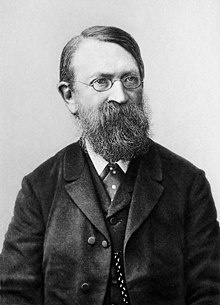
Ernst Mach
Austrian physicist and philosopherWikipedia
20
MENTIONS
15
EPISODES
15
PODCASTS
Search complete. 20 mentions across 15 episodes found for "Ernst Mach".
Sep 30, 2026

Kehlan MorganGUEST
And, uh, uh, anyway, I'm saying all these things, uh, not in order to say that there is no ether, but rather that this notion of an absolute background is something that if we're going to believe in it, we're going to have to believe in something that has never been observed, something that is completely hypothetical, um, But look at what the alternative is.
Kehlan MorganGUEST
The alternative is to say, actually, you know what? Ernst Mach was right.
Kehlan MorganGUEST
There is no absolute background.
Kehlan MorganGUEST
Things are actually constituted relationally in one another in the way that they empirically seem to be.

AbhayNARRATOR
Thus, it seems very natural to reduce the total effect of inertia of a body to action and reaction between it and the other bodies in the universe, as indeed ever since Newton's time, gravity has been completely reduced to action and reaction between bodies.
AbhayNARRATOR
From the equations of the general theory of relativity, it can be deduced that this total reduction of inertia to reciprocal action between masses, as required by Ernst Mach, for example, is possible only if the universe is spatially finite.
AbhayNARRATOR
On many physicists and astronomers, this argument makes no impression.
AbhayNARRATOR
Experience alone can finally decide which of the two possibilities is realized in nature.

George GaleGUEST
And there are some theories in cosmology and astrophysics that people are arguing about, and we're just gonna have to accumulate evidence because people, people hang on to their theories.
George GaleGUEST
I mean, Ernst Mach said one time, he said, "The only way for a, a new theory to take over is for the old guys to die." And [chuckles] I, you know, in, in a way that's true.
George GaleGUEST
It's just you tend to hang on to what you believe.
George GaleGUEST
And the best one I've ever seen, there was a, an astrophysicist, a cosmologist that I interviewed one time, and gosh, now I can't even remember his name.

George GaleGUEST
And there are some theories in cosmology and astrophysics that people are arguing about, and we're just gonna have to accumulate evidence because people, people hang on to their theories.
George GaleGUEST
I mean, Ernest Mach said one time, he said, "The only way for a, a new theory to take over is for the old guys to die." And [chuckles] I, you know, in, in a way that's true.
George GaleGUEST
It's just you tend to hang on to what you believe.
George GaleGUEST
And the best one I've ever seen, there was a, an astrophysicist, a cosmologist that I interviewed one time, and gosh, now I can't even remember his name.

Tim PalmerGUEST
Um, but this is separate or different from non-locality.
Tim PalmerGUEST
And I, just to give an example of what I mean, um, you know, there, there was this famous, uh, Ernst Mach back in the, um, early 20th century proposed this thing called Mach's principle, uh, which was a real motivation for Einstein in formulating his theory of general relativity.
Tim PalmerGUEST
And what Mach's principle says is that the, what determines whether a, a frame of reference is, uh, is, if you like, rotating, non-inertial, you know.
Tim PalmerGUEST
Um, I mean, like, you know, the Earth.

speaker_0NARRATOR
Vienna in the eighteen eighties was a city of extraordinary intellectual ferment.
speaker_0NARRATOR
It was the Vienna of Gustav Mahler and Hugo von Hofmannsthal, of Sigmund Freud and Ernst Mach, a city where the boundaries between art, science, philosophy, and psychology were permeable and constantly being crossed.
speaker_0NARRATOR
The young Steiner absorbed this atmosphere like a sponge, moving between the precise world of mathematics and physics and the more speculative world of philosophy and aesthetics.
speaker_0NARRATOR
He was, by all accounts, an unusual student: intensely focused, intellectually voracious, and quietly certain that the conventional boundaries between disciplines were artificial and limiting.

Dean BuonomanoGUEST
And what we really are referring to, time is a convention to measure change.
Dean BuonomanoGUEST
So there's this great quote by, um, by, uh, Ernst Mach, um, the physicist, and to paraphrase, he's saying something like this: "It's utterly impossible to measure change using time." Because time is an abstraction we arrive at by measuring change.
Dean BuonomanoGUEST
So what he means is at the end of the day, when we talk about time, we're only talking about something measured by clocks.
Dean BuonomanoGUEST
But what is a clock? Clock is just something that changes in some reproducible way as we started off this conversation, right? So there's nothing magical about clocks.

Cynthia NollGUEST
This work was actually done by some very famous physicists in the 19th century, people you've probably heard of or studied.
Cynthia NollGUEST
Hermann von Holtz, Ernst Mach are two of those people who actually studied not only did amazing discoveries related to physics, but also developed methodologies to understand eyes, ears.
Cynthia NollGUEST
They discovered the vestibular system, which helps with balance.
Cynthia NollGUEST
Those techniques that they developed to do quantitative descriptions are still used today.

Diane CastilloNARRATOR
It comes first from the physicists who have investigated the problem of the psychological origin of the data of physics, and second from the mathematicians who have investigated the logical dependence of geometry on its postulates.
Diane CastilloNARRATOR
The most representative name among the physicists who have concentrated attention upon the epistemological problem insofar as it affects scientific method is Ernst Mach, 1838-1916.
Diane CastilloNARRATOR
He does not stand alone.
Diane CastilloNARRATOR
Many others deserve mention, and particularly W.K. Clifford and later Karl Pearson in England.

Sergei GepshteinGUEST
So what is physiological space? Physiological space, it's a description of how space is given to an individual, constrained by their capacity, perceptual capacity, motoric capacity, right? It is indeed mesoscale.
Sergei GepshteinGUEST
And as a certain physicist pointed out, the eminent Ernst Mach, in order to understand how we do physics, or how rather you do physics, we have to first understand how physical properties, so-called physical properties, are given to us for our senses.
Sergei GepshteinGUEST
After his consequential work on mechanics, he has written a number of important contributions to what we call today scientific psychology and neuroscience, trying to understand exactly that.
Sergei GepshteinGUEST
How space construed through capacities of the organism.
Sergei GepshteinGUEST
Just like that, by our professional training, each one of us is tuned to a particular band If it were a spectrum of concepts of space, if you're a physicist, you think, I don't know, Kolobachevsky and space is the real one, right? If you are an architect, you would argue that this is just an abstraction.
Sergei GepshteinGUEST
Those physicists deal with abstractions, and we architects deal with reality.
Sergei GepshteinGUEST
Now, just to enforce it a little bit and simplify things, So, I gave you these conceptions of space from Minkowski and Ernst Mach talking about space, and then Gestalt psychologists, and then phenomenologist Merleau-Ponty, and then a number of architects dealing exactly with the question of how to convert your experience of space from two-dimensional drawings to three-dimensional experience.
Sergei GepshteinGUEST
In Western architecture, in oriental architecture, this is the study of painting, of how you experience a virtual three-dimensional space by looking at the painting, even though you know very well that you're looking at a two-dimensional surface of canvas or a panel of wood, right, to Bakhtin or Bachelard.
5 more episodes mention Ernst Mach.
Create an account to see the whole feed, search across every transcript, and follow the entities you care about.