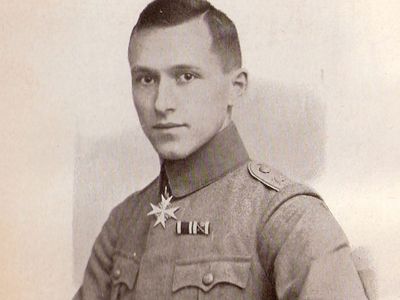
Ernst Jünger
German authorWikipedia
17
MENTIONS
14
EPISODES
14
PODCASTS
Search complete. 17 mentions across 14 episodes found for "Ernst Jünger".
Oct 2, 2026

Michael MoynihanHOST
I said, oh, it's that guy.
Michael MoynihanHOST
The press is named, I believe, after Ernst Jünger, the German writer.
Michael MoynihanHOST
You can do your own research on – who did write a very good book about World War I and was a – loved by the Nazis.
Michael MoynihanHOST
Just put it that way.

Alice WinnGUEST
And then I would...
Alice WinnGUEST
i have this notebook right and i'd be like okay so that's that's from you know one of the best books for this was um ernst junger's storm of steel uh which is a german stormtrooper account and it's uh it's it's really incredible it's a really really useful book if you're ever doing anything to do with global one like i strongly recommend you read it just just for research but it's it's a good book as well um but uh I just remember reading, for instance, Edward Living's account of the Battle of the Somme in a book called 24 Hours on the Somme, and he described someone who was nursing his friend in a crump hole, and then a bomb fell near them and boiled the water and boiled him alive.
Alice WinnGUEST
And it's like, that doesn't...
NehaHOST
That would not go through your head.
Alice WinnGUEST
how to think of that right I would be like well presumably everyone was shot in the head and that's how they don't but that's not how it works and so the the research um really sort of made me feel more confident because as you plug in the specifics not only about how people are getting hurt but also about how people are responding right it's in in uh Ernst Junger's account um There's a moment when, you know, the narrator, I think it is Ernst, is it himself? I think it's a memoir.
Alice WinnGUEST
The narrator has this really like cold kind of expressionless attitude to the front.
Alice WinnGUEST
And then he's behind the reserve line and he sees someone like cut their hand on a truck or something and he like passes out.

Bonaventure ChapmanHOST
Um, so he's...
Bonaventure ChapmanHOST
And the n- the good part about these guys writing in the '20s and '30s, um, and Ernest Junger has this kind of feeling too, the guys that really spent time in the trenches, spent time around this, this period th- thought philosophical about it, is the kind of turning over to the, the age of the machine.
Joseph Anthony KressHOST
Mm-hmm.
Bonaventure ChapmanHOST
Uh, at this point, the Industrial Revolution had been kicking for a little while.

Patrick McNamaraGUEST
It's a pleasure to talk with you again.
James EllisHOST
This time around, we are once again going to be discussing Ernst Jünger's concept figure of the Anarch.
James EllisHOST
But this time, it is from a full-length book of yours, which we were just saying is probably is the first full-length book on Jünger's concept of the Anarch, uh, called The Anarch as Katechon: Literary, Neuroscience, and Evolutionary Studies of a Liminal Figure.
James EllisHOST
Um, and, you know, I just-- I would describe this book basically as an attempt to take what I think is, you know, textually is a literary figure, but anyone who approaches the Anarch will understand quickly that it is something bigger.

John PodhoretzHOST
Um, uh, but the reckoning of people like Guitry and all kinds of people, uh, Marcel Carné, who made Children of Paradise and others, like, and, uh, how they, um-
Seth MandelPANELIST
Ernst Jünger
John PodhoretzHOST
...
John PodhoretzHOST
they, they themselves, they ne- they themselves never reckoned with, uh, their ro- They, they, they tried to live out the rest of their lives not having to take responsibility for having, uh...

Jon GreenawayGUEST
The problem is death, and the problem is, like, o- o- one's own being towards it.
AdamHOST
No, absolutely, and I turn it to the being towards death of thinking about something like Ernst Jünger, total mobilization, war as mystical experience, being embodied in this kind of stuff.
AdamHOST
But also just, I'm thinking of the Administratum here.
AdamHOST
It, it is a kind of militarized austerity.

Harry HoriGUEST
... and is mine gonna be m- stronger and more ruthless than his?
Jack MaxeyHOST
I, you know, this all reminds me, I'm, I'm a great fan of a, a German author named Ernst Jünger, who wrote a, a book on the First World War, which I recommend to everybody.
Jack MaxeyHOST
It's the greatest book on the First World War ever, called Storm of Steel.
Jack MaxeyHOST
But later in his life, uh, and he was a guy who found faith, I mean, he, he actually got, became a Catholic at age 102, I believe, and later in life he wrote a lot, number of philosophical books, and one of them was called, I believe it was called The Forest, and the basic premise was that the world we're describing right now is coming, and he saw that the only place that mankind could survive, you know, from the surveillance state was to go back into the deep forests of our, of our forebears and, uh, you know, to...

Neil RenicGUEST
which is really about the unrelenting misery of that war and how destructive it was to the souls, to the brains, to the bodies of the young men who fought in it.
Neil RenicGUEST
But there's also other books on that war, like Ernst Jünger's Storm of Steel, where he just is like, I had the best time ever.
Neil RenicGUEST
And that's not to kind of minimize the horrors of war, because I do think war is horrific, but I think We don't want to fool ourselves into thinking that everyone comes back in the same condition.
Neil RenicGUEST
Some people find more immensely rewarding this kind of existential experience where they bond with others and they never feel more alive than when they fight in it, I think.

Jonathan PageauHOST
That's right, leadership is a much better, that's what we should be aiming towards.
Rusty RenoGUEST
And Ernst Junger, he wrote that the true vocation of nobility is to protect the weak.
Jonathan PageauHOST
Mm-hmm, yeah.
Jonathan PageauHOST
Well, that's the solution to the problem, I think, of the strong gods.

Andrew MitchellGUEST
So briefly, briefly, this started with a military interest.
Andrew MitchellGUEST
World War I, the youngest recipient to win the Polar Merite, which is the highest German military honor, Ernst Jünger.
Andrew MitchellGUEST
He and his younger brother, Friedrich George, experienced the totality of the Western Front and have a beautiful – a beautiful relationship for decades afterwards.
Andrew MitchellGUEST
They both have a falling out with the Nazi party.
Andrew MitchellGUEST
But these brothers have this really fascinating correspondence during World War II.
Andrew MitchellGUEST
And in the middle of it, Friedrich George writes, what if the sinking of the Titanic... was the beginning of our current era in the sense in which we see with the Nazis, we see with the Soviets, we see even with the Americans, a desire to tap into forces greater than that of the merely human.
Andrew MitchellGUEST
And for the Jünger brothers, this is Titanic, right? So they're proposing from sort of 1912 until an unknown future, A titanic age in which man seeks to release, if you will, right? Unchain the titans, the titanic powers and the titanic energies that have been curtailed since one would assume the gods gave man law and order.
Andrew MitchellGUEST
And so what we might expect to see are greater manifestations of a chaos, of a Uranus-like spirit, of Kronos, the boomer father who eats his kids kind of idea.
4 more episodes mention Ernst Jünger.
Create an account to see the whole feed, search across every transcript, and follow the entities you care about.