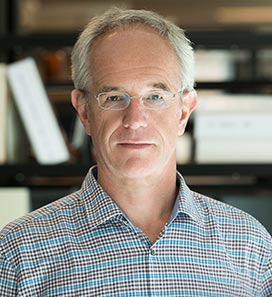
Eric Verdin
President and CEO of the Buck Institute for Research on Aging
5
APPEARANCES
5
PODCASTS
Sep 14, 2026


Eric VerdinGUEST
That is actually one of the things that is exciting me the most, even though both Paola and I agree this is early data.
Eric VerdinGUEST
So we could measure that group over a period of time, and we could measure the people who actually... underwent some level of training using the sensei helmet, or I don't know what you call it, Paola.
15 MINS LATER

Phil NewmanHOST
Eric, you've taken the brain years assessment yourself, right? So what was the experience like and what did you learn personally? And did anything in the results surprise you?

Elizabeth PoynorHOST
So NAD, taking NAD helpful or not helpful? Because I think that we have to talk about taking NAD as a supplement, as a separate, actually more nuanced research you're looking into, right?
13 MINS LATER


Eric VerdinGUEST
But I also have my own lab, uh, and I focus on understanding the role of the immune system.
Eric VerdinGUEST
The immune system seems to be one of the few organs, along with the central nervous system, that play a dominant role in aging.
Eric VerdinGUEST
And so there's evidence, for example, that if you, if you have a lesion only in the immune system, this will cause aging in the whole organism.
Eric VerdinGUEST
The other thing is aging in the immune system I think has not received the attention that it requires, and this was highlighted during the pandemic-
10 MINS LATER
Eric VerdinGUEST
Now, there is something that happens when we are born, is that we're not being, um, as old as our parents were.


Mark HymanHOST
Let's start with, like, why, why are mitochondria and cellular energy so important to aging?
Eric VerdinGUEST
The big reason that everyone, uh, knows is the... or most people agree on, is the energy, energy requirement.
Eric VerdinGUEST
What people think about, um, moving your arms, thinking, uh, everything that we do is depending on generating energy.
Eric VerdinGUEST
Typically, we get that energy from our food, okay? So we're able to extract energy from the food.
Eric VerdinGUEST
The place where that energy conversion happens is in the mitochondria, okay? Most of your, our energy generation happens in the mitochondria.


Erik VerdinGUEST
And that's in contrast to the adaptive immune system, because once the initial response has been generated, either via an infection or a vaccination, this is what a vaccination is, it presents you with a given fraction or the whole virus or a part of it, your body will mount a response and this will lead to the amplification of a subset of cells that are selective.
Erik VerdinGUEST
We have a process by which we generate so-called diversity, which is billions of different forms of antibodies or T-cell receptors that are recognizing, in principle, every chemical structure, every protein from a microorganism.
Erik VerdinGUEST
Now, what happens during the initial encounter, either being a vaccination or an infection, is those B-cells or those T-cells that have a receptor that is able to recognize the pathogen will become amplified, and they will turn out large amount of the antibody or the T-cell clones.
38 MINS LATER