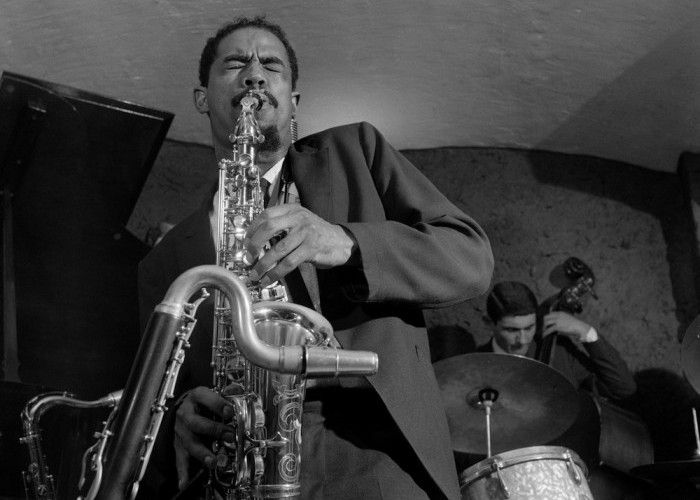
Eric Dolphy
American multi-instrumentalist and composerWikipedia
28
MENTIONS
14
EPISODES
12
PODCASTS
Search complete. 28 mentions across 14 episodes found for "Eric Dolphy".
Sep 9, 2026

Mike WattHOST
Eat the document, right? Uh, Damon Smith, George R.
Mike WattHOST
Samson, K. Curtis Lyle with Redefining Eric Dolphy.
Mike WattHOST
The Regal Selects with The Hall of the Very Good.
Mike WattHOST
Okay, origin story.
56 MINS LATER
Mike WattHOST
But as I get less younger, I'm thinking four string drum set.
Mike WattHOST
Yeah, yeah.
Mike WattHOST
Speaking of Eric Dolphy, you know, played toward Chico Hamilton.
Mike WattHOST
Chico Hamilton could get songwriting

Greg CarrHOST
I'll talk about those again in a minute.
Greg CarrHOST
On the air this week, we played Barber's Fables, Charles Mingus's 1960 composition, where he and Danny Richmond, his longtime drummer, going back and forth with Eric Dolphy playing on saxophone.
Greg CarrHOST
Charles Mingus asks Danny Richmond, name me someone sick and ridiculous.
Greg CarrHOST
And then Danny Richmond from behind the drum kit says, Governor Barbers.
Greg CarrHOST
And Mingus says, why is he so sick and ridiculous? won't let us in his school then he's a fool oh fool and then here comes eric dolphy on the horn and then he names he says name me some more that is sick and ridiculous he says bilbo rockefeller eisenhower why are they so sick and ridiculous two four six eight they brainwash and teach you hate so i mean fables of fathers but mingus's politics are not far from his music Louis Armstrong, who was known not to involve himself in the politics.
Greg CarrHOST
In fact, he was criticized by younger people.
Greg CarrHOST
but not getting politically involved in things in the 1950s and 60s for being the kind of entertainer, as Ozzie Davis once said of him, you know, we called what Armstrong did, oofta.

Lawrence PuryearHOST
On this centennial, I'd like to explore how he sounded to the people critiquing him while he was still alive, and how that differs, or doesn't, with how his work is viewed today.
Lawrence PuryearHOST
Famously, in the November 23rd, 1961 issue of Downbeat magazine, critic John Tyen reviews a Coltrane and Eric Dolphy performance at the Jazz Workshop in Los Angeles.
Lawrence PuryearHOST
He said at the time, quote, I heard a good rhythm section go to waste behind the nihilistic exercises of the two horns, end quote.
Lawrence PuryearHOST
He calls what they're doing, quote, an anarchistic course in their music that can but be termed anti-jazz, end quote.
Lawrence PuryearHOST
Anti-jazz in downbeat about John Coltrane.
Lawrence PuryearHOST
John Coltrane and Eric Dolphy actually engaged with the critique.
Lawrence PuryearHOST
In April of 62, they sat for another issue of Downbeat, and Dolphy was asked whether his music even swings.
Lawrence PuryearHOST
Of course I do, he said.

Ken LasterHOST
It's also supplemented by Booker Little on trumpet.
Ken LasterHOST
Eric Dolphy on alto saxophone, along with a brass section consisting of several French horns, tubas, baritone saxophones, euphoniums, trombones, and the like, a 21-piece ensemble.
Ken LasterHOST
And Eric Dolphy and McCoy Tyner are credited with the orchestration.
Ken LasterHOST
That's a 1961 release on Impulse Records.
Ken LasterHOST
We're going to continue on for the rest of the show with some new releases, beginning with the great bassist Dave Holland, and he released a single with the Dave Holland Quintet.

speaker_0HOST
He was a huge jazz double bassist.
speaker_0HOST
He was famous for playing on Eric Dolphy's avant-garde classic, Out to Lunch, and also directed the improvisational session behind Van Morrison's Astral Weeks.
speaker_0HOST
Little Brother Montgomery passed away in 1985 at the age of 79 from natural causes.
speaker_0HOST
He was an influential blues and jazz pianist.
speaker_0HOST
Horace Silver was born in 1928, jazz pianist and composer who was a pioneer of the hard bop style of jazz, famous for tracks like Song for My Father.
speaker_0HOST
Clifford Jordan was born in 1931, neo-bop tenor saxophonist who gained fame playing alongside Charles Mingus and also Eric Dolphy before leading his own sessions for Blue Note Records.
speaker_0HOST
Walter Davis Jr. was born in 1932, a hard bop jazz pianist who is highly regarded for his work with Art Blakey's Jazz Messengers.
speaker_0HOST
Emile Richards was born in 1932, jazz bassist who became huge during the swing era, toured extensively with the Savoy Sultans.

ShomHOST
Even if you think back to Miles Davis, John Coltrane, that era, Woody Shaw.
ShomHOST
Eric Dolphy, there's a wave in the US and then afterwards, there's a kind of demand that comes in Europe.
ShomHOST
And there's this pattern I've seen over 70 years, maybe longer, where people go to Europe and they're more celebrated.
ShomHOST
They have new opportunities.
AmirGUEST
Right.
AmirGUEST
I mean, it's the same thing in Japan, too.
AmirGUEST
I mean, you know, like I tell people here, they're like, Amir, why did you move to Berlin? Why did you, you know, so I'm like, I'm just following the footsteps of, like you said, Eric Dolphy, you know, Dexter Gordon.
AmirGUEST
You know, he lived in Scandinavia for like a very long time.

Mike BaggettaGUEST
Okay.
Mike BaggettaGUEST
What's this guy about? And you can learn about Eric Dolphy once you learn about Charles Mingus.
Mike BaggettaGUEST
You can learn about John Coltrane once you learn about Eric Dolphy.
Mike BaggettaGUEST
And then you can learn about Miles Davis once you learn about John Coltrane.
Mike BaggettaGUEST
It just shows that connectedness.
Mike BaggettaGUEST
I mean, for me, it's like my dad, to Jeff Beck, to Charles Mingus, to Dolphy, to Coltrane, to Miles Davis, to Mike Stern, to whatever.
Mike BaggettaGUEST
It's like a
Austin RichHOST
direct line, yeah.

Greg CarrHOST
Well, September the 2nd, 1959.
Greg CarrHOST
Dee, can you bring up, get ready to cue up Charles Mingus on bass, Eric Dolphy on alto sax, Ted Kirsten on trumpet, and the great Danny Richmond on drums.
Greg CarrHOST
1960 release on the album mingus plays mingus um october of that year 1960 three years after september the 2nd 1957 ernest green elizabeth eckford terence roberts carletta walls lanier melba patillo bills minnie jean brown tricky gloria ray carl mark jefferson thomas and thelma mothershed where left their previous institutions, in some cases, Paul Lawrence Dunbar High School or Horace Mann High School to magnificent HBHSs, Historically Black High Schools in Little Rock, Arkansas, and punched their way with the help of lawyers like Thurgood Marshall and more close to them, the great Daisy Bates, who writes about this in her memoir, The Long Shadow of Little Rock.
Greg CarrHOST
They are known colloquially as the Little Rock Nine.
Greg CarrHOST
Thank you.
Greg CarrHOST
To all you Negro artists out there who are saying, I just want to make my music and talking about naked women and sex and drugs and whatever.
Greg CarrHOST
Take all of that up and throw it in the trash and sound a little bit with Charles Mingus, Eric Dolphy, Ted Kirsten, Danny Richmond.
Greg CarrHOST
I think you can recover.

CraigHOST
Yeah, John Coltrane from the 50s, I believe.
CraigHOST
And I'm going to play the next one, which is Eric Dolphy, who influenced this tune.
CraigHOST
It's called Hat and Beard.
speaker_0UNKNOWN
All
CraigHOST
And John Coltrane has two and a half million monthly listeners.
CraigHOST
Wow.
CraigHOST
And Eric Dolphy has 31,000, so he's not quite the same league, but interesting stuff.
CraigHOST
That was a small...
4 more episodes mention Eric Dolphy.
Create an account to see the whole feed, search across every transcript, and follow the entities you care about.