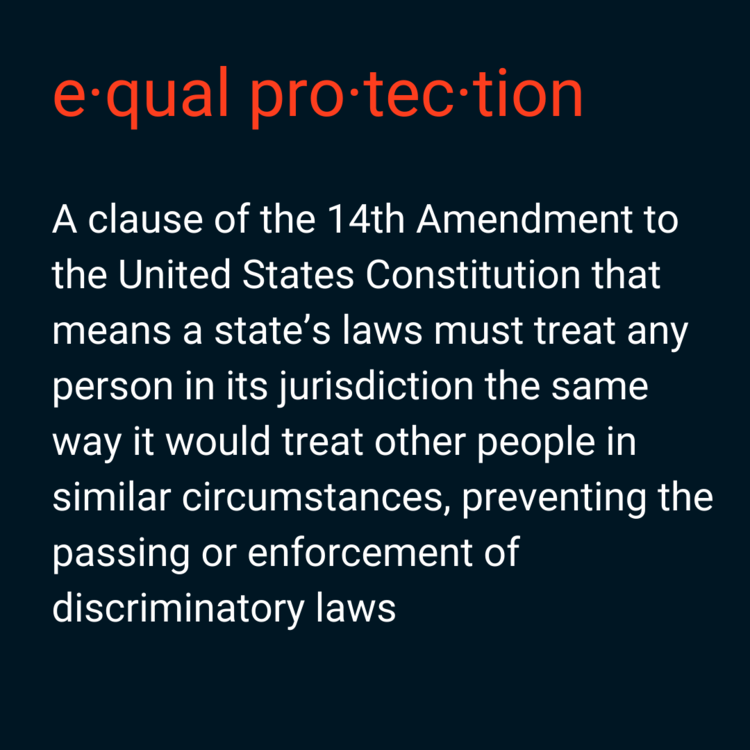
Equal Protection Clause
122
MENTIONS
63
EPISODES
58
PODCASTS
Search complete. 122 mentions across 63 episodes found for "Equal Protection Clause".
Sep 17, 2026

speaker_2HOST
It is up to Congress to decide whether to seat that state's representatives.
speaker_3HOST
Conversely, the court will hear voting rights cases under the Equal Protection Clause because equal protection provides manageable standards like one person, one vote.
speaker_2HOST
So once you navigate through all of these gatekeeping doctrines, standing, ripeness, mootness, political questions, the federal court has conclusively established its authority to hear the dispute.
speaker_3HOST
Exactly.
17 MINS LATER
speaker_3HOST
There can be no independent constitutional bars.
speaker_3HOST
Congress cannot use federal money to induce a state to violate a separate constitutional provision.
speaker_3HOST
For example, Congress cannot offer a state a billion dollars in education funding on the condition that the state segregates its public schools because that violates the Equal Protection Clause.
speaker_2HOST
And requirement five, which is the most heavily litigated and complex, the anti-coercion principle.

Verla VieiraNARRATOR
While the state court is no doubt correct in asserting that marriage is a social relation subject to the state's police power, Maynard v. Hill, 125 U.S. 190, 1888, the state does not contend in its argument before this court that its powers to regulate marriage are unlimited notwithstanding the commands of the Fourteenth Amendment, nor could it do so in light of Meyer v. Nebraska, 262 U.S. 390, 1923, and Skinner v. Oklahoma, 316 U.S. 535, 1942.
Verla VieiraNARRATOR
Instead, the state argues that the meaning of the Equal Protection Clause, as illuminated by the statements of the framers, is only that state penal laws containing an interracial element as part of the definition of the offense must apply equally to whites and Negroes in the sense that members of each race are punished to the same degree.
Verla VieiraNARRATOR
Thus, the state contends that, because its miscegenation statutes punish equally both the white and the Negro participants in an interracial marriage, these statutes, despite their reliance on racial classifications, do not constitute an invidious discrimination based upon race.
Verla VieiraNARRATOR
The second argument advanced by the state assumes the validity of its equal application theory.
Verla VieiraNARRATOR
The argument is that, if the Equal Protection Clause does not outlaw miscegenation statutes because of their reliance on racial classifications, the question of constitutionality would thus become whether there was any rational basis for a state to treat interracial marriages differently from other marriages.
Verla VieiraNARRATOR
On this question, the state argues, the scientific evidence is substantially in doubt and, consequently, this court should defer to the wisdom of the state legislature in adopting its policy of discouraging interracial marriages.
Verla VieiraNARRATOR
Because we reject the notion that the mere equal application of a statute containing racial classifications is enough to remove the classifications from the Fourteenth Amendment's proscription of all invidious racial discriminations, we do not accept the state's contention that these statutes should be upheld if there is any possible basis for concluding that they serve a rational purpose.
Verla VieiraNARRATOR
The mere fact of equal application does not mean that our analysis of these statutes should follow the approach we have taken in cases involving no racial discrimination where the Equal Protection Clause has been arrayed against a statute discriminating between the kinds of advertising which may be displayed on trucks in New York City, Railway Express Agency, Inc. v.

Mary McCordHOST
Another person in Missouri brings a case in federal district court.
Mary McCordHOST
So that was the Missouri Supreme Court, brings case in federal district court saying, "Under the 14th Amendment and the Equal Protection Clause, those of us who voted in the primaries under this new map," that they never should've even been using, frankly, "we're now going to be treated differently because if we go back and use the old map for the upcoming election, we might have been voting in a primary for somebody, and now we're in a different district because now we're using the old map and not the new map." And a federal judge appointed by Donald Trump, and I hate even saying that 'cause a lot of times it doesn't matter, but I think here it's worth noting-
Andrew WeissmannHOST
Yes
Mary McCordHOST
... after the Missouri Supreme Court had already said, "Use the, uh, old map," and after, I forgot an important detail, after the secretary of state had run to the Supreme Court seeking a stay, and that had gone to Justice Kavanaugh, and Justice Kavanaugh didn't even refer it to the full court.

Paul LawrenceGUEST
And if you look and you read the case, the case said, there's this earlier case that we decided called Aberdeen Savings, which definitively decided in our state that an income tax is a property tax.
Paul LawrenceGUEST
So you have to go back and read, what did Aberdeen actually decide? The issue that was decided in that case was whether the tax at issue violated the Equal Protection Clause of the United States Constitution.
Paul LawrenceGUEST
The court in Aberdeen never reached the question of whether the tax was okay or not under the 14th Amendment.
Paul LawrenceGUEST
And in holding that the tax was not okay under the Equal Protection Clause of the Washington Constitution, the court cited a U.S. Supreme Court case that had come out recently.
Paul LawrenceGUEST
Well, that U.S. Supreme Court case that was cited and relied upon by Aberdeen and therefore cited and relied upon by Culleton was overturned by the U.S. Supreme Court in 1976.
Paul LawrenceGUEST
And in overturning The case, the U.S. Supreme Court said, this case is a relic of a bygone era.

Maya HensonGUEST
So they file a lot of complaints with the Office of Civil Rights, with the Federal Department of Education, and a lot of federal lawsuits.
Maya HensonGUEST
There was a school in Illinois that had an affinity group that was for Black biracial African-American kids, and they claimed that that violated the Equal Protection Clause.
Maya HensonGUEST
So they filed a complaint with the office of civil rights, the federal office of civil rights.
Maya HensonGUEST
There was also a lawsuit that they filed against a school district in Massachusetts because they had an affinity group for students of color.

Bruce NielsonHOST
Worse yet, Bolling versus Sharpe, v. Sharpe, was a similar ruling, ruling in Washington, DC.
Bruce NielsonHOST
But in Washington, DC, the Equal Protection Clause of the Constitution does not apply.
Bruce NielsonHOST
Uh, the Equal Protection Clause was the whole basis for the ruling [laughs].
Bruce NielsonHOST
So in that ruling, in Bolling v. Sharpe, uh, where they couldn't invoke the Equal Protection Clause, they just didn't bother to explain their ruling much at all, [laughs] um, for why they were saying you, you could not segregate.
speaker_3HOST
It evolves.
speaker_4HOST
Parallel to due process is the Equal Protection Clause.
speaker_3HOST
Yeah.
speaker_4HOST
Nor deny to any person within its jurisdiction the equal protection of the laws.

Michael ScudderMODERATOR
That is broad, okay? But would that, would that be a violation of the 14th Amendment or would, in, in, in the, in the state of Illinois's position, is that a perfectly fine law?
Sarah HungerGUEST
Well, our argument under the Equal Protection Clause is that this law is facially neutral as it co- as it, as to race, um-
Michael ScudderMODERATOR
But so what-
Sarah HungerGUEST
... and does not have an intent of invidious discrimination.

speaker_0HOST
What you'll learn in this broadcast.
speaker_0HOST
Why the Equal Protection Clause covers every child in a state.
speaker_0HOST
How a 5-4 vote blocked a permanent uneducated underclass.
speaker_0HOST
What schools may never ask for at the registration desk.
speaker_2NARRATOR
It holds that states cannot constitutionally deny students a free public K-12 education based on their immigration status or their parent status.
speaker_2NARRATOR
The vote was close, five to four.
speaker_2NARRATOR
The court found that denying education to undocumented children violates the Equal Protection Clause of the 14th Amendment because those children are persons within a state's jurisdiction.
speaker_2NARRATOR
That right still stands today, but it's being tested.

Clint SmithHOST
And the Court finally agreed with them.
Clint SmithHOST
On May 17, 1954, the Supreme Court unanimously held that segregated public schools violated the Equal Protection Clause.
Clint SmithHOST
In his decision, Chief Justice Earl Warren said, We conclude that in the field of public education, the doctrine of separate but equal has no place.
Clint SmithHOST
Separate educational facilities are inherently unequal.
53 more episodes mention Equal Protection Clause.
Create an account to see the whole feed, search across every transcript, and follow the entities you care about.