Epworth Sleepiness Scale
12
MENTIONS
11
EPISODES
10
PODCASTS
Search complete. 12 mentions across 11 episodes found for "Epworth Sleepiness Scale".
Oct 7, 2026

Michael BreusHOST
Okay
Michael GrandnerGUEST
... a guy named, a sports psychologist named Ben Potenciano, where he gave a bunch of Major League Baseball players the Epworth Sleepiness Scale.
Michael GrandnerGUEST
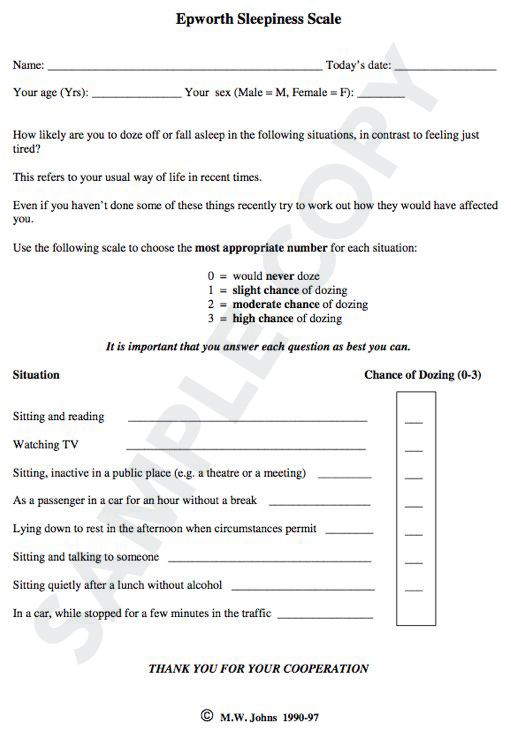
So for people who don't know, it's just eight items.
Michael BreusHOST
Yeah.

speaker_0NARRATOR
On this test, a well-rested person typically takes more than fifteen minutes to fall asleep, while a severely sleep-deprived person may fall asleep in under five minutes.
speaker_0NARRATOR
Another tool used to measure subjective sleepiness is the Epworth Sleepiness Scale, a simple questionnaire that asks people to rate how likely they are to doze off in various everyday situations.
speaker_0NARRATOR
The Stanford Sleepiness Scale is an even simpler tool that asks a person to pick one statement from a list that best describes how alert or drowsy they feel right now.
speaker_0NARRATOR
Researchers have found that people are generally poor at judging their own level of sleepiness, especially when they are chronically sleep-deprived.

Karen LasserHOST
Sure.
Karen LasserHOST
And do you find validated instruments like the Epworth Sleepiness Scale to be clinically useful?
Tom ScammellGUEST
Yeah.
Tom ScammellGUEST
We use that quite frequently.
Tom ScammellGUEST
The Epworth Sleepiness Scale is not a diagnostic instrument for narcolepsy per se.
Tom ScammellGUEST
It's just a subjective scale that gives you a sense of how sleepy somebody is.
Tom ScammellGUEST
And so the scores range from zero to twenty-four.

speaker_1UNKNOWN
Again, sits on that metabolic spectrum.
speaker_1UNKNOWN
We should do this using both the Epworth sleepiness scale to assess for sleepiness, but also the stop bang questionnaire, which is more specific and sensitive in terms of detecting underlying sleep apnea.
Kevin FernandoHOST
So thank you all for listening.
Kevin FernandoHOST
I hope you found this podcast helpful.
speaker_4NARRATOR
On this test, a well-rested person typically takes more than fifteen minutes to fall asleep, while a severely sleep-deprived person may fall asleep in under five minutes.
speaker_4NARRATOR
Another tool used to measure subjective sleepiness is the Epworth Sleepiness Scale, a simple questionnaire that asks people to rate how likely they are to doze off in various everyday situations.
speaker_4NARRATOR
The Stanford Sleepiness Scale is an even simpler tool that asks a person to pick one statement from a list that best describes how alert or drowsy they feel right now.
speaker_4NARRATOR
Researchers have found that people are generally poor at judging their own level of sleepiness, especially when they are chronically sleep-deprived.

speaker_1HOST
For subjective assessment, we use validated questionnaires.
speaker_1HOST
The Epworth Sleepiness Scale, or ESS, measures trait sleepiness, how likely you are to doze off in specific situations like reading or watching TV.
Manaan KarrayHOST
And the other one is the ISI.
speaker_1HOST
Yes.

Robert AdamsGUEST
and you're sleeping an okay amount, you probably need a referral anyway.
Robert AdamsGUEST
The set of questions that we use, and it's an imperfect set, is the Epworth Sleepiness Scale, which is a set of eight questions.
Robert AdamsGUEST
Developed in Australia, hence the Epworth name, and it is universally used to access sleep studies by GPs, for example.
Robert AdamsGUEST
You know, if you want a direct referral for a sleep study, you fill in the question around the risk of sleep apnea, you know, the stop bang or the OSA 50, and then determine whether you have symptoms that relate to that.

Bryce PerrinGUEST
I'm super passionate about this, and this is just my opinion.
Bryce PerrinGUEST
However, if you look at the screening questionnaires, like the Epworth Sleepiness Scale, for example, that when you go to your GP, they have to fill out these questionnaires to see if you qualify for a Medicare-funded sleep study.
Bryce PerrinGUEST
And some of the questions on that, you get points for being male, for having a really high BMI, or having a larger neck circumference.
Bryce PerrinGUEST
which a lot of women just don't have because it kind of goes against diagnosing the women.

Robert AdamsGUEST
and you're sleeping an okay amount, you probably need a referral anyway.
Robert AdamsGUEST
The set of questions that we use, and it's an imperfect set, is the Epworth Sleepiness Scale, which is a set of eight questions.
Robert AdamsGUEST
Developed in Australia, hence the Epworth name, and it is universally used to access sleep studies by GPs, for example.
Robert AdamsGUEST
You know, if you want a direct referral for a sleep study, you fill in the question around the risk of sleep apnea, you know, the stop bang or the OSA 50, and then determine whether you have symptoms that relate to that.

Anthony ChanCORRESPONDENT
And there are scores that you can do in clinic to assess.
Anthony ChanCORRESPONDENT
Firstly, for sleep apnea, there is something called a STOP-BANG score, and also the Epworth Sleepiness Score you can be used to look at daytime sleepiness, and then you can use the Fasset F score, which is a way of measuring fatigue.
Anthony ChanCORRESPONDENT
And these should be considered on top of the typical scores that we use, namely BASDAI or SDAS.
Anthony ChanCORRESPONDENT
And when we have a fuller appreciation of this, we may refer this patient to a sleep clinic for confirmation of sleep apnea, for they may benefit from other treatments and also for weight management services to be involved in this patient, psychological services for their low mood.
1 more episode mentions Epworth Sleepiness Scale.
Create an account to see the whole feed, search across every transcript, and follow the entities you care about.