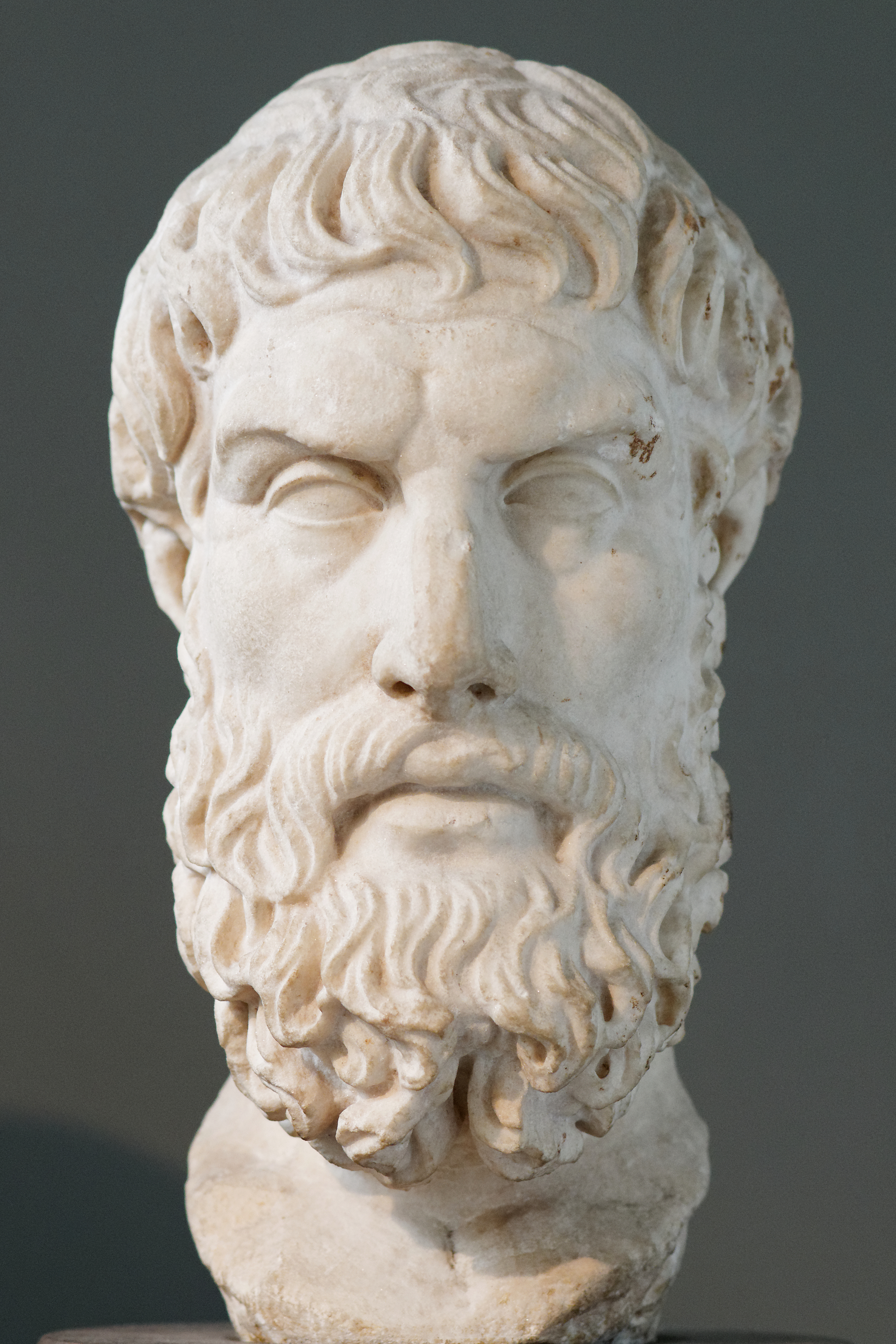
Epicurus
Greek philosopherWikipedia
1.3k
MENTIONS
245
EPISODES
205
PODCASTS
Search complete. 1333 mentions across 245 episodes found for "Epicurus".
Sep 17, 2026

JohnHOST
Socrates, for those who don't know, was one of ancient Greece's most influential philosophers.
JohnHOST
With his interrogative nature, he stood alongside people like Plato and Aristotle and Epicurus as one of the great minds of the ancient world.
JohnHOST
Plato even issued a statement in his defense.
JohnHOST
And at the age of 70, Socrates was brought to trial and charged with impiety, or a lack of reverence for the Greek gods, as well as corrupting the Athenian youth, allegedly.

speaker_3NARRATOR
Socrates adopted the doctrine from Anaxagoras, and it forthwith became the ruling idea in philosophy, except in the school
speaker_14NARRATOR
of Epicurus, who ascribed all events to chance.
speaker_14NARRATOR
I was delighted with the sentiment, Plato makes Socrates say, and hoped I had found a teacher who would show me nature in harmony with reason.
speaker_14NARRATOR
who would demonstrate in each particular phenomenon its specific aim and, in the whole, the grand object of the universe.

Daniel LiebermanGUEST
Yes.
Daniel LiebermanGUEST
I mean, my favorite quote in the entire book is attributed to Epicurus.
Daniel LiebermanGUEST
I'm not sure he actually said it, but, you know, he says, practice moderation so you can enjoy the pleasures of life in abundance.
Daniel LiebermanGUEST
You know, I think all these elimination diets are they're not practical for most of us and they're not necessary.

speaker_5NARRATOR
But it met defeat in a different spirit.
speaker_5NARRATOR
Epicurus, son of Neocles, of the old Athenian clan of the Philaidae, was born on a colony in Samos in 341 BC.
speaker_5NARRATOR
His father was evidently poor, else he would hardly have left Athens to live on a colonial farm, nor have had to eke out his farming by teaching an elementary school.
speaker_5NARRATOR
We do not know how much the small boy learned from his father, but for older students there was a famous school on the neighboring island of Teos, where a certain Nausiphanes taught the Ionian tradition of mathematics and physics, as well as rhetoric and literary subjects.
speaker_5NARRATOR
Epicurus went to this school when he was fourteen, and seems among other things to have imbibed the atomic theory of Democritus, without realizing that it was anything peculiar.
speaker_5NARRATOR
He felt afterwards as if his school days had been merely a waste of time.
speaker_5NARRATOR
At the age of eighteen he went to Athens, the center of the philosophic world, but he only went, as Athenian citizens were in duty bound, to perform his year of military service as a Phoebus.
speaker_5NARRATOR
The next year, however, 322, Perdiccas of Thrace made an attack on Samos and drove out the Athenian colonists.

Steven SeitelNARRATOR
There was, however, a school of philosophical speculation which might have led to the foundation of a theory of progress if the historical outlook of the Greeks had been larger and if their temper had been different.
Steven SeitelNARRATOR
The atomic theory of Democritus seems to us now, in many ways, the most wonderful achievement of Greek thought, but it had a small range of influence in Greece, and would have had less if it had not convinced the brilliant mind of Epicurus.
Steven SeitelNARRATOR
The Epicureans developed it, and it may be that the views which they put forward as to the history of the human race are mainly their own superstructure.
Steven SeitelNARRATOR
These philosophers rejected entirely the doctrine of a golden age and a subsequent degeneration which was manifestly incompatible with their theory that the world was mechanically formed from atoms without the intervention of a deity.
Steven SeitelNARRATOR
End of footnote.
Steven SeitelNARRATOR
The gradual amelioration of their existence was marked by the discovery of fire and the use of metals, the invention of language, the invention of weaving, the growth of arts and industries, navigation, the development of family life, the establishment of social order by means of kings, magistrates, laws, the foundation of cities.
Steven SeitelNARRATOR
The last great step in the amelioration of life, according to Lucretius, was the illuminating philosophy of Epicurus, who dispelled the fear of invisible powers and guided man from intellectual darkness to light.
Steven SeitelNARRATOR
But Lucretius and the school to which he belonged did not look forward to a steady and continuous process of further amelioration in the future.

speaker_5ADVERTISER
Any door, the right support.
David RonaldNARRATOR
and his accusation is that if they are justly excluded while he himself is guilty of the same practices he is a wicked man but if he is not guilty of wickedness in doing such things neither are they who do the same as he but even if it be impossible to show by what power jesus wrought these miracles it is clear that christians employ no spells or incantations but the simple name of jesus and certain other words in which they repose faith according to the holy scriptures moreover since he frequently calls the christian doctrine a secret system of belief we must confute him on this point also since almost the entire world is better acquainted with what christians preach than with the favourite opinions of philosophers for who is ignorant of the statement that jesus was born of a virgin and that he was crucified and that his resurrection is an article of faith among many and that a general judgment is announced to come in which the wicked are to be punished according to their deserts and the righteous to be duly rewarded and yet the mystery of the resurrection not being understood is made a subject of ridicule among unbelievers in these circumstances to speak of the christian doctrine as a secret system is altogether absurd but that there should be certain doctrines not made known to the multitude which are revealed after the exoteric ones have been taught is not a peculiarity of christianity alone but also of the philosophic systems in which certain truths are exoteric and others esoteric some of the hearers of pythagoras were content with his ipse dixit while others were taught in secret those doctrines which were not deemed fit to be communicated to profane and insufficiently prepared ears moreover all the that are celebrated everywhere throughout greece and barbarous counties although held in secret have no discredit thrown upon them so that it is vain that he endeavours to calumniate the secret doctrines of christianity seeing he does not correctly understand its nature it is with a certain eloquence indeed that he appears to advocate the cause of those who bear witness to the truth of christianity by their death in the following words and i do not maintain that if a man who has adopted a system of good doctrine is to incur danger from men on that account he should either apostatise or feign apostasy or openly deny his opinions and he condemns those who while holding the christian views either pretend that they do not or deny them saying that he who holds a certain opinion ought not to feign recantation or publicly disown it and here celsus must be convicted of self contradiction for from other treatises of his it is ascertained that he was an epicurean but here because he thought that he could assail christianity with better effect by not professing the opinions of epicurus he pretends that there is a something better in man than the earthly part of his nature which is akin to god and says that they in whom this element viz the soul is in a healthy condition are ever seeking after their kindred nature meaning god and are ever desiring to hear something about him and to call it to remembrance observed now the insincerity of his character having said a little before that the man who had embraced a system of good doctrine ought not even if exposed to danger on that account from men to disavow it or pretend that he had done so nor yet openly disown it he now involves himself in all manner of contradictions for he knew that if he acknowledged himself an epicurean he would not obtain any credit when accusing those who in any degree introduced the doctrine of providence and who place a god over the world and we have heard that there were two individuals of the name of celsus both of whom were epicureans the earlier of the two having lived in the time of nero but this one in that of adrian and later he next proceeds to recommend that in adopting opinions we should follow reason and a rational guide since he who assents to opinions without following this course is very liable to be deceived and he compares inconsiderate believers to metragyrtae and soothsayers and milthrae and sabadeans and to anything else that one may fall in with and to the phantoms of hecate or any other demon or demons for as amongst such persons are frequently to be found wicked men who taking advantage of the ignorance of those who are easily deceived lead them away whither they will so also he says is the case among christians and he asserts that certain persons who do not wish either to give or receive a reason for their belief keep repeating do not examine but believe and your faith will save you and he alleges that such also say the wisdom of this life is bad but the foolishness is a good thing to which we have to answer that if it were possible for all to leave the business of life and devote themselves to philosophy no other method ought to be adopted by any one but this alone for in the christian system also it will be found that there is not to speak at all arrogantly at least as much of investigation into articles of belief and of explanation of dark sayings occurring in the prophetical writings and to the parables in the gospels and of countless other things which either were narrated or enacted with a symbolical signification as is the case with other systems but since the course alluded to is impossible partly on account of the necessities of life partly on account of the weakness of men as only a very few individuals devote themselves earnestly to study what better method could be devised with the view of assisting the multitude than that which was delivered by jesus to the heathen and let us inquire with respect to the great multitude of believers who have washed away the mire of wickedness in which they formerly wallowed whether it were better for them to believe without a reason and so to have become reformed and improved in their habits through the belief that men are chastised for sins and honoured for good works or not to have allowed themselves to be converted on the strength of mere faith but to have waited until they could give themselves to a thorough examination of the necessary reasons for it is manifest that on such a plan all men with very few exceptions would not obtain this amelioration of conduct which they have obtained through a simple faith but would continue to remain in the practice of a wicked life now whatever other evidence can be furnished of the fact that it was not without divine intervention that the philanthropic scheme of christianity was introduced among men this also must be added for a pious man will not believe that even a physician of the body who restores the sick to better health could take up his abode in any city or country without divine permission since no good happens to men without the help of god And if he who has cured the bodies of many, or restored them to better health, does not effect his cures without the help of God, how much more he who has healed the souls of many, and has turned them to virtue, and improved their nature, and attached them to God who is over all things, and taught them to refer every action to his good pleasure, and to shun all that is displeasing to him, even to the least of their words, or deeds, or even of the thoughts of their hearts.
David RonaldNARRATOR
in the next place since our opponents keep repeating those statements about faith we must say that considering it as a useful thing for the multitude we admit that we teach those men to believe without reasons who are unable to abandon all other employments and give themselves to an examination of arguments and our opponents although they do not acknowledge it yet practically do the same for who is there that on betaking himself to the study of philosophy and throwing himself into the ranks of some sect either by chance or because he is provided with a teacher of that school adopts such a course for any other reason except that he believes his particular sect to be superior to any other for not waiting to hear the arguments of all the other philosophers and of all the different sects and the reasons for condemning one system and for supporting another he in this way elects to become a stoic or a platonist or a peripatetic or an epicurean or a follower of some other school and is thus born although they will not admit it by a kind of irrational impulse to the practice say of stoicism to the disregard of the others despising either platonism as being marked by greater humility than the others or peripateticism as more human and as admitting with more fairness than other systems the blessings of human life and some also, alarmed at first sight about the doctrine of providence, from seeing what happens in the world to the vicious and to the virtuous, have rashly concluded that there is no divine providence at all, and have adopted the views of Epicurus and Celsus.
David RonaldNARRATOR
chapters eleven through twenty of against celsus book one by origin translated by frederick crombie this librivox recording is in the public domain since then as reason teaches we must repose faith in some one of those who have been the introducers of sex among the greeks or barbarians why should we not rather believe in god who is over all things and in him who teaches that worship is due to god alone and that other things are to be passed by either as non-existent or as existing in deed and worthy of honour but not of worship and reverence and respecting these things he who not only believes but who contemplates things with the eye of reason will state the demonstrations that occur to him and which are the result of careful investigation and why should it not be more reasonable seeing all human things are dependent upon faith to believe god rather than them
speaker_4SOUNDBITE_SPEAKER
The hardest part was figuring out where to go.
David RonaldNARRATOR
For who enters on a voyage, or contracts a marriage, or becomes the father of children, or casts seed into the ground, without believing that better things will result from so doing? Although the contrary might, and sometimes does happen.
David RonaldNARRATOR
And yet, the belief that better things, even agreeably to their wishes, will follow, makes all men venture upon uncertain enterprises, which may turn out differently from what they expect.
David RonaldNARRATOR
And if the hope and belief of a better future be the support of life in every uncertain enterprise why shall not this faith rather be rationally accepted by him who believes on better grounds than he who sails the sea or tills the ground or marries a wife or engages in any other human pursuit in the existence of a god who was the creator of all these things and in him who with surpassing wisdom and divine greatness of mind dared to make known this doctrine to men in every part of the world at the cost of great danger and of a death considered infamous which he underwent for the sake of the human race having also taught those who were persuaded to embrace his doctrine at the first to proceed under the peril of every danger and of ever impending death to all quarters of the world to ensure the salvation of men in the next place when celsus says in express words if they would answer me not as if i were asking for information for i am acquainted with all their opinions but because i take an equal interest in them all it would be well and if they will not but will keep reiterating as they generally do do not investigate c they must he continues explain to me at least of what nature these things are of which they speak and whence they are derived c now with regard to his statement that he is acquainted with all our doctrines we have to say that this is a boastful and daring assertion for if he had read the prophets in particular which are full of acknowledged difficulties and of declarations that are obscure to the multitude and if he had perused the parables of the gospels and the other writings of the law and of the jewish history and the utterances of the apostles and had read them candidly with a desire to enter into their meaning he would not have expressed himself with such boldness nor said that he was acquainted with all their doctrines even we ourselves who have devoted much study to these writings would not say that we were acquainted with everything for we have a regard for truth Not one of us will assert, quote, I know all the doctrines of Epicurus, end quote, or will be confident that he knows all those of Plato in the knowledge of the fact that so many differences of opinion exist among the expositors of these systems.

speaker_1NARRATOR
Aristotle says of Anaxagoras, as the originator of the thought in question, that he appeared as a sober man among the drunken.
speaker_1NARRATOR
Socrates adopted the doctrine from Anaxagoras, and it forthwith became the ruling idea in philosophy, except in the school of Epicurus, who ascribed all events to chance.
speaker_1NARRATOR
"I was delighted with the sentiment," Plato makes Socrates say, "and hoped I had found a teacher who would show me nature in harmony with reason, who would demonstrate in each particular phenomenon its specific aim and in the whole the grand object of the universe.
speaker_1NARRATOR
I would not have surrendered this hope for a great deal.

speaker_2NARRATOR
Aristotle says of Anaxagoras, as the originator of the thought in question, that he appeared as a sober man among the drunken.
speaker_2NARRATOR
Socrates adopted the doctrine from Anaxagoras, and it forthwith became the ruling idea in philosophy, except in the school of Epicurus, who ascribed all events to chance.
speaker_2NARRATOR
I was delighted with the sentiment, Plato makes Socrates say, and hoped I had found a teacher who would show me nature in harmony with reason.
speaker_2NARRATOR
would demonstrate in each particular phenomenon its specific aim and, in the whole, the grand object of the universe.

speaker_2NARRATOR
Aristotle says of Anaxagoras, as the originator of the thought in question, that he appeared as a sober man among the drunken.
speaker_2NARRATOR
Socrates adopted the doctrine from Anaxagoras, and it forthwith became the ruling idea in philosophy, except in the school of Epicurus, who ascribed all events to chance.
speaker_2NARRATOR
I was delighted with the sentiment, Plato makes Socrates say, and hoped I had found a teacher who would show me nature in harmony with reason.
speaker_2NARRATOR
would demonstrate in each particular phenomenon its specific aim and, in the whole, the grand object of the universe.

Rafael PetardiGUEST
I just grabbed the handle, The Epicurious Kitchen.
Rafael PetardiGUEST
after Epicurus, the philosopher, Epicurean, somebody who likes food and dining.
Rafael PetardiGUEST
And that's where it would be.
Rafael PetardiGUEST
But the challenge for me right now is finding logistics of it.
235 more episodes mention Epicurus.
Create an account to see the whole feed, search across every transcript, and follow the entities you care about.