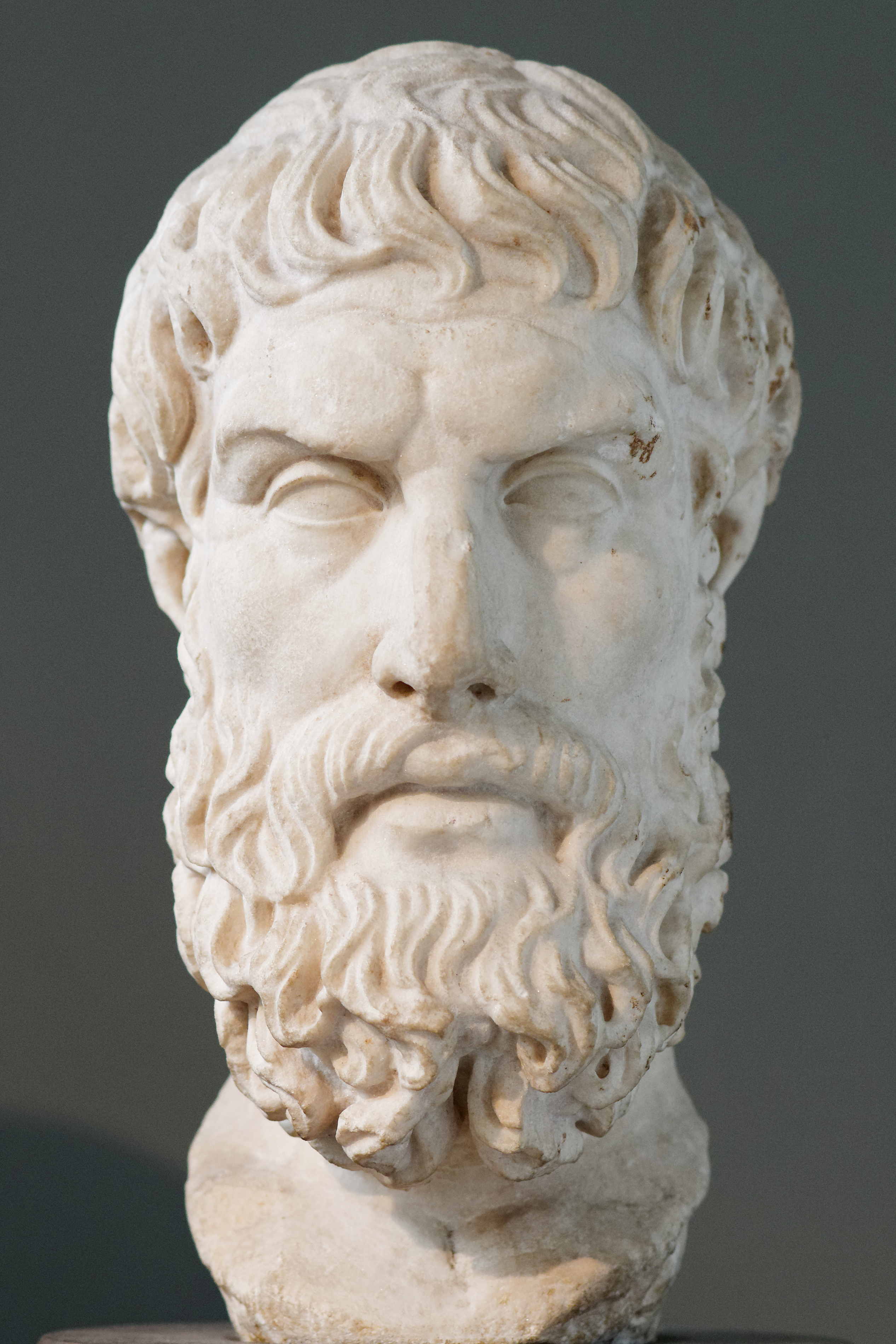
Epicureanism
508
MENTIONS
195
EPISODES
158
PODCASTS
Search complete. 508 mentions across 195 episodes found for "Epicureanism".
Sep 20, 2026

speaker_7UNKNOWN
[laughs] Whoo.
Ryan HolidaySOUNDBITE_SPEAKER
I might, I might point you to a philosophy called Epicureanism.
Bill MaherSOUNDBITE_SPEAKER
Right.
Ryan HolidaySOUNDBITE_SPEAKER
That seems more your style.

Alfonso AsensioGUEST
And it was kind of, for the time, it was a radical philosophy.
Alfonso AsensioGUEST
We just basically say, look, reject social conventions and live a natural life in harmony with the world, right? Epicureanism, in a way, I think has suffered from the same.
Alfonso AsensioGUEST
Like, if you ask somebody what an Epicurean is, it's probably understood that somebody who greatly enjoys sensual pleasure, right? But I think that's a misrepresentation of the principle of what he called ataraxia, which was freedom from anxiety.
Alfonso AsensioGUEST
Epicurus, what he taught was that people often pursue unnecessary or excessive pleasure, thinking that will bring them happiness.

speaker_0NARRATOR
Ends, then, must first be given, relatively to which only can the notion of perfection, whether internal in ourselves or external in God, be the determining principle of the will.
speaker_0NARRATOR
But an end being an object which must precede the determination of the will by a practical rule, and contain the ground of the possibility of this determination, and therefore contain also the matter of the will, taken as its determining principle, such an end is always empirical, and therefore may serve for the Epicurean principle of the happiness theory, but not for the pure rational principle of morality and duty.
speaker_0NARRATOR
Thus, talents and the improvement of them, because they contribute to the advantages of life or the will of God, if agreement with it be taken as the object of the will, without any antecedent independent practical principle, can be motives only by reason of the happiness expected therefrom.
speaker_0NARRATOR
Hence it follows, first, that all the principles here stated are material, secondly, that they include all possible material principles, and finally the conclusion that since material principles are quite incapable of furnishing the supreme moral law, as has been shown, the formal practical principle, the pure reason, according to which the mere form of a universal legislation must constitute the supreme and immediate determining principle of the will, is the only one possible which is adequate to furnish categorical imperatives, that is, practical laws, which make actions a duty, and in general to serve as the principle of morality, both in criticizing conduct and also in its application to the human will to determine it.
1 HR 58 MINS LATER
Julie from MalhamNARRATOR
Such is the nature of the true motive of pure practical reason.
Julie from MalhamNARRATOR
It is no other than the pure moral law itself, inasmuch as it makes us conscious of the sublimity of our own supersensible existence and subjectively produces respect for the higher nature in men who are also conscious of their sensible existence and of the consequent dependence of their pathologically very susceptible nature.
Julie from MalhamNARRATOR
Now with this motive may be combined so many charms and satisfactions of life that even on this account alone the most prudent choice of a rational Epicurean reflecting on the greatest advantage of life would declare itself on the side of moral conduct, and it may be even advisable to join this prospect of a cheerful enjoyment of life with that supreme motive which is already sufficient of itself, but only as a counterpoise to the attractions which vice does not fail to exhibit on the opposite side, and not so as even in the smallest degree to place in this the proper moving power when duty is in question.
Julie from MalhamNARRATOR
For that would be just the same as to wish to taint the purity of the moral disposition in its source.

speaker_4NARRATOR
Ends, then, must first be given, relatively to which only can the notion of perfection, whether internal in ourselves or external in God, be the determining principle of the will.
speaker_4NARRATOR
But an end being an object which must precede the determination of the will by a practical rule, and contain the ground of the possibility of this determination, and therefore contain also the matter of the will, taken as its determining principle, such an end is always empirical, and therefore may serve for the Epicurean principle of the happiness theory, but not for the pure rational principle of morality and duty.
speaker_4NARRATOR
Thus talents and the improvement of them, because they contribute to the advantages of life or the will of God, if agreement with it be taken as the object of the will, without any antecedent independent practical principle, can be motives only by reason of the happiness expected therefrom.
speaker_4NARRATOR
Hence it follows, first, that all the principles here stated are material, secondly, that they include all possible material principles, and finally the conclusion that since material principles are quite incapable of furnishing the supreme moral law, as has been shown, the formal practical principle, the pure reason, according to which the mere form of a universal legislation must constitute the supreme and immediate determining principle of the will, is the only one possible which is adequate to furnish categorical imperatives, that is, practical laws, which make actions a duty, and in general to serve as the principle of morality, both in criticizing conduct and also in its application to the human will to determine it.
3 HRS 7 MINS LATER
D. E. WittkowerNARRATOR
The ancient Greek schools were, properly speaking, only two, and in determining the conception of the summum bonum these followed in fact one and the same method, inasmuch as they did not allow virtue and happiness to be regarded as two distinct elements of the summum bonum, and consequently sought the unity of the principle by the rule of identity.
D. E. WittkowerNARRATOR
But they differed as to which of the two was to be taken as the fundamental notion.
D. E. WittkowerNARRATOR
The Epicureans said, To be conscious that one's maxims lead to happiness is virtue.
D. E. WittkowerNARRATOR
The Stoics said, To be conscious of one's virtue is happiness.

speaker_4NARRATOR
They had learned from Plato himself to distrust the senses, and from the conflict of opinions to distrust reason.
speaker_4NARRATOR
Their maxim was, "Suspend thy judgment," or as Pliny expresses it, "Only one thing is certain, that nothing is certain." Epicureanism is not necessarily coarse.
speaker_4NARRATOR
Men may be utilitarians without being swine, in spite of Horace.
speaker_4NARRATOR
But it is necessarily selfish and relative.

John Van StanNARRATOR
Indeed, might not this very Socratism be a sign of decline, of weariness, of disease, of anarchically disintegrating instincts? And the Hellenic cheerfulness of the later Hellenism merely a glowing sunset.
John Van StanNARRATOR
The Epicurean will counter to pessimism merely a precaution of the sufferer.
John Van StanNARRATOR
And science itself, our science? Aye, viewed as a symptom of life, what really signifies all science? Whither, worse still, whence all science? Well, is scientism perhaps only fear and evasion of pessimism? A subtle defense against truth? Morally speaking, something like falsehood and cowardice.
John Van StanNARRATOR
And unmoralally speaking, an artifice? Oh, Socrates, Socrates, was this perhaps thy secret? Oh, mysterious ironist, was this perhaps thine irony? Two.

speaker_6NARRATOR
We can thus guess where the great note of interrogation concerning the value of existence had been set.
speaker_6NARRATOR
Is pessimism necessarily the sign of decline, of decay, of failure, of exhausted and weakened instincts, as was the case with the Indians, as is to all appearance the case with us modern men and Europeans? Is there a pessimism of strength, an intellectual predilection for what is hard, awful, evil, problematical in existence, owing to well-being, to exuberant health, to fullness of existence? Is there perhaps suffering in overfullness itself, a seductive fortitude with the keenest of glances, which yearns for the terrible as for the enemy, the worthy enemy with whom it may try its strength, from whom it is willing to learn what fear is, what means tragic myth to the Greeks of the best, strongest, bravest era, and the prodigious phenomenon of the Dionysian, and that which was born thereof, tragedy, and again that of which tragedy died, the Socratism of morality, the dialectics contentedness and cheerfulness of the theoretical man? Indeed, might not this very Socratism be a sign of decline, of weariness, of disease, of anarchically disintegrating instincts, and the Hellenic cheerfulness of the later Hellenism merely a glowing sunset? The Epicurean will counter to pessimism merely a precaution of the sufferer, and science itself, our science, I viewed as a symptom of life, what really signifies all science.
speaker_6NARRATOR
Whither were still whence all science? Well, is scientism perhaps only fear and evasion of pessimism, a subtle defense against truth, morally speaking something like falsehood and cowardice, and unmoralistically speaking an artifice? O Socrates, Socrates, was this perhaps thy secret? O mysterious ironist, was this perhaps thine irony? 2.
speaker_6NARRATOR
What I then laid hands on, something terrible and dangerous, a problem with horns, not necessarily a bull itself, but at all events a new problem.

GonerilVOICE_ACTOR
Here do you keep a hundred knights and squires, men so disordered, so deboshed and bold, that this our court, infected with their manners, shows like a riotous inn.
GonerilVOICE_ACTOR
Epicurism and lust make it more like a tavern or a brothel than a graced place.
GonerilVOICE_ACTOR
The shame itself doth speak for instant remedy.' Be then desired by her that else will take the thing she begs, a little to disquantity your train, and the remainder that shall still depend, to be such men as may besort your age, which know themselves and you.
LearVOICE_ACTOR
Darkness and devils saddle my horses, call my train together.

Bill BoerstNARRATOR
An intense practicality was a mark of the later Greek philosophy.
Bill BoerstNARRATOR
This was common to Stoicism with its rival Epicureanism.
Bill BoerstNARRATOR
Both regarded philosophy as the art of life, though they differed in their conception of what that art should be.
Bill BoerstNARRATOR
Widely as the two schools were opposed to one another, they had also other features in common.

Thomas PeterVOICE_ACTOR
Here do you keep a hundred knights and squires, men so disordered, so debauched and bald, that this our court, infected with their manners, shows like a riotous inn.
Thomas PeterVOICE_ACTOR
Epicurism and lust makes it more like a tavern or a brothel than a graced palace.
Thomas PeterVOICE_ACTOR
The shameless self doth speak for instant remedy.
Thomas PeterVOICE_ACTOR
be then desired by her that else will take the things she begs a little to disquantity your train and the remainder that shall still depend to be such men as may besort your age which know themselves and you
185 more episodes mention Epicureanism.
Create an account to see the whole feed, search across every transcript, and follow the entities you care about.