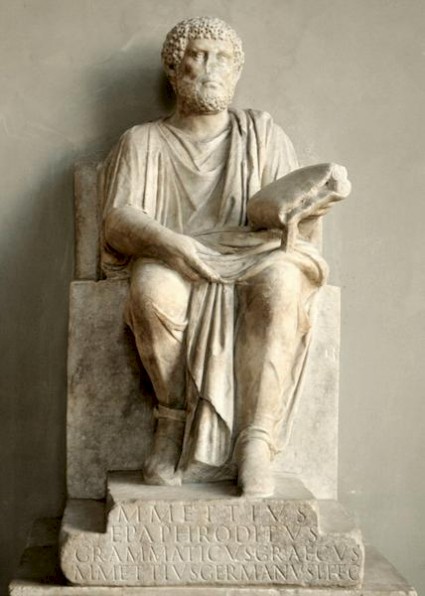
Epaphroditus
Freedman of NeroWikipedia
42
MENTIONS
12
EPISODES
11
PODCASTS
Search complete. 42 mentions across 12 episodes found for "Epaphroditus".
Oct 14, 2026

speaker_0HOST
It's the sort of word you might use for a thing someone adds to their possessions.
speaker_0HOST
As a young man, he ended up in Rome, in the household of Epaphroditus, a former slave of Nero's who had risen to become one of his most powerful secretaries.
speaker_0HOST
It was the world of the imperial court at its murkiest.
speaker_0HOST
Favors, fears, intrigues, men who gave the orders one day and fell from grace the next.
speaker_0HOST
Epictetus saw it all from below, from the place of the one who waits at table and listens without anyone paying him the slightest attention.
speaker_0HOST
Years later, he would tell his class about a scene from that house.
speaker_0HOST
Epaphroditus owned a slave, a shoemaker, who was no use to him, so he sold him.
speaker_0HOST
As chance would have it, the man ended up in the emperor's household and became Caesar's shoemaker.

Bill MoseleyNARRATOR
One.
Bill MoseleyNARRATOR
I suppose that by my books of the antiquity of the Jews, most excellent Epaphroditus, have made it evident to those who peruse them that our Jewish nation is of very great antiquity and had a distinct subsistence of its own originality.
Bill MoseleyNARRATOR
As also I have therein declared how we came to inhabit this country wherein we now live.
Bill MoseleyNARRATOR
Those antiquities contain the history of five thousand years and are taken out of our sacred books, but are translated by me into the Greek tongue.
2 HRS 8 MINS LATER
Rick TabisNARRATOR
Against Appion by Flavius Josephus, translated by William Wiston.
Rick TabisNARRATOR
Book 2, sections 1 through 4.
Rick TabisNARRATOR
In the former book, most honored Epaphroditus, I have demonstrated our antiquity and confirmed the truth of what I have said from the writings of the Phoenicians and the Chaldeans and the Egyptians.
Rick TabisNARRATOR
I have, moreover, produced many of the Grecian writings as witnesses thereto.
speaker_1NARRATOR
While still very young, he was taken to Rome.
speaker_1NARRATOR
His owner was called Epaphroditus, and he was no ordinary master.
speaker_1NARRATOR
He had once been a slave himself, had won his freedom, and had risen to become one of the secretaries of the Emperor Nero, a man who handled petitions, favors, and secrets at the very heart of power.
speaker_1NARRATOR
In his house, Epictetus saw at close quarters how those who had everything lived, and he saw something few people ever see, how frightened they were.
speaker_1NARRATOR
Epaphroditus allowed him something unusual.
speaker_1NARRATOR
He let him attend the classes of Musonius Rufus, the great Stoic teacher in Rome, and there that young slave, lame with no money and no future, found what nobody could buy him or take from him, a way of looking at life.
speaker_1NARRATOR
Musonius was not a gentle teacher.
speaker_1NARRATOR
The first attachment a Stoic learns to let go of is attachment to things.

Ryan HolidayHOST
He was a, he was a professor at a, a- at a war college or a professor at an Ivy League university where, where he really is teaching and preparing the future masters of the universe for their inevitable role in society.
Steve HanselmanGUEST
And, you know, he had, as a, as a young boy, he had a front row seat on the court of Nero, you know, working for Epaphroditus, and he tells these great stories about things he saw, and they're not very flattering.
Steve HanselmanGUEST
[laughs]
Ryan HolidayHOST
Sure.

speaker_0HOST
Epiketetus was a slave.
speaker_0HOST
His owner, Epaphroditus, broke his leg deliberately, just to demonstrate his power over him.
speaker_0HOST
Epiketetus' response, by his own account, was to tell Epaphroditus calmly that the leg was breaking.
speaker_0HOST
When it broke, he simply noted that he'd said it would.
14 MINS LATER
speaker_0HOST
O.
speaker_0HOST
Will.
speaker_0HOST
Inc.'s concept of extreme ownership.
speaker_0HOST
You are responsible for every action within your power.

speaker_3NARRATOR
The date of the birth of Epictetus is unknown.
speaker_3NARRATOR
The only recorded fact of his early life is that he was a slave in Rome, and his master was Epaphroditus, a profligate freedman of the Emperor Nero.
speaker_3NARRATOR
There is a story that the master broke his slave's leg by torturing him, but it is better to trust to the evidence of Simplicius, the commentator on the Enchiridion, or Manual, who says that Epictetus was weak in body and lame from an early age.
speaker_3NARRATOR
It is not said how he became a slave, but it has been asserted in modern times that his parents sold the child.
speaker_3NARRATOR
It may seem strange that such a master should have wished to have his slave made into a philosopher, but Garnier, the author of Mémoires sur les ouvrages d'Epictète, explains this matter very well in a communication to Schweighauser.
speaker_3NARRATOR
Garnier says, quote, Epictetus, born at Hierapolis of Phrygia, of poor parents, was indebted apparently for the advantages of a good education to the whim, which was common at the end of the Republic and under the first emperors among the great of Rome, to reckon among their numerous slaves grammarians, poets, rhetoricians, and philosophers, in the same way as rich financiers in these later ages have been led to form at a great cost rich and numerous libraries.
speaker_3NARRATOR
This supposition is the only one which can explain to us how a wretched child, born as poor as Iris, had received a good education, and how a rigid Stoic was the slave of Epaphroditus, one of the officers of the Imperial Guard.
speaker_3NARRATOR
For we cannot suspect that it was through predilection for the Stoic doctrine, and for his own use, that the confidant and the minister of the debaucheries of Nero would have desired to possess such a slave.

Rebecca Eden WalkerNARRATOR
The main body rushed to attack them, and they were soon caught and slain.
Rebecca Eden WalkerNARRATOR
Then, standing over their dead bodies, they scoffed at Ananus for his patronage of the people, and at Jesus for the address which he had delivered from the wall.
Rebecca Eden WalkerNARRATOR
They actually went so far in their impiety as to cast out the corpses without burial, although the Jews are so careful about funeral rites that even malefactors who have been sentenced to crucifixion are taken down and buried before sunset.
Rebecca Eden WalkerNARRATOR
Compare Deuteronomy twenty-one, twenty-two, and following verse, John nineteen thirty-one.

SeanHOST
The first is Epictetus, a former slave.
SeanHOST
His master, a man named Epaphroditus, was reportedly twisting his leg one day, torturing him.
SeanHOST
Epictetus said calmly, you are going to break it.
SeanHOST
Epaphroditus continued.
SeanHOST
Epictetus said, did I not tell you that you would break it? And when it broke, Epictetus simply noted that he had told him so.
SeanHOST
The point is not that he felt no pain.

speaker_5NARRATOR
The date of the birth of Epictetus is unknown.
speaker_5NARRATOR
The only recorded fact of his early life is that he was a slave in Rome and his master was Epaphroditus, a profligate freedman of the Emperor Nero.
speaker_5NARRATOR
There is a story that the master broke his slave's leg by torturing him, but it is better to trust to the evidence of Simplicius, the commentator on the Enchiridion, or Manual, who says that Epictetus was weak in body and lame from an early age.
speaker_5NARRATOR
It is not said how he became a slave, but it has been asserted in modern times that his parents sold the child.
speaker_5NARRATOR
It may seem strange that such a master should have wished to have his slave made into a philosopher, but Garnier, the author of Mémoires sur les ouvrages d'Epictète, explains this matter very well in a communication to Schweighauser.
speaker_5NARRATOR
Garnier says, quote, Epictetus, born at Hierapolis of Phrygia, of poor parents, was indebted apparently for the advantages of a good education to the whim, which was common at the end of the Republic and under the first emperors among the great of Rome, to reckon among their numerous slaves grammarians, poets, rhetoricians, and philosophers, in the same way as rich financiers in these later ages have been led to form at a great cost rich and numerous libraries.
speaker_5NARRATOR
This supposition is the only one which can explain to us how a wretched child, born as poor as Iris, had received a good education, and how a rigid Stoic was the slave of Epaphroditus, one of the officers of the Imperial Guard.
speaker_5NARRATOR
For we cannot suspect that it was through predilection for the Stoic doctrine and for his own use that the confidant and the minister of the debaucheries of Nero would have desired to possess such a slave, end quote.
2 more episodes mention Epaphroditus.
Create an account to see the whole feed, search across every transcript, and follow the entities you care about.