Entry/Exit System
30
MENTIONS
15
EPISODES
14
PODCASTS
Search complete. 30 mentions across 15 episodes found for "Entry/Exit System".
Sep 25, 2026

Agnieszka DybowskaGUEST
This
AnitaHOST
year, I believe the EU's entry-exit system also became fully operational and it applies to 25 EU Schengen member states as well as Iceland, Liechtenstein, Norway and Switzerland.
AnitaHOST
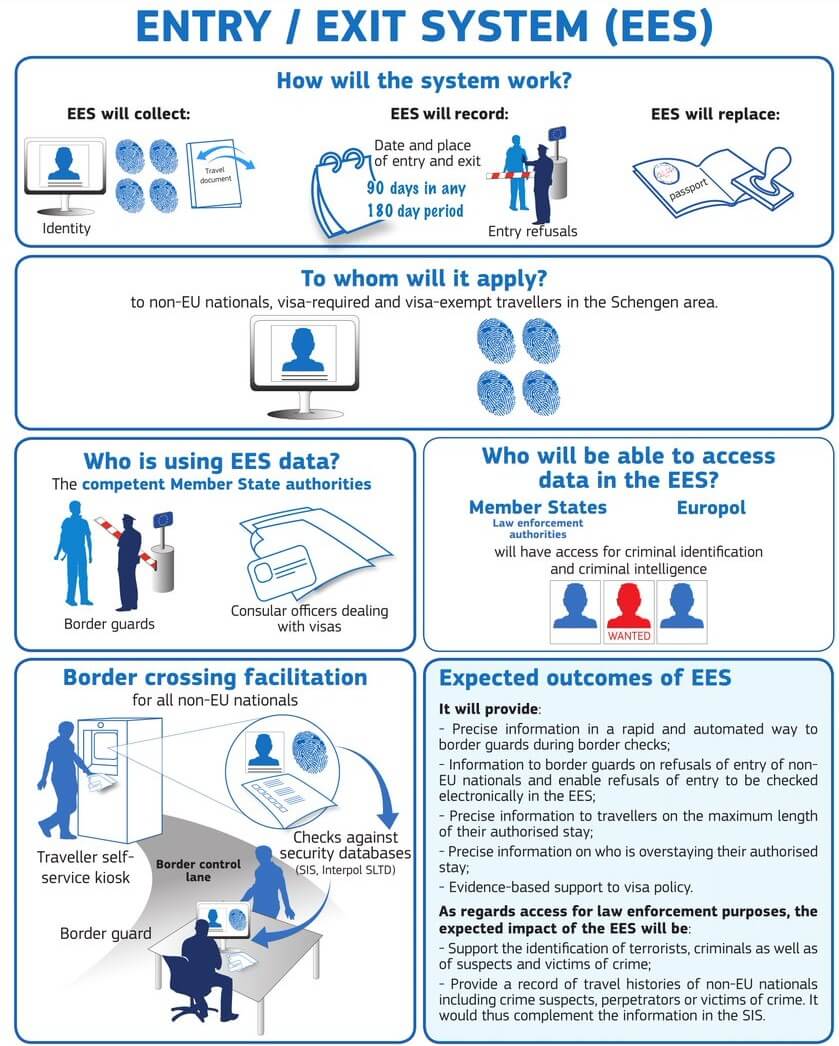
What it means is that it requires travelers to register their biometric details, for example fingerprints or their photo, and it replaces the previous system where travelers had their passports manually stamped.
AnitaHOST
Could you share some insight on these challenges and how Eurocontrol works to support the aviation sector here?
Agnieszka DybowskaGUEST
For airports, even a small challenge in passenger processing can have a significant impact during the peak periods.
Agnieszka DybowskaGUEST
And it was identified as a risk in the network operational plan.
Agnieszka DybowskaGUEST
And while Eurocontrol is not responsible for implementing the entry-exit system itself, the network manager supported the stakeholders and airports by providing information and some predictions that could help the local actors anticipate and mitigate potential operational impacts.
Agnieszka DybowskaGUEST
The main concerns that we had were related to impacts that would be generated for the network by longer processing times, longer queues during peak periods, connecting passengers and their issues, and the knock-on effects that these delays can have on airport operations and flight punctuality.

Ilisa OmanHOST
Having said all that, there are countries that are having problems.
Ilisa OmanHOST
And nine countries, France, Germany, Italy, Greece, Portugal, Malta, the Netherlands and Switzerland and Belgium are delaying the EES, the entry exit system indefinitely right now.
Sean MouttetHOST
Yeah, I think the problem probably is all these countries do not have like a unified computer system.
Sean MouttetHOST
Right.
Ilisa OmanHOST
For a few more years.
Ilisa OmanHOST
So that's what we've talked about.
Ilisa OmanHOST
So that was the EES.
Ilisa OmanHOST
And now the other thing that we've talked about a lot on the podcast are- what I call the ETIAS.

Jake Cullum-HollinsHOST
This is the biggest thing.
Jake Cullum-HollinsHOST
So I had a newspaper ring me yesterday asking me for advice on EES for an article.
Jake Cullum-HollinsHOST
And they were like, what needs to change in order to make EES more effective?
speaker_0ADVERTISER
The mighty dollar.
speaker_0ADVERTISER
Once upon a time, it had a whole menu named after it.

Neville BoundsHOST
The scheme has faced fierce criticism from Ryanair and others.
Neville BoundsHOST
The European Union describes the entry-exit system as an automated IT system designed to register non-EU nationals travelling on short stays each time they cross the external borders of the participating European countries.
Neville BoundsHOST
Following years of postponements, the system was rolled out from October 2025 with full implementation originally anticipated by the following April this year.
Neville BoundsHOST
However, faced with the prospect of significant border queues due to software failures, officials granted countries a 150-day grace period during which they could drop the checks to avoid travel chaos.

Ralph RodriguezHOST
Why are nine Schengen countries suddenly hitting the brakes on their entry exit system deployments in Europe?
speaker_1HOST
Ah, the EES delays.
Ralph RodriguezHOST
Yeah, the report notes they repertain informal flexibility over their EES biometric collections specifically because of persistent implementation problems.
Ralph RodriguezHOST
Is the core matching math actually failing out in the wild?
speaker_1HOST
What's fascinating here is the severe operational delta between algorithmic accuracy and real-world service delivery.

Claire NewellGUEST
It's not on the list, but because it's like kind of the conversation right now, Canada and the EU and possible connections here in the office.
Claire NewellGUEST
Everybody's talking about what would this mean for travel? You know how we've been talking about the EES and how you have to get your fingerprints done and all the biometrics, your face scans.
Claire NewellGUEST
That will never go away.
Claire NewellGUEST
That's just kind of coming and going to and from the EU.

Abby LaubHOST
system.
Robin ClineHOST
And that's what it's called for Europe right now, EES, electronic entry system.
Robin ClineHOST
Those are two different things entirely.
Robin ClineHOST
A visa is where you're going to actually have to make an application.

NickHOST
And I've actually read it up.
NickHOST
Uh, particularly Malpensa have experienced severe passenger bottlenecks due to a full rollout of the European Union's Entry/Exit System, or known as the EES.
NickHOST
So basically, what this means is that non-EU passengers from countries such as Australia, UK, US, Canada, they must undergo initial biometric registration at self-service kiosk, capturing four fingerprints and a facial image, and that takes about five minutes per passenger.
NickHOST
And this has ex- exponentially slowed down the throughput compared to traditional visual passport checks where somebody just stamps your passport, in you go.

Chelsea DickensonHOST
What, again? Guys, you don't realise this has been going on For so long.
Chelsea DickensonHOST
It's a bit like EES took so long to come in and then this was always going to be the natural progression that we'd move on to.
Chelsea DickensonHOST
By the way, ETS, the easiest way to think about it is an E visa.
Chelsea DickensonHOST
You know how when you go to the US...
Chelsea DickensonHOST
Oh, this is that? This is the EU's
James RobinsonHOST
version.
James RobinsonHOST
Will it replace? No, it's in addition to EES.
James RobinsonHOST
Correct.
Claire NewellGUEST
So just be really aware of that.
Claire NewellGUEST
The other thing, I'm going to stick with Europe for a second here, because we have talked about the EES.
Claire NewellGUEST
You know, I did two business trips to Europe this past summer for the morning show, like Global's morning show.
Claire NewellGUEST
And I had to do this EES system when I went abroad.
Claire NewellGUEST
once through Iceland and once through Venice.
Claire NewellGUEST
And this is where you do your facial recognition and the biometrics with fingerprints.
5 more episodes mention Entry/Exit System.
Create an account to see the whole feed, search across every transcript, and follow the entities you care about.